'ED Arrest Part Of Political Vendetta To Keep Me In Jail Till 2027 UP Elections' : Azam Khan Argues Before Allahabad High Court
Sparsh Upadhyay
16 Nov 2026 1:59 PM IST
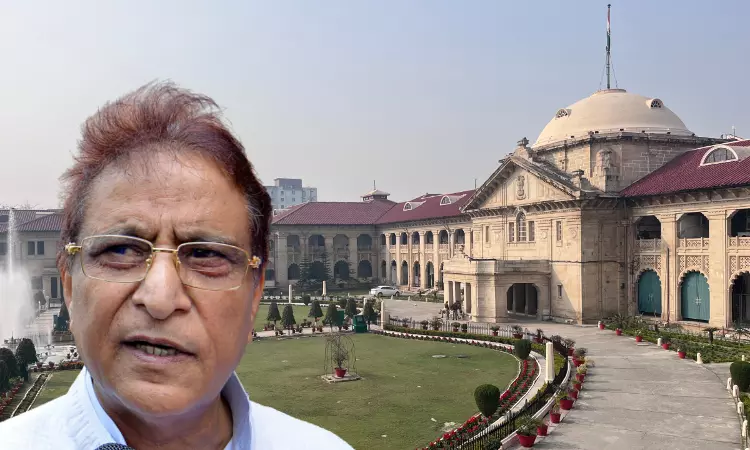
"ED has run amok...Goats, Cows become the proceeds of crime. I mean, what is this going on?", Senior Advocate Kapil Sibal argues for Khan.
Former Uttar Pradesh Minister and Samajwadi Party leader Mohd. Azam Khan today argued before the Allahabad High Court that his arrest by the Enforcement Directorate (ED) on October 31, barely 40 minutes after he walked out of jail upon securing release in the dual PAN card case, was part of a political vendetta intended to keep him behind bars until the 2027 Uttar Pradesh Assembly elections.
Appearing for Khan, Senior Advocate Kapil Sibal argued that successive criminal cases are being lodged against Khan whenever he was about to secure release and that it not a case of prosecution, but 'persecution'.
"ED and the authorities in Uttar Pradesh are acting hand in glove for the purposes of persecuting the petitioner...An attempt was made to ensure that the petitioner remains in jail. For the 2024 election, and now the 2027 election” Sibal argued before a bench of Justice Rajiv Gupta and Justice Devendra Singh-I.
Sibal argued that the ED had revived a 7-year-old money laundering investigation by introducing unrelated cases and creating a fresh predicate offence to ensure his continued incarceration.


For context, Khan is before a Court pursuant to a November 5 order of the Supreme Court transferring his writ petition challenging ED arrest to the Allahabad High Court. The petition also seeks Khan's release from custody.
Khan's main submissions
Beginning his submissions today, Sibal argued that the proceedings against Khan are part of a political vendetta. He submitted thus:
"Every time I'm about to be released or sentence to be suspendethat the aim d, twas hey will lodge another case. And this way…I'll be kept there for life. And I'm 80 years old".
"Now they realized that I will be free as my sentence was suspended by the High Court in dual PAN Card case on October 29. They got to know I'll come out. So as I moved out of the jail, they arrested me in another case outside the jail. They were standing outside the gate. 6:30 pm I came out. 7:10 pm, they arrested me", Sibal further submitted.
To explain the background of the case, Sibal told the bench that 26 FIRs were registered between July 12 and July 20, 2019, concerning alleged incidents dating back to 2006, when Khan was not in power.
He pointed out that several FIRs were registered during the night, including at 1:12 AM and 2 AM, and alleged that the complaints contained similar allegations, narration and handwriting.
"All of them woke up together one fine morning and said, no, we must lodge FIRs in respect of something that happened in 2006," he submitted.
He further apprised the bench that the ED registered an Enforcement Case Information Report (ECIR) on August 1, 2019, based on these FIRs.
According to Sibal, Khan had secured bail in all these cases, in which charge-sheets had been filed, charges framed and trials were pending.
He further referred to 28 additional FIRs allegedly incorporated into the same ECIR through an addendum, including cases concerning alleged incidents in 2016.
Reading out some of the allegations, Sibal referred to complaints claiming that Khan and others had forcibly entered houses, threatened residents, looted cash and jewellery, taken livestock and demolished houses using bulldozers.
Questioning the nature of the alleged proceeds of crime, he remarked thus:
"ED has run amok...Goats and cows become the proceeds of crime...what is all this going on?"
He also questioned how multiple incidents involving alleged looting, forcible occupation and demolition of houses could have occurred in the manner described within a short interval.
Sibal told the Court that Khan had been acquitted in four of these cases. However, ED counsel, Senior Advocate Zoheb Hussain, clarified that the acquittal orders had been challenged through appeals and revisions.
Sibal also questioned the ED's search of the Maulana Mohammad Ali Jauhar University and its subsequent attachment of the university's properties as he argued that the original ECIR and the FIRs added to it had no connection with the university.
According to Sibal, the ED's application referred to 1.552 hectares of land allegedly grabbed from farmers, valued at approximately Rs. 3.11 crore, but the agency proceeded to attach university land and buildings allegedly worth around Rs. 500 crore.
He further submitted that the properties in question had already been restored to the farmers by the district administration and that some of them had subsequently been sold to third parties.
"So the land which is the proceeds of crime, according to them, before this investigation, is already been restored. What are they investigating in the ECIR. Where is the reason to believe that I should be arrested? Nothing survives. The attachment doesn't survive. That investigation doesn't survive. The proceeds of crime are not there. So what are they investigating?", Sibal questioned.
Sibal further submitted that on October 10, the ED wrote to the Uttar Pradesh Director General of Police under Section 66(2) of the PMLA seeking registration of a fresh FIR on the basis of a valuation report.
Pursuant to the ED's communication, FIR No. 224 of 2026 was registered on October 13 at Azeem Nagar police station in Rampur. The FIR alleged diversion of government funds and misuse of official influence in favour of the university and the Maulana Mohammad Ali Jauhar Trust.
Sibal highlighted that the FIR was registered less than 12 hours before the High Court was scheduled to take up Khan's plea seeking suspension of sentence in the dual PAN card case.
On the legality of the arrest, Sibal submitted that Khan walked out of Rampur jail at approximately 6:30 PM on October 31 after furnishing bail bonds in the dual PAN card case, but was arrested by the ED at around 7:10 PM outside the jail premises.
Referring to the arrest memo, he pointed out that the column containing details of the person to whom the arrest information was communicated was left blank.
He alleged that the ED neither supplied the grounds of arrest to Khan nor communicated them to his son, who was present at the time of arrest.
Instead, the agency allegedly sent an email and WhatsApp message to Khan's 84-year-old sister, stating that he had refused to receive the grounds of arrest.
Sibal submitted that neither communication was accompanied by a copy of the grounds of arrest.
He further argued that the requirement of informing an arrested person of the grounds of arrest was a mandatory constitutional safeguard under Article 22(1), relying on the Supreme Court's judgment in Vihaan Kumar v. State of Haryana.
The Court also inquired from Sibal as to how he could pray that he shall not be arrested or taken into custody in any other FIR, ECIR, on complaint arising out of facts relating to any period prior to the filing, when he had not challenged the same?
To this, Sibal argued thus:
"I'm not arguing that you should quash the FIRs. But here, the allegations made in the FIR or complaint are so absurd and inherently improbable on the basis of which no prudent person can ever reach a just conclusion that there is sufficient ground for proceeding against the accused".
Sibal, however, added that he shall be challenging the FIRs, but meanwhile, his ED arrest be quashed. He added that his intent was to say that in case the authorities wanted to arrest him, they should come to the court and seek his arrest.
ED Says Azam Khan Refused To Accept Grounds Of Arrest
Opposing the petition, Senior Advocate Zoheb Hussain, appearing for the ED, argued that the scope of the present proceedings was limited to examining whether Khan's arrest violated Article 22(1) or involved procedural violations affecting his fundamental rights.
He submitted that the petition did not challenge the underlying predicate offences, the FIRs, or the ECIR and its addendum. It was also not a bail petition, he argued.
Relying on the Supreme Court's judgments, Hussain contended that the ED had five contemporaneous documents, including a Panchnama and video recordings, demonstrating that Khan was repeatedly asked to read and receive the grounds of arrest but refused.
He also pointed to the remand order, which recorded Khan's signature acknowledging receipt of documents under protest. His advocate had also acknowledged receiving the arrest order, arrest intimation memo and 12 pages of grounds of arrest.
"The documents are received under protest. Now, whether you received them under protest or not, you have received them. They were handed over before the commencement of the arguments in remand. The IO therefore took a contemporaneous video record and got a punchdown recorded through independent witnesses," Hussain argued.
Referring to the Panchnama, he submitted that Khan had repeatedly refused to receive the grounds of arrest and had also declined to disclose the name of any family member to whom the arrest intimation could be communicated.
"The obligation of the prosecution is to hand over and supply the written grounds of arrest. A person who refuses to receive it and refuses to give details of the relatives, can he come to the court and say my fundamental right has been violated when it is his own conduct which led to his non-receipt?" Hossain submitted.
Additional Solicitor General SV Raju, appearing for the ED, relied on Section 48 of the Bharatiya Nagarik Suraksha Sanhita (BNSS), arguing that the arrested person was required to disclose or nominate the relative or friend to whom the arrest information could be communicated.
He alleged that Khan had deliberately refused to cooperate to subsequently claim violation of his constitutional rights.
"He is a very clever person. Here is a person who is trying to play smart and law is not meant for such persons. He knows that if I accept, this ground will not be available. So he's creating a defense," Raju submitted.
The ED also disputed the allegations of mala fides, arguing that the Supreme Court's judgment in State of Haryana v. Bhajan Lal, relied upon by Sibal, concerned the quashing of an FIR.
Raju relied on State of Bihar v. P.P. Sharma and J.A.C. Saldanha cases to argue that malafides would be of secondary importance if the investigation produces unimpeachable evidence disclosing the offence.
"This has been done. Charge sheet has been filed against him (Khan), same has been accepted and cognizance taken", he added.