



- Home
- /
- Top Stories
- /
- Bar Council Of India Decisions,...
Bar Council Of India Decisions, Including NALSAR Action, Taken Without Discussions With Members : BCI Member Tells Supreme Court
LIVELAW NEWS NETWORK
22 Sept 2026 9:30 PM IST
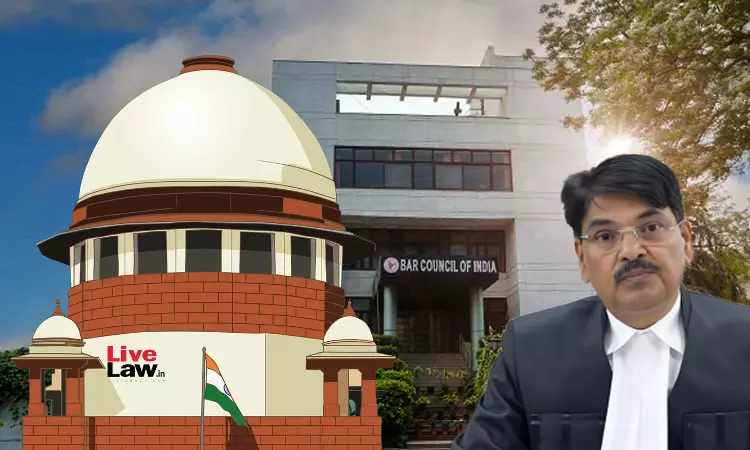
The Attorney General or the Solicitor General were never informed of the BCI meetings though they are ex-officio members, the BCI member stated.
A member of the Bar Council of India has told the Supreme Court that important decisions and communications have repeatedly been taken or issued in the name of the BCI without deliberation with its members, while the Attorney General for India and Solicitor General of India, who are ex-officio members of the Council, have not been provided notice and agendas of its meetings.BCI member N...
This is a premium content
Available exclusively to
Our subscribers
Subscribe Premium 
INR 1099+GST
Your support helps us to bring you more content at
an affordable subscription scheme !!!
All payment options available
A member of the Bar Council of India has told the Supreme Court that important decisions and communications have repeatedly been taken or issued in the name of the BCI without deliberation with its members, while the Attorney General for India and Solicitor General of India, who are ex-officio members of the Council, have not been provided notice and agendas of its meetings.
BCI member N Manoj Kumar, in his reply affidavit filed in the writ petition moved by advocate Yogamaya MG challenging the continuation of Manan Kumar Mishra as BCI Chairman, has substantially supported the concerns raised in the petition regarding the functioning, governance and finances of the apex statutory body of advocates.
BCI decisions taken unilaterally
Kumar has contended that the statutory authority under the Advocates Act is vested in the BCI collectively and cannot be converted into the individual authority of an office-bearer. According to him, there has been a "consistent pattern of unilateral decision-making" in the BCI. He has further alleged that agendas for meetings have on several occasions been circulated or posted in messaging groups only shortly before meetings, leaving members insufficient time to study matters and participate effectively in deliberations.
He has also stated that minutes of BCI meetings have not been circulated among members for confirmation and approval. Important institutional and policy decisions, he says, have on several occasions been communicated in the name of the BCI without the underlying deliberations or resolutions being placed before its members.
On several occasions, agendas for meetings have been circulated or posted in messaging groups only shortly before the commencement of such meetings.
The Minutes of the Meetings have never been circulated amongst the members for confirmation and approval. This is a serious procedural violation.
Important institutional and policy decisions have also, on several occasions, been communicated in the name of the Bar Council of India without the underlying deliberations or resolutions being placed before the members. This practice violates the fundamental principle that the statutory Council must function as a collective body with meaningful participation of all members.
NALSAR action was not placed before General Council
Kumar said that the controversial August 13 direction issued by the BCI Chairman to stop the enrolment of the 2026 graduating batch of NALSAR University of Law, Hyderabad, was not placed before the General Council for deliberation and that no resolution authorising the action had been disclosed. He subsequently wrote to the Chairman objecting to the action. Though the decison was subsequently withdrawn by the BCI Chairman, he said that "this incident demonstrates a pattern of unilateral exercise of institutional authority by the Chairman, contrary to the statutory scheme which vests such authority in the collective Council".
AG, SG not given notices and agendas
Kumar stated that although the Advocates Act specifically provides for the Attorney General and Solicitor General to be ex-officio members of the BCI, notices and agendas of BCI meetings have not been circulated to them, thereby preventing their meaningful participation in the Council's deliberations.
He states that he had raised the issue with the Chairman, following which an assurance was given that notices and agendas would be circulated to the law officers for future meetings. However, according to the affidavit, the assurance was not complied with and the practice continued.
The Advocates Act specifically providing for the Attorney General for India and the Solicitor General of India to be the ex officio members of the Bar Council of India no notices and agendas of the meetings of the Bar Council of India have been circulated to them, thereby effectively preventing their meaningful participation in the deliberations of the Council. This omission is particularly significant given that the Attorney General and Solicitor General, as the principal law officers of the Union, bring institutional perspectives essential to the functioning of the BCI.
Whenever I raised this issue with the Chairman, an assurance was given that notices and agendas would be duly circulated to them for all future meetings so as to ensure their participation. However, despite this commitment, the assurance has not been complied with, and the practice of excluding them from proper notice continues. This non-compliance not only violates the statutory scheme but also demonstrates a pattern of institutional indifference to commitments made regarding procedural regularity and inclusive decision-making.
These statements of the BCI member assume significance in the backdrop of the Supreme Court's observations earlier this month that, until a newly elected BCI is constituted, Manan Kumar Mishra's continuation should be treated as a pro tem arrangement for day-to-day functioning and that the Attorney General should be involved in policy decisions. The Court had also suggested involving the AG and SG when matters having significant policy implications are considered.
Raises questions over PEARL-FIRST Trust
Kumar has also raised concerns over the constitution and functioning of the BCI Trust PEARL-FIRST.
Kumar stated that despite repeated requests, he was not furnished the original Trust Deed for a considerable period. Upon examining the 2020 Trust Deed, he found provisions under which certain persons were constituted as "Permanent Managing Trustees", allowing them to continue as trustees even after ceasing to be members of the BCI.
It may be recalled that the Supreme Court, in its hearing on September 2, had questioned the provisions allowing BCI office-bearers to remain as permanent trustees even after their tenure.
The affidavit also raises questions concerning the financial arrangements between the BCI and PEARL-FIRST in relation to the All India Bar Examination.
He questions under what authority under the Advocates Act or the Rules framed under it receipts arising from the AIBE, which he describes as a regulatory function of the BCI, can be credited or transferred to a separate Trust.
He has sought the complete accounting trail of AIBE receipts, including the accounts into which examination fees were credited, transfers between the BCI and PEARL-FIRST, payments made to examination agencies and vendors, surplus generated from individual examinations and the eventual utilisation of such surplus.
Challenges Five-Year Tenure Of BCI Chairman
On the continuation of Manan Kumar Mishra as Chairman, BCI member Manoj Kumar raised questions over the legal basis for his five-year tenure. The affidavit refers to Rule 12(2), Chapter I, Part II of the BCI Rules, which prescribes a two-year tenure for the Chairman and Vice-Chairman, or until cessation of membership, whichever is earlier.
Kumar contrasts this with the April 21, 2025 Gazette Notification recording Mishra's tenure from April 17, 2025 to April 16, 2030. He describes the difference as an "apparent inconsistency" and says the authority for extending the tenure to five years, and its consistency with the statutory scheme, requires examination.
The reply affidavit of Manoj Kumar has been filed through AoR Biju P Raman.
Case : Yogamaya MG v. Union of India and others | W.P.(C) NO. 1092/2026


