



- Home
- /
- Top Stories
- /
- BCI Must Act Against Lawyers...
BCI Must Act Against Lawyers Speaking To Media About Their Own Cases: Justice Abhay Oka
Amisha Shrivastava
19 Sept 2026 12:50 PM IST
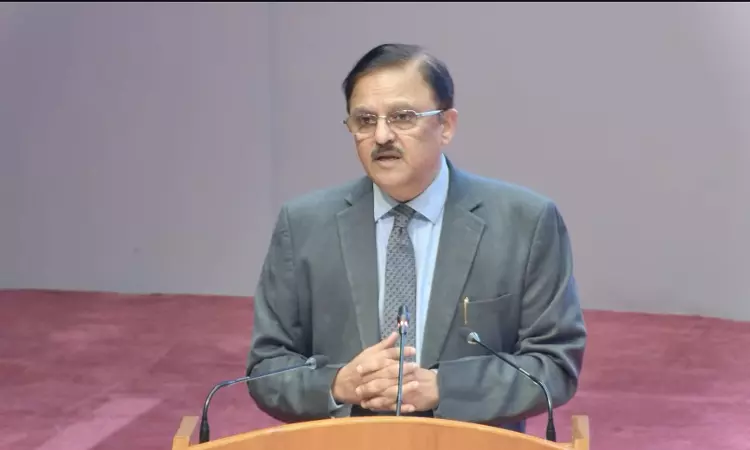
“Is it really correct to address the media on the submissions made in ongoing case?” he asked.
Former Supreme Court judge Justice Abhay Oka called upon the Bar Council of India to act against lawyers who speak to the media about their arguments in ongoing cases, saying the practice can amount to self-promotion and may fall within the restrictions on advertising and solicitation under the Bar Council of India Rules.Speaking at the “Discourse on Ethics in Criminal Litigation, Trial...
This is a premium content
Available exclusively to
Our subscribers
Subscribe Premium 
INR 1099+GST
Your support helps us to bring you more content at
an affordable subscription scheme !!!
All payment options available
Former Supreme Court judge Justice Abhay Oka called upon the Bar Council of India to act against lawyers who speak to the media about their arguments in ongoing cases, saying the practice can amount to self-promotion and may fall within the restrictions on advertising and solicitation under the Bar Council of India Rules.
Speaking at the “Discourse on Ethics in Criminal Litigation, Trial by Media & Admissibility of Statements” organised by the Centre for Discourses on Criminal and Constitutional Jurisprudence, Justice Oka questioned why lawyers go to the media after sensitive hearings and discuss the submissions made before the court.
“Is it really correct to address the media on the submissions made in ongoing case?” he asked.
Justice Oka said he had also seen lawyers hosting podcasts at the end of the day discussing arguments made before courts and the questions asked by judges. He noted that some lawyers go to the extent of suggesting that the questions asked by judges indicate that their clients are likely to win.
“The duty of the lawyers is to argue to the best of their ability and assist the court as the officers of the court,” he said.
Referring to the Rule 5 of the Bar Council of India Rules, which prohibits advertising and solicitation of work by advocates, Justice Oka noted that the rule provides that an advocate shall not solicit work or advertise in any manner and prohibits promotion through interviews, furnishing or inspiring newspaper comments and producing photographs for publication in connection with a case.
This provision could apply when a lawyer appearing in an ongoing case gives an interview to the media, seeks publication of their photograph or discusses the case publicly, he said.
“When a lawyer in an ongoing case gives interview to the media, he wants his photograph to be published in the media, may not be in print media, but in electronic media, I believe that this Rule will be attracted. You are soliciting the work, you are advertising your skills,” he said.
He said the time had come for the Bar Council to act, while adding in a lighter vein that it was difficult to believe that the Bar Council of India would act in such a manner.
“But they are the ones who have statutory power and they are expected to act,” Justice Oka said.
Justice Oka's comments came while he was speaking on the broader question of media trials and reporting of ongoing judicial proceedings.
He said he was a firm believer in open court hearings and believed that the media and citizens had a right to know what happens in courts. He also supported live-streaming of proceedings before the High Courts and the Supreme Court.
However, he highlighted that media discussions based on live-streamed proceedings can create a wrong impression when judicial questions are treated as indications of the judges' final views.
Justice Oka pointed out that judges may put questions to lawyers to seek clarification, test a particular submission or indicate a prima facie view so that counsel can effectively address it. A prima facie view, he stressed, is not necessarily the final view of the court.
He highlighted that there had been cases where judges expressed a prima facie view during arguments but ultimately delivered judgments taking the opposite view.
Justice Oka also opposed courts issuing gag orders against the media. Referring to the Supreme Court's judgment in Wikimedia Foundation v. ANI Media, he said that courts cannot tell the media what to report or direct it to remove portions of a report.
He referred to the principle of open justice and emphasised that courts should remain open to public observation, debate and criticism. He said that constructive criticism of courts should be welcomed.
Justice Oka said that if a person commits contempt, the court can take action under the Contempt of Courts Act. However, this s different from directing the media not to report something or to report it in a particular manner, he said.
“Issuing gag orders against the media is not at all the solution. It will make the problem worse,” he said.
He said that such orders violate Article 19(1)(a) of the Constitution. He further highlighted that a gag order could sometimes be interpreted as suggesting that a court had something to hide or conceal.
Justice Oka also spoke about the role played by other stakeholders in shaping public opinion during pending criminal cases. He criticised investigating officers and senior police officials for holding press conferences during ongoing investigations and disclosing details such as witness statements, identification of accused persons and the manner in which an investigation was proceeding.
He said that such disclosures could prejudice the investigation by revealing its direction and could also allow evidence to be destroyed or manipulated.
He also cautioned against police officials telling the media that an accused had confessed while in custody. The media, he said, should explain to the public that such a confession cannot ordinarily be proved against the accused and is not admissible in evidence.
Justice Oka further criticised political statements during investigations that an accused would be hanged or punished. He said that the question whether an accused was guilty and the sentence to be imposed were matters for the court, with sentencing being the exclusive province of the court.
He also referred to instances where public prosecutors speak to the media before a trial begins and disclose that they were personally requested by a Chief Minister or Home Minister to appear in the case. Such statements, he said, can send wrong signals about the justice delivery system.
On media trials, Justice Oka said that there may not be a “trial by media” in the true sense, but police officers, politicians, prosecutors and lawyers can provide information to the media which then influences public opinion.
He emphasised that media reporting itself was welcome when it was objective and accurate, and the need of the hour was self-restraint by all stakeholders.
“The real solution is educating all the stakeholders and restraint,” he concluded.
The video of the event can be watched here.
Also from the event - Extra-Judicial Killings Are On Rise; Constitution Doesn't Approve Such Shortcut Methods: Justice Ujjal Bhuyan
Tags

Amisha Shrivastava
Amisha Shrivastava is a Senior Correspondent with LiveLaw, covering the Supreme Court of India. She can be reached at amisha@livelaw.in

