



14 Lawyers – Portraits From Bar By Raju Ramachandran: A Book Review
Amit Pai
6 July 2026 8:30 AM IST
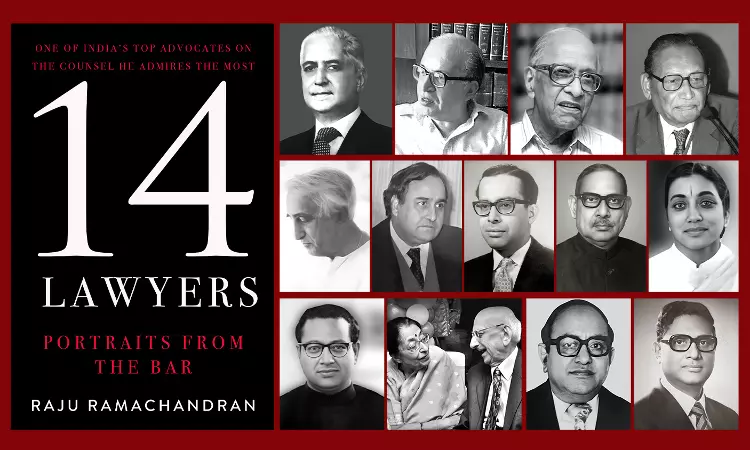
I first learnt of Senior Counsel and former ASG Raju Ramachandran's intent to write pen-portraits of lawyers he admired on the hot summer morning on which the annual SCBA Elections were held in May 2025. Both he and I - early voters were waiting in line for the process to begin and were chatting. And ever since, I have been eagerly waiting to read his book titled 14 Lawyers – Portraits from the Bar. The book comprising of pen portraits of distinguished lawyers is an excellent read. An institution like the Supreme Court is not defined by the mortar and bricks that make up its fine architecture. It is defined by the women and men who make the institution and the history of our Supreme Court. Raju Ramachandran has identified 14 Lawyers, of whom little is documented, and written about their role in building the institution. In his preface, describing his choice, he writes:
“They may not have enjoyed the eminence of the marketplace, and they are unlikely to figure in lists of 'top lawyers' polled by glossy magazines. But their life stories have inspired me, and I am sure my contemporaries will remember them. There are at least two full generations who have joined the Bar and the Bench after I have, and I want them to know about my heroes.”
What makes this written recording of history interesting is the fact that the author himself was closely associated with the protagonists, bringing in a personal touch quite unlike the impersonal biographical accounts entirely based on research from material available in the archives of libraries. It is a product of his attending hearings in the Supreme Court from his days in law school and thereafter joining the Bar during the period of the Emergency.


Barry Sen has written his memoirs (which are now out of print) which detail his many accomplishments but the fact that Sen was a “gentlemen counsel” can only be expressed by a person who has closely watched him like the author. And it is certainly no surprise that “an about-to-become Chief Justice” had not much of an idea of Barry Sen's life. Notably, Sen remains the youngest to be designated senior at the age of 31! About Frank Anthony I knew little even though I studied through till Class X in a Frank Anthony School. The undisputed leader of the Anglo-Indian community for over four decades, the author has enlisted the many contributions of Frank Anthony in public life, as an educationist and in the Courts in matters not just involving minority right, but also public law.
R.K. Garg is certainly a name that is commonly known in the corridors of the Court, because of the chamber block and the library on the third floor where one can read one's briefs in peace and quiet. Garg was quite to the contrary of the peace and quiet and a vociferous voice. The younger Supreme Court Bar knows little about the fiery Garg and his contributions something that the author has recounted in good detail. Garg was mistreated by his erstwhile party the CPI - even at his death with a refusal to place wreath on the body a lifelong comrade! Almost like the indomitable Somnath Chatterjee was treated with an expulsion when he refused to resign as the Speaker of the Lok Sabha in 2008. He was broken in the evening of his life. Somnath Chatterjee's family refused to allow the CPM to place their flag on his body. It's no surprise that the author had a personal connect with Garg for before they had their differences (as noted by the author) Garg and M.K. Ramamurthi (the author's senior and uncle) took up causes for the proletariat together. This brings us to M.K. Ramamurthi a lawyer of whom so little is known today. An advocate for David in every cause against Goliath. Principled as he was, Ramamurthi never took up briefs for the management and did not put Judges on a divine pedestal. He too was a vociferous voice for the labour movement. The author describes them as “acolytes” of the indomitable “the unrepentant communist” A.S.R. Chari - himself a great criminal and labour lawyer. The contribution of Garg and Ramamurthi in the development of labour jurisprudence in India is not celebrated as much as it ought to. There is a sense of honesty with which the author writes about the relationship between Ramamurthi and Shyamala Pappu (his other senior) a topic which many would rather speak of in hushed tones (or more likely in a gossipy manner) but this is not how he defines the personality and nature of Shyamala Pappu. In fact, the Ramamurthi-Shyamala equation is put in a matter-of-fact manner before discussing the remarkable achievements of Shyamala Pappu as a counsel before the Delhi High Court and Supreme Court something to which many are oblivious to.
The civil liberties movement in India was pioneered by several lawyers of whom Tarkunde, Gobinda Mukhoty are relics in the law reports but the lives around the practice of law has little recording - a gap that the author has filled. Tarkunde lived by principles, and his remarkable life was not any different - particularly during the Emergency and thereafter. An anecdote in the book of Mukhoty telling a Judge to extend the courtesy of informing the Bar of a late sitting is quite telling of the stature the members of the Bar enjoyed. Compare this to the modern-day phenomenon of “sequence” which has left many lawyers who took up the law to avoid mathematics dabble with an irrational series of numbers! Another stalwart who enjoyed stature was S.N. Kackar who told off a belligerent Justice D.A. Desai when he was bullying a lady lawyer. Although he never became Attorney General (a nomenclature he desired to be defined by), Kackar's tenure as Solicitor General and his succession to the office of the Law Minister are quite a feat in themselves. As Law Minister, he had the privilege of appointing Lal Narayan Sinha whom he had succeeded as Solicitor General as the Attorney General. The soft-spoken Lal Narayan Sinha was known as a man of a few words and whose depth in the knowledge of law has been covered by the author in full measure including the non-law serving of two rasgullas during conference. These accounts are special not only because of the personal connect that the author has had with them but also because of the lack of recorded information despite having played an important role in the history of the institution.
Both Tehmtan Andhyarujina and Dipankar Gupta, both formidably solid on the law were seen around the Courts appearing until as recently as a decade ago. Andhyarujina succeeded Gupta as Solicitor General. Neither was aggressive in the style of advocacy but that's hardly a measure to achieve greatness in advocacy. The author has remarked for both these individuals as well as B. Sen and Lal Narayan Sinha that their style of advocacy would perhaps have not enabled them to be noticed enough to be designated senior advocate. While this may be the author's view, the evolution of court room advocacy in manner notwithstanding the sheer brilliance and knowledge of the law these four men displayed would surely not go unnoticed in this day and age, as in that day and age. Both Andhyarujina and Gupta appeared in landmark cases and contributed to the growth of constitutional jurisprudence. It is no surprise that Dipankar Gupta was designated at the age of 38, but rather unusual that he refused to be a Law Officer twice, before he was finally appointed to the office of Solicitor General. Andhyarujina's belief in the error of the basic structure doctrine even surpassed his senior Seervai he continued to be as the author puts it “an original intent-wallah”. One aspect the author has perhaps overlooked is the contribution of Andhyarujina in the enactment of the SARFEASI Act.
The life and contribution of Nirmal Hingorani and Pushpa Kapila (later Kapila Hingorani) is hardly recorded anywhere - except in the expansion of article 21 in the law reports. The industrious couple whose adventure in public interest litigation opened the gates to the many who were unable to knock the doors of the courts for realizing their most basic human rights is a tale well told in law reports. The author has given the human effort behind the jurisprudence. The refusal of Kapila Hingorani “widely acknowledged as the 'mother of public interest litigation' in India” to be designated by Chief Justice Bhagwati is important because at the time Leila Seth was the only woman to have been designated. Perhaps she ought not to have refused this honour. The author is justified in remarking that she ought to have been designated in her lifetime. Nirmal Hingorani was designated. The influence in the public law sphere by this power couple is a story well told by the author.
I have deliberately left Govind Swaminadhan - the fourteenth and last of the author's “heroes” in the book - for the end because he is distinct from the rest not being a resident Supreme Court practitioner. Notwithstanding this, his contribution to the law and his outstanding advocacy is documented by the author. His “angrez” style did not deter the Dravidian Government of the day from appointing him Advocate General. It's well known in history that Govind Swaminadhan stood up and told Chief Justice Ray that he had never sought a review of Kesavananda Bharati at the hearing in November 1975 soon thereafter aborted. But what came as a revelation was his practice of simple living and high thinking. The author notes:
“Govind was a teetotaller and loved a life of nearly Gandhian discomfort, going as far as not sleeping under a fan”.
14 Lawyers is not Raju Ramachandran's autobiography but pen portraits of lawyers whose voice was heard and presence was felt in the Supreme Court corridors. Intertwining with his own life does make it a shade autobiographical. Raju Ramachandran not only does justice to his protagonists but a yeoman service to recording of history in a desirable and reader-friendly manner. It is in the unputdownable category
Author is an Advocate practicing at Supreme Court of India. Views are personal.


