



- Home
- /
- Top Stories
- /
- Can Accused Inspect Evidence Not...
Can Accused Inspect Evidence Not Relied By Prosecution Before Trial? Supreme Court Reserves Order
Amisha Shrivastava
1 Sept 2026 5:36 PM IST
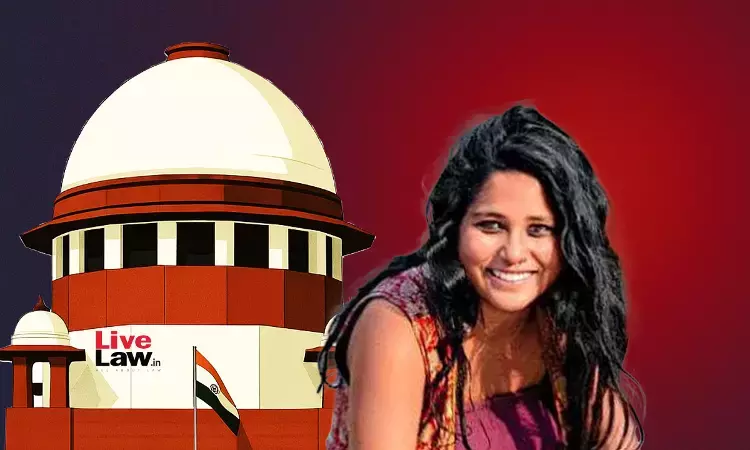
The Supreme Court today reserved its order on a plea filed by the Delhi Police challenging the Delhi High Court order permitting Devangana Kalita, an accused in the Delhi riots larger conspiracy case, to inspect unrelied documents kept in the malkhana.A bench of Justice Aravind Kumar and Justice Vipul M Pancholi heard the matter.Additional Solicitor General SV Raju, appearing for the...
This is a premium content
Available exclusively to
Our subscribers
Subscribe Premium 
INR 1099+GST
Your support helps us to bring you more content at
an affordable subscription scheme !!!
All payment options available
The Supreme Court today reserved its order on a plea filed by the Delhi Police challenging the Delhi High Court order permitting Devangana Kalita, an accused in the Delhi riots larger conspiracy case, to inspect unrelied documents kept in the malkhana.
A bench of Justice Aravind Kumar and Justice Vipul M Pancholi heard the matter.
Additional Solicitor General SV Raju, appearing for the Delhi Police, argued that an accused is entitled to receive the list of unrelied documents but cannot seek their inspection before the charges are framed. He submitted that the trial commences only after the framing of charges and that the right to seek inspection arises at a later stage.
Raju relied on judgments including State of Orissa v. Debendra Nath Padhi, Sarla Gupta v. Directorate of Enforcement and P. Ponnusamy v. State of Tamil Nadu to contend that inspection of unrelied documents is not permissible at the stage of framing of charge.
He submitted that after the charges are framed, an accused can seek production of documents by invoking Section 91 of the CrPC, and at the stage of entering defence can seek production of documents under Section 233 CrPC.
Raju submitted that the purpose of furnishing the list of unrelied documents is to make the accused aware of the material collected by the investigating officer, so that the accused can seek production of a particular document at the appropriate stage. He argued that allowing inspection before charges are framed would only delay the trial.
“Inspection is only for the purpose of delaying the trial that they are asking this,” he said submitted.
Senior Advocate Kapil Sibal, appearing for Kalita, however, said the Delhi Police had not even furnished the list of unrelied documents to her despite the chargesheet having been filed in 2020.
Raju agreed that the list would be furnished. “He's right. Unrelied list is not given. We'll give him the unrelied list,” he said.
Sibal submitted that the list would enable the defence to identify significant documents and seek inspection of specific material, if required.
Relying on the judgment concerning former Delhi Deputy Chief Minister Manish Sisodia, Sibal said that inspection of unrelied documents had been permitted even before framing of charges. He pointed out that Sisodia's case involved around 69,000 pages and the court had held that an accused could not be denied reasonable time to inspect the material to avail the right to a fair trial.
Sibal also referred to orders of Delhi trial courts permitting inspection of unrelied documents kept in the malkhana in cases investigated by the Enforcement Directorate and the National Investigation Agency.
“In similar vein, the power and procedure of courts permitting inspection of record Malkhana prior to framing of charge is rooted in rulings and practice of trial courts,” he submitted.
Justice Aravind Kumar observed that the prosecution was taking a different position despite such inspection being permitted in other cases. “Now they claim wisdom has dawned on them,” the judge remarked.
Sibal also sought a video seized by the police, contending that it could show that Kalita had participated in peaceful protests. He highlighted that the same video had been considered by the Delhi High Court while granting her bail. Sibal said that the High Court had examined the case diary and material in a sealed cover and found that Kalita's presence was seen in peaceful agitation, with no material showing that she had instigated women of a particular community or made a hate speech.
He argued that the video was not defence material sought to be produced by Kalita, but material seized by the investigating agency, recorded in a seizure memo and accompanied by a Section 65B certificate under the Indian Evidence Act.
Referring to the seizure memo, Sibal said it recorded the seizure of video clips of the riots at a school, recorded by cameraman Prem Singh. He also referred to Singh's statement that he had been engaged for videography and asked by the police to record the events.
Sibal argued that the prosecution could not seize the material, include it in the seizure memo and then designate it as unrelied upon when it could assist the accused. He said Kalita should be allowed to inspect the video before framing of charges if it could exculpate her.
He clarified that he was not invoking Section 91 CrPC, but only seeking inspection of material already seized by the police.
Sibal further submitted that even at the stage of framing charges, the court is not barred from summoning material withheld by the investigating agency if it is of “sterling quality” and has a crucial bearing on the question of framing charges.
He also referred to a Delhi court order in an NIA case permitting inspection of unrelied documents by relying on the Supreme Court's judgment in Manish Sisodia v. Directorate of Enforcement. He said the Delhi Police had not objected to such inspection in several other cases, including NIA cases, but was opposing it in Kalita's case.
Raju maintained that the judgments relied upon by Sibal either arose in different factual circumstances or concerned later stages of proceedings. He submitted that the judgments had to be understood in the context of the stage at which the accused sought the documents.
After hearing the arguments, the Court reserved order and permitted both sides to file short notes of submissions not exceeding two pages.
Background
The case arises from the Delhi High Court's June 6 order rejecting Kalita's plea seeking videos of the CAA-NRC protests and WhatsApp chats relied upon by the Delhi Police, citing the sensitive information involved. At the same time, it permitted her to inspect the unrelied documents kept in police custody.
The Delhi Police challenged that direction before the Supreme Court. On July 20, the Court stayed the High Court's order.
Kalita was granted bail by the Delhi High Court in June 2021 along with co-accused Asif Iqbal Tanha and Natasha Narwal. The Supreme Court dismissed the Delhi Police's challenge to the bail order in May 2023.
In August 2023, the trial court had refused Kalita's plea seeking the entire CCTV footage of North-East Delhi and WhatsApp chats of police officials in the UAPA case.
Case Details: State NCT of Delhi v. Devangana Kalita, SLP(Crl) No. 12447/2026, Diary No. 38990/2026
Tags

Amisha Shrivastava
Amisha Shrivastava is a Senior Correspondent with LiveLaw, covering the Supreme Court of India. She can be reached at amisha@livelaw.in

