



- Home
- /
- Top Stories
- /
- Can Special Intensive Revision...
Can Special Intensive Revision Deviate From Rules? Procedure Must Be Transparent : Supreme Court To Election Commission
Anmol Kaur Bawa
22 Jan 2026 1:14 PM IST
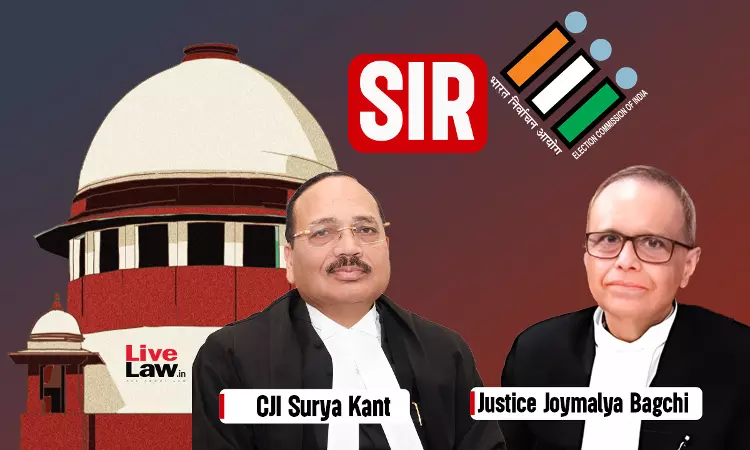
In the challenge to the SIR across various states, the Supreme Court yesterday observed that the ECI cannot have untrammelled and unregulated powers under Section 21(3) of the Representation of the People Act, 1950, which empowers the Commission to carryout an intensive revision "in such manner as it may think fit".The Court opined that such a 'manner' has to be within the...
This is a premium content
Available exclusively to
Our subscribers
Subscribe Premium 
INR 1099+GST
Your support helps us to bring you more content at
an affordable subscription scheme !!!
All payment options available
In the challenge to the SIR across various states, the Supreme Court yesterday observed that the ECI cannot have untrammelled and unregulated powers under Section 21(3) of the Representation of the People Act, 1950, which empowers the Commission to carryout an intensive revision "in such manner as it may think fit".The Court opined that such a 'manner' has to be within the constitutional framework and principles of natural justice.
A bench comprising Chief Justice of India Surya Kant and Justice Joymalya Bagchi was hearing the arguments of Senior Advocate Rakesh Dwivedi, for the Election Commission of India(ECI).
Justice Bagchi posed whether the ECI had the power to deviate from the pre-existing rules on revision of electoral rolls, especially Form 6 under Rule 13 of Registration of Electors Rules 1960, which details the process for raising objections and claims. And could the ECI stipulate its own set of documents which it allows for SIR, beyond those listed in Form 6?
"Rule 13 is the rule-making power through which Form 6 is notified. Form 6 has about 6 documents, and your SIR has 11 documents. We would call upon you to answer - can you increase the number of documents or eliminate the documents which are there for place of birth, place of residence, and say no, we will not look into the document which is there in Form 6, we would look only for the 11 documents."
He added, "Yes, there cannot be any debate that it is not untrammelled, but it is unique to the ECI. The ECI, in this respect, has the widest discretion, however the intensive revisions also have a guideline."
To answer this, Dwivedi referred to Section 21(2)(a) which states :
"The said electoral roll—(a)shall, unless otherwise directed by the Election Commission for reasons to be recorded in writing, be revised in the prescribed manner by reference to the qualifying date."
Dwivedi submitted that the revision of the rolls is not necessarily to be done as per statutory rules alone, but can happen differently if any special circumstances exist. He said:
"Namely, the roll prepared under S.21(1) will be revised, not only according to the rules, but in specific situations maybe existing, where the ECI may deviate from the rules."
Here, Justice Bagchi again pointed out that ECI has to go as per the 'prescribed manner', meaning the rules underlying the provisions.
Dwivedi countered that the provision in the beginning only clarified that there is no time period prescribed, which is clear from the starting phrase-" Unless otherwise directed". He further added that the main clause S.21(3), which empower the ECI to conduct the SIR, starts with the phrase - " Notwithstanding anything contained in sub-section (2)". This means that S.21(3) has to be read independently from S.21(2) on general revision of rolls. He stressed "S.21(3) is an independent, different, distinct power"
S.21(3) reads : " Notwithstanding anything contained in sub-section (2), the Election Commission may at any time, for reasons to be recorded, direct a special revision of the electoral roll for any constituency or part of a constituency in such manner as it may think fit."
Justice Bagchi then asked whether the quality of the inquiry for revision was the same under S.21 (2) and S.21 (3) ?
Dwivedi clarified that if the ECI does not follow the manner prescribed under S.21(2), then that inquiry would amount to a deviation from the rules, but the same cannot be said for S.21(3) due the presence of the phrase " in such manner as it may think fit" implying discretion upon the ECI for the manner in which SIR would be done.
CJI then weighed in to inquire that even under the said interpretation, shouldn't the ECI ensure that whatever process they adopt ensures transparency?
"Assuming the way you are interpreting, the question remains, there is an SIR voter list under (3), the revision of the list can lead to serious consequences, therefore when an action is likely to impact on the civil rights of the people, why should we not expect from you that the procedure you will follow will not be less than transparent under S.21 (2) ?"
Dwiviedi clarified that it was not the ECI's case that an SIR can be conducted overlooking the basic constitutional principles of equality, fairness and transparency.
"I have conceded in the begining mylords that I have to stand the test of Article 14- reasonable, just and fair; transparency; ease of voter; and keeping in mind Article 326- nobody can deviate from 326- so these are the 5 broad parameters, so it is not my submission that we can just frame any kind of SIR, I will have to explain that it is just and fair."
At a later point, Justice Bagchi expressed ECI had to still ensure that the SIR process was within the constitutional framework, pointing at ECI's powers under S.21(3), he said:
"No power can be untrammled, no power can be completely unregulated"
Dwiviedi agreeingly replied, "Absolutely!"
The CJI also weighed in to point out that while S.21(3) does not mandate the SIR to go as per the rules 'prescribed' which is different from other clauses of S.21, but the phrase " in such manner as it may think fit" under S.21(3) has to be understood in line with the existing principles of natural justice.
"The word 'prescribed' which is mentioned in S.21(1) ans S.21(2), three times, that word is constitutionally missing in S.21 (3)- but its speaks 'in the manner ' - there has to be a manner, the manner must be in conformity with principles of natural justice , transparency and all other well-known principles."
The bench will continue hearing the matter today at 2 PM.
A detailed report on ECI's previous arguments can be read here.
Case Details: ASSOCIATION FOR DEMOCRATIC REFORMS vs. ELECTION COMMISSION OF INDIA| W.P.(C) No. 000640 / 2025

Anmol Kaur Bawa
Reporter

