



- Home
- /
- Top Stories
- /
- Can't Lay Down Blanket Rules On...
Can't Lay Down Blanket Rules On State Interference In Religion For Social Reform : Supreme Court In Sabarimala Reference Hearing
Gursimran Kaur Bakshi
22 April 2026 4:41 PM IST
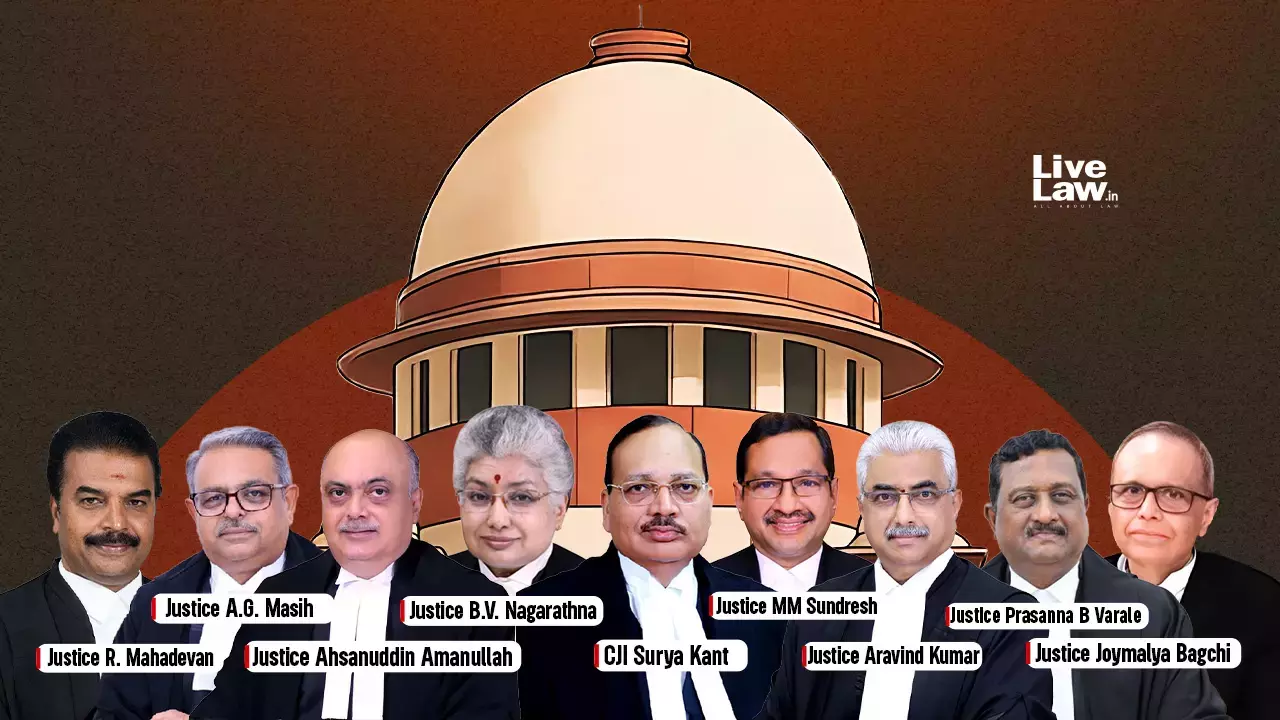
On the seventh day of hearing in the Sabarimala reference, the Supreme Court observed that it would be difficult to lay down any universal or prospective guidelines on when the State can intervene in religious practices in the name of social reform, emphasizing that such questions would necessarily depend on the facts of each case.The 9-judge bench engaged in an extensive discussion on the...
This is a premium content
Available exclusively to
Our subscribers
Subscribe Premium 
INR 1099+GST
Your support helps us to bring you more content at
an affordable subscription scheme !!!
All payment options available
On the seventh day of hearing in the Sabarimala reference, the Supreme Court observed that it would be difficult to lay down any universal or prospective guidelines on when the State can intervene in religious practices in the name of social reform, emphasizing that such questions would necessarily depend on the facts of each case.
The 9-judge bench engaged in an extensive discussion on the scope of the State's power under Article 25(2)(b) of the Constitution, which permits legislation for social welfare and reform affecting religious practices.
The bench comprises Chief Justice of India Surya Kant, Justice BV Nagarathna, Justice MM Sundresh, Justice Ahsanuddin Amanullah, Justice Aravind Kumar, Justice Augustine George Masih, Justice Prasanna B Varale, Justice R Mahadevan and Justice Joymalya Bagchi.
Difficult to lay down rules for future guidance : CJI
Summing up the day's exchanges, the Chief Justice remarked that while the expression "social welfare and reform" is broad and the State is not an outsider to such processes, the Court cannot frame blanket rules applicable to all future situations.
"I think the issue stands quite well debated. Part III is an embargo on Article 25(1) on individual devotees' rights. When you exercise Article 25(1) rights, you have to respect Part III also," the CJI observed.
He added that the State, as a representative of the people's will, may legitimately act to address social evils, but judicial assessment would always be context-specific.
"So far as social welfare or reforms are concerned, it is a very wide term and the State is not a stranger or an alien. State represents the will of the people and if the people want certain social evils to be reformed, probably that power can be exercised. But it is very difficult for us to lay down any future guidance. It will always depend on case to case as to whether the reforms fall under Article 25(2)(b) or, in the name of reforms, it amounts to an infringement of a religious practice," the CJI said.
Will a law allowing women entry in Sabarimala be a 'social reform' move?
During the hearing, Justice Nagarathna posed a pointed hypothetical to test the contours of the State's power. She asked whether a State law that expressly permits entry of young women into the Sabarimala temple, in the name of social reform, would amount to an invasion of religious practice or could be sustained as a valid reform measure.
"Suppose, the Kerala rules would have said in the name of social reforms, the entry of women between the ages of 10 to 50 to the temple is permitted, is it an invasion or could we say it's not an essential practice and therefore upheld. What is the extent of invasion there?"
Responding to the query, Senior Advocate Gopal Subramanium offered a nuanced answer, submitting that even in such cases, the Court would need to undertake a careful inquiry into the nature and basis of the practice before determining whether State intervention qualifies as social reform.
He argued that the Court must examine whether the exclusion forms part of an ancient tradition, custom, or usage belonging to a denomination, and whether it fundamentally deprives devotees of their right to worship.
"In such a case, your Lordships would have to be satisfied and would need to undertake an inquiry to see whether the exclusion, as part of ancient tradition, custom or usage, did not fundamentally take away the rights of the devotees to go to the temple," he submitted.
Subramanium emphasized that if a practice is limited in scope, grounded in rational considerations, and forms part of an established denominational tradition, it would ordinarily merit respect as part of that religious practice.
"I submit with respect that, in such a case, if the usage is present, custom is present, it is entitled to respect ipso fact as a part of that tradition. Customs and usages can't be thrown away," he added.
Subramanium also cautioned that the expression "social welfare and reform" cannot be used as a mere pretext to invade religious freedoms protected under Articles 25 and 26 of the Constitution.
He submitted that legislation claiming to advance social reform must withstand judicial scrutiny to determine whether it genuinely addresses a social evil or merely disguises an intrusion into religious autonomy.
"Social welfare and reforms must not be a cloak. There is an element of scrutiny involved by the Court to truly examine whether it is advancing social reform," he argued.
Justice Bagchi described Article 25(2)(b) as a "narrow window" of legislative competence when it comes to interference in religious affairs, observing that while general laws may regulate property management of religious institutions, direct interference in religious practices must be justified strictly as a measure of social reform.
The Bench also explored whether legislative measures inspired by Directive Principles of State Policy or constitutional duties could qualify as social reform legislation under Article 25(2)(b).
Justice Bagchi raised the question whether the State could invoke constitutional visions embodied in the Directive Principles to justify intervention in religious practices.
"Will the state be understood to be within its limits if it says that its enforcing constitutional duties in enforcing a law or making a law within the ambit of social reform because the state has some constitutional duties envisaged under directive principles of state policy. It has the constitutional duties to enforce fundamental duties of the citizens. will these qualify for social reform legislations?" Justice Bagchi asked.
In response, Subramanium gave the example of superstitious practices which are so abhorrent, which can be regulated by social reform laws.
He submitted that although the concept of social reform is capable of wide interpretation, the State must establish a direct nexus between the reform sought and the objective pursued, failing which Article 25(2)(b) could become a "silent inroad" into religious freedom.
He emphasized that freedom of religion and conscience forms part of the Constitution's basic structure and therefore requires strict scrutiny of legislative measures affecting religious practices.
Justice Nagarathna also gave the example of Sati, and said that its abolition can be regarded as a social welfare measure.
Essential Religious Practice Test Not Be Discarded Totally : Subramanium
Subramanium urged the Court not to abandon the test altogether, arguing that it serves as a safeguard against extraneous or superstitious practices being shielded under the guise of religion.
He argued that the observations of Justice Gajendragadkar in Durgah Committee do not go that far as suggesting that only essential religious practices are protected under Article 25. According to him, this was a test to demarcate religious and secular activities, and maintained that it holds some relevance "in the context of dealing with claims based on religion which may not belong to religion at all, but are being masked, or clothed with as being religious under the mask of religion."
He submitted that the Court should have a "tool" to ascertain such claims, and can come in aid in discovering the components of that particular religion.
Justice Nagarathna expressed reservations about the judiciary being called upon to sit in judgment as to whether a religious practice was essential.
Subramanium traced the origins of the doctrine to the landmark Shirur Mutt judgment, explaining that the decision upheld regulation of temple endowments primarily to ensure that dedicated religious property was administered in accordance with the donor's intent and principles of trust law.
Justice Nagarathna suggested that the ERP doctrine should operate as a safeguard rather than a restrictive threshold.
“It should act as a stricture or an aiding tool for protection,” she observed.
Justice Sundresh added that judicial review of religious practices does not always require a determination of essentiality, particularly when assessing the validity of legislation enacted under Article 25(2)(b), which permits State intervention for social welfare and reform.
“What is required by the court, the challenge will be only when the law has been created or where there is a vacuum. There is no need for essentiality. You will have to see whether a religious practice is there or not,” Justice Sundresh said.
Justice Aravind Kumar raised concerns about the judicial role in resolving disputes involving competing interpretations within a religion.
“In case of multiple accepted religions or practices, what is the juridical basis on which the court can interpret? Whether the court can declare one authoritative over the other?” he asked.
Subramanium responded that courts are not devoid of adjudicatory power in such matters and may rely on evidence when resolving intra-denominational disputes.
“There is no other place where legal rights or legal injury can be established except in a court,” he said, adding that determining the nature of a practice would require evidentiary assessment rather than theological preference.
Hearings will continue tomorrow.
Live updates from today's hearing can be followed here.
Gursimran Kaur Bakshi
Gursimran is the Principal Correspondent with LiveLaw for the Supreme Court. She can be reached out at: simrankaurbakshi@livelaw.in

