



- Home
- /
- Top Stories
- /
- Can't Take Information From...
Can't Take Information From 'WhatsApp University': Justice Nagarathna
Gursimran Kaur Bakshi
23 April 2026 11:42 AM IST
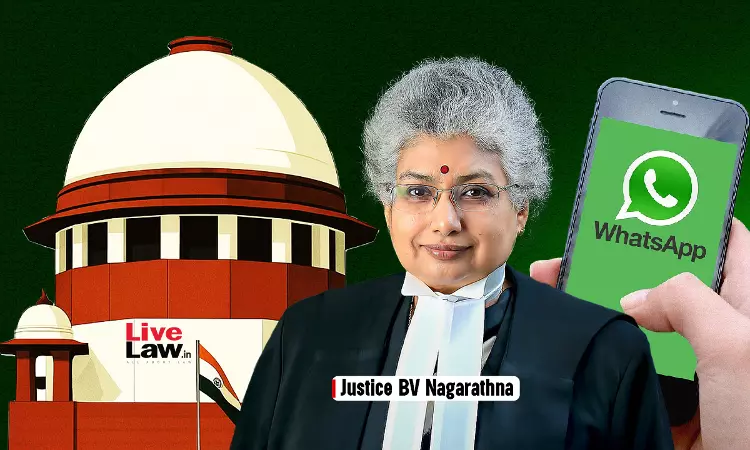
The eighth day of the Sabarimala reference hearing witnessed a light-hearted exchange in the Supreme Court, with Justice BV Nagarathna remarking that information cannot be accepted from "WhatsApp University".The comment came in response to a submission by Senior Advocate Neeraj Kishan Kaul, who argued that there was no harm in accepting knowledge and wisdom regardless of the source. Kaul...
This is a premium content
Available exclusively to
Our subscribers
Subscribe Premium 
INR 1099+GST
Your support helps us to bring you more content at
an affordable subscription scheme !!!
All payment options available
The eighth day of the Sabarimala reference hearing witnessed a light-hearted exchange in the Supreme Court, with Justice BV Nagarathna remarking that information cannot be accepted from "WhatsApp University".
The comment came in response to a submission by Senior Advocate Neeraj Kishan Kaul, who argued that there was no harm in accepting knowledge and wisdom regardless of the source. Kaul was referring to a newspaper article authored by Dr. Shashi Tharoor that called for judicial restraint in matters relating to religious relief.
Chief Justice of India Surya Kant observed that while the Court respected eminent authors and thinkers, the article ultimately reflected a personal opinion, and that "personal opinion is personal opinion", indicating that such views cannot carry binding value for the Court.
"There is no harm in drawing from all sources. If knowledge and wisdom come from any source, any country, any university, they should be welcomed. We are far too rich as a civilisation not to accept all forms of knowledge and information," Kaul replied.
"But not from WhatsApp University," Justice Nagarathna said.
"I am not getting into that. I am not into which university is good or bad, which is really inconsequential to this debate..... The point is simply that wherever knowledge and information come from, they must be accepted," Kaul replied.
Kaul is appearing for the Dawoodi Bohra community head in a writ petition challenging the practice of excommunication.
Kaul argued that the rights of a denomination under Article 26(b) cannot be read as subject to the social reform legislations adopted by the State in pursuance of Article 25(2)(b) in all contexts. He submitted that the Devaru judgment does not lay down a blanket rule that Article 26(d) be subject to Article 25(2)(b) in all contexts, as the case was in the context of temple entry alone.
He advocated a harmonious construction of Articles 26(b) and 25(2)(b). Justice Nagarathna at this point commented, "When a legislation is enacted under Article 25(2)(b), it cannot be said that the right of a religious denomination will always prevail. Those rights are themselves subject to public order, morality and health. That can form the basis of social reform or social welfare legislation." Kaul agreed.
Kaul further argued that the word 'morality' in Articles 25 and 26 cannot be understood as 'constitutional morality'. Abhorrent practices will, in any case, be hit by 'public morality', and there was no need to import the concept of 'constitutional morality'.
"If constitutional morality is read into morality then we are bringining it lot more than what has been envisaged," Kaul warned.
This was in response to a query by Justice Amanullah about why constitutional morality cannot be used in Articles 25/26, since it was an evolving and dynamic concept, as opposed to social morality, which might be static.
The hearing is progressing. Live updates can be followed here.
Gursimran Kaur Bakshi
Gursimran is the Principal Correspondent with LiveLaw for the Supreme Court. She can be reached out at: simrankaurbakshi@livelaw.in

