



- Home
- /
- Top Stories
- /
- 'Capable Of Misuse, Vague': Supreme...
'Capable Of Misuse, Vague': Supreme Court Stays UGC Equity Regulations 2026
Debby Jain
29 Jan 2026 1:06 PM IST
'Are we going backwards from whatever we gained in terms of achieving a casteless society?' the Court asked.
The Supreme Court on Thursday ordered that the University Grants Commission (Promotion of Equity in Higher Education Institutions) Regulations, 2026, be kept in abeyance.The Court expressed certain reservations about the Regulations, which are being challenged as discriminatory towards "general classes".The Court suggested that the Regulations must be revisited by a committee comprising...
This is a premium content
Available exclusively to
Our subscribers
Subscribe Premium 
INR 1099+GST
Your support helps us to bring you more content at
an affordable subscription scheme !!!
All payment options available
The Supreme Court on Thursday ordered that the University Grants Commission (Promotion of Equity in Higher Education Institutions) Regulations, 2026, be kept in abeyance.
The Court expressed certain reservations about the Regulations, which are being challenged as discriminatory towards "general classes".
The Court suggested that the Regulations must be revisited by a committee comprising eminent jurists. The Regulations are prima facie "vague" and are "capable of misuse", the Court observed during the hearing.
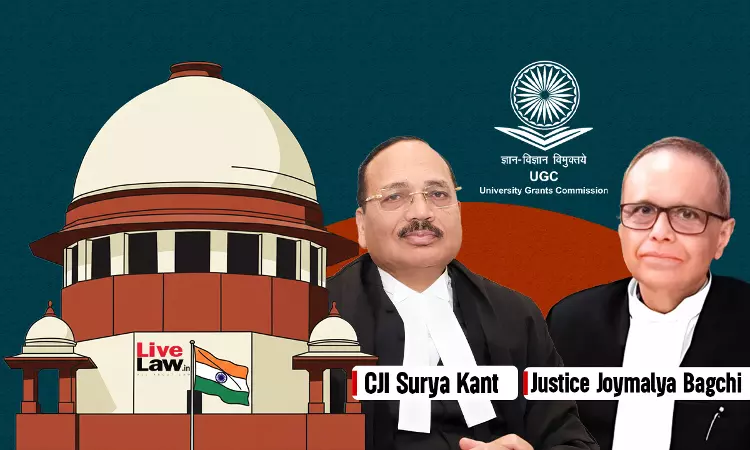
A bench comprising CJI Surya Kant and Justice Joymalya Bagchi was hearing three writ petitions which challenge the constitutionality of the 2026 Regulations. These have been filed by - Mritunjay Tiwari, Advocate Vineet Jindal and Rahul Dewan.
The Court issued notice to the Union and the University Grants Commission on the petitions, returnable on March 19. Till then, the 2026 Regulations are kept in abeyance. The Court further ordered that the 2012 UGC Regulations will operate in the meantime.
Major concerns raised by the Bench about the Regulations
During the hearing, the bench orally flagged the following issues with respect to the Regulations :
- The provisions are vague and are capable of being misused.
- Why "caste-based discrimination" is separately defined when the definition of "discrimination" takes care of all forms of discriminatory treatment?
- Why ragging has been left out of the Regulations?
Suggesting a revisiting of the Regulation, CJI told Solicitor General of India Tushar Mehta :
"Mr SG, we would like to have your response. Today we do not want to pass any order...some committee should be there with eminent jurist...have 2-3 persons...who understand social values and ailments society is facing. How entire society should grow...how people are going to behave outside campus if we create this...they must apply their mind."
Petitioners' arguments :
Advocate Vishnu Shankar Jain, appearing for one of the petitioners, referred to the definition of "caste-based discrimination" as per Regulation 3(1)(c), which is "discrimination only on the basis of caste or tribe against the members of the scheduled castes, scheduled tribes, and other backward classes". Jain said that discrimination against general category persons has not been included in Regulation 3(1)(c). He submitted that since Regulation 3(1)(e) defined "discrimination", there was no need for a specific definition of "caste-based discrimination."
"When S.3(e) is already in place, what's the need for 3c? It has no reasonable nexus with objective...it presumes that only a particular section faces caste-based discrimination," Jain submitted. He argued that the provision was hit by Article 14 of the Constitution, and sought a stay of Regulation 3(1)(c).
CJI Kant at this point, asked if Regulation 3(e) would take care of all forms of discrimination.
"When a student of south India, suppose he gets admission in an institution of north India, or vice versa, and some kind of sarcastic, insulting or humiliating comments are made against such student, and the caste identity of the victim and the attackers are not known, will this provision (Regulation 3(e)) address the issue," CJI Kant asked. Jain answered in the affirmative.
Another counsel submitted an instance where a fresher, belonging to the general category, faces ragging at the instance of a senior belonging to the scheduled caste. He submitted that there is no remedy for such an instance as per the present Regulations, and said that the fresher may even face a reverse case under the UGC Regulations. CJI then questioned if ragging was covered under the UGC Regulations. The counsel replied in the negative.
"Why the Regulations do not address ragging and why it is assumed that only caste-based discrimination exists? There are divisions based on junior-senior everywhere and most harassment happens on those lines," he submitted.
Are we becoming regressive from becoming a casteless society?
CJI also pointed out that among the scheduled castes, there are persons who have become economically prosperous.
"Whatever we have gained in terms of achieving a casteless society, are we now becoming regressive?" CJI asked.
CJI also questioned the remedial provision proposed in the Regulations in the form of separate hostels for different castes. "For god's sake, don't do this! We all used to stay together...There are inter-caste marriages also," CJI Kant said.
Justice Bagchi added that "unity in India" must be reflected in educational institutions.
"One point is Art 15(4) empowers the state to make special laws for SCs, STs...but if 2012 regulations spoke of a more widespread, all-inclusive policy...why should there be a regression in a protective, ameliorative framework? Principle of non-regression also pervades," Justice Bagchi said.
Senior Advocate Indira Jaising, who appeared in the 2019 PIL(filed by mothers of Rohit Vemula and Payal Tadvi), which led to the present regulations, defended the same. The bench shared its concerns with Jaising.
"Prima facie language of the regulations...there is complete vagueness...capable of misuse...some expert may advise remodulation," CJI Kant said.
Justice Bagchi also questioned the need for Regulation 3(1)(c) when Regulation 3(1)(e) was already there.
"We are looking to create a free and equitable atmosphere in universities. We find no reason when 3e is subsisting as it was...how does 3c become relevant? Is it a redundancy?" Justice Bagchi asked.
CJI Kant told Jaising that the Regulations have the effect of "dividing the society." "There are 4-5 questions...otherwise this will have very sweeping consequences...dividing society..will lead to very dangerous impact!" CJI said.
Justice Bagchi also questioned the omission of ragging from the 2026 Regulations.
When the bench proposed to stay the regulations, Jaising opposed. She said that it will leave the students without any remedy, as the 2012 Regulations were repealed. The bench said that it will order the revival of the 2012 Regulations.
"The 2026 regulations are ordered to be be kept in abeyance. In exercise of Art 142, we direct that 2012 Regulations will continue in force till further orders," the bench ordered.
Background
To recap, the UGC framed the latest Regulations following a PIL filed before the Supreme Court in 2019 by Radhika Vemula and Abeda Salim Tadvi, mothers of Rohit Vemula and Payal Tadvi respectively, seeking a mechanism to end caste-based discrimination in campuses. Rohit Vemula and Payal Tadvi both reportedly died by suicide over caste-discrimination faced in their universities.
In early 2025, the top Court told the Union that it was looking to create a "very strong and robust mechanism" for "really" tackling the unfortunate issues. It further gave liberty to the petitioners and other stakeholders to give suggestions for incorporation in UGC's draft regulations. After considering stakeholder suggestions, UGC finally notified the Regulations in January this year, which had the effect of superseding its earlier 2012 Regulations.
The Regulations, formulated with the objective of promoting "equity" in higher education institutions, are being opposed by some sections. While members of non-reserved categories are seeking a roll back of the Regulations, the reserved categories are opposing any roll back. Petitions have been filed in the Supreme Court contending that the Regulations promote discrimination against "general classes". Advocate Vineet Jindal's petition specifically challenges Regulation 3(1)(c), which defines "caste-based discrimination", contending that the provision should be "caste-neutral".
Explainer: UGC's 2026 Regulations For Tackling Discrimination In Colleges & Surrounding Controversy
Case Title:
(1) MRITUNJAY TIWARI Versus UNION OF INDIA AND ANR., W.P.(C) No. 101/2026
(2) VINEET JINDAL Versus THE UNION OF INDIA AND ANR., W.P.(C) No. 109/2026
(3) RAHUL DEWAN AND ORS. Versus UNION OF INDIA AND ANR., W.P.(C) No. 108/2026
Click Here To Read/Download Order
#SupremeCourt to hear today petitions challenging UGC (Promotion of Equity in Higher Education Institutions) Regulations, 2026.#UGCRegulations are challenged as discriminatory against general categories.
— Live Law (@LiveLawIndia) January 29, 2026
Bench : CJI Surya Kant & J Joymalya Bagchi.
#UGCRegulations2026 pic.twitter.com/qWh115DYS4
Tags

Debby Jain
Debby Jain is a Correspondent with LiveLaw, covering the Supreme Court of India

