



- Home
- /
- Top Stories
- /
- Challenge To Election...
Challenge To Election Commissioners' Law : Supreme Court Reserves Order On Larger Bench Reference
Amisha Shrivastava
30 July 2026 4:43 PM IST
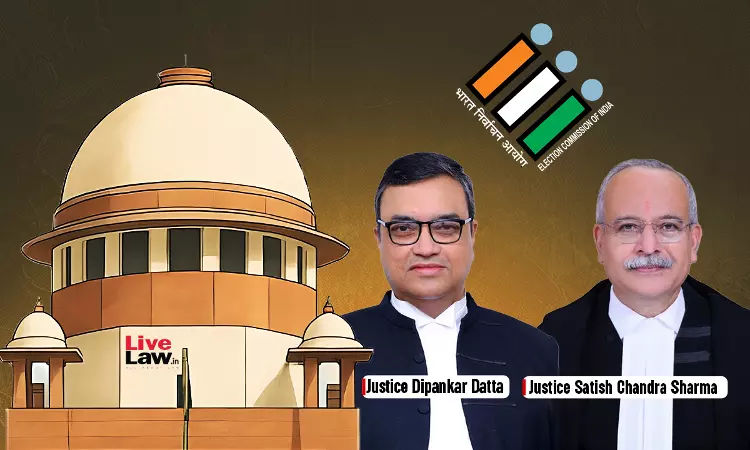
The Supreme Court on Thursday reserved its order on the preliminary issue of whether the batch of petitions challenging the constitutional validity of the Chief Election Commissioner and Other Election Commissioners (Appointment, Conditions of Service and Term of Office) Act, 2023 should be referred to a larger Bench.A Bench of Justice Dipankar Datta and Justice Satish Chandra Sharma...
This is a premium content
Available exclusively to
Our subscribers
Subscribe Premium 
INR 1099+GST
Your support helps us to bring you more content at
an affordable subscription scheme !!!
All payment options available
The Supreme Court on Thursday reserved its order on the preliminary issue of whether the batch of petitions challenging the constitutional validity of the Chief Election Commissioner and Other Election Commissioners (Appointment, Conditions of Service and Term of Office) Act, 2023 should be referred to a larger Bench.
A Bench of Justice Dipankar Datta and Justice Satish Chandra Sharma reserved orders after hearing detailed submissions from the Union government and the petitioners on the question of reference.
The Centre urged the Court to refer the matter to a Constitution Bench, contending that the petitions raise substantial questions relating to the interpretation of Article 324 of the Constitution and the extent of Parliament's legislative power to prescribe the appointment mechanism for Election Commissioners.
Attorney General for India R Venkataramani submitted that the Constitution Bench judgment in Anoop Baranwal v. Union of India, which had directed that the Chief Election Commissioner (CEC) and Election Commissioners (ECs) be appointed by a committee comprising the Prime Minister, the Leader of Opposition and the Chief Justice of India until Parliament enacted a law, itself gave rise to constitutional issues requiring authoritative determination by a larger Bench.
Taking the Court through the Anoop Baranwal judgment, the Attorney General argued that if the petitioners' contention was that the field stood completely occupied by that judgment, Parliament would effectively have no authority to legislate on the issue.
Solicitor General Tushar Mehta also pressed for a reference, arguing that Anoop Baranwal only prescribed an interim arrangement and did not lay down a binding constitutional requirement that the Chief Justice be part of the selection committee.
According to him, the petitions raise several substantial constitutional questions, including whether Parliament's law under Article 324 can be invalidated merely because it does not include an "outsider" such as the Chief Justice in the selection committee, whether Parliament's legislative power is subject to implied constitutional limitations, and whether courts can presume bad faith or abuse of power by constitutional authorities while examining legislation.
He argued that a constitutional court cannot begin with an assumption that the Prime Minister or the executive would act against democratic values.
"The office of Prime Minister has a sanctity attached," Mehta submitted.
"If his decision is not to be trusted... then why not have a provision that even while selecting his Cabinet he must consult some former judge or outsider?" he asked.
He further argued that holding the statutory committee to be inadequate would amount to doubting both Parliament's legislative wisdom and the constitutional trust reposed in elected institutions.
"My question is whether one organ of the State can presume that the Prime Minister and other ministers would act in bad faith, would not act in the interest of democracy, would not act in furtherance of constitutional principles because they have a numerical majority," Mehta submitted.
The Bench, however, repeatedly questioned whether the issue necessarily required a reference before hearing the matter on merits.
Justice Datta observed that if every substantial constitutional question had to be referred immediately, every Article 32 petition would have to be placed before a Constitution Bench.
The Bench also questioned whether precedents such as Pradeep Chandra Parija on references under Article 145(3) deprived a two-judge Bench of the power to directly make a refernece to 5-judge Bench. Justice Datta observed that if a previous judgment conclusively settled the issue, the petitions could simply be dismissed. Conversely, once notice had been issued, it indicated that there was no conclusive authority directly governing the issue.
During the hearing, Justice Datta also drew attention to the importance of public confidence in appointments to the Election Commission.
Responding to the Centre's argument that the Court should trust the Prime Minister, Justice Datta said:
"Why wouldn't we trust the Prime Minister? Of course we would trust the Prime Minister."
He added that the issue was not one of distrust but of institutional fairness.
"Election Commissioner has to be an independent person. Should there not be a show of fairness? We are not saying fairness has not been achieved by this committee. Just like justice is not only to be done, it has to be shown to be done, we are on the second part," the judge observed.
Petitioners oppose reference
The petitioners opposed the request for reference, arguing that the constitutional principles governing appointments to the Election Commission had already been authoritatively settled by the Constitution Bench in Anoop Baranwal.
Advocate Prashant Bhushan submitted that Article 145(3) does not require every constitutional challenge to be referred to a larger Bench merely because a statute is being tested for the first time.
"The issue of whether a case raises a substantial question of law and has to be referred has already been decided in a large number of cases. If the question of law has already been decided by a Constitution Bench, it need not be referred," Bhushan argued.
When Justice Sharma observed that the present statute was being tested for the first time, Bhushan responded that every constitutional challenge involves a new statute but what matters is whether the governing constitutional principle has already been settled.
According to him, Anoop Baranwal had already held that permitting the executive to dominate appointments to the Election Commission violates the constitutional guarantee of free and fair elections.
"The government itself deciding who is to be appointed the Election Commissioner is violative of democracy and free and fair elections. Ipso facto this law, which still allows government dominance through a 2:1 majority, is also violative," he submitted.
Senior Advocate Vijay Hansaria argued that the Union had raised the plea for reference only after the matter had been heard extensively over several dates.
"It was only on the twenty-eighth hearing that this request regarding reference was first raised," he submitted, pointing out that even the Union's written reply had not sought a reference.
Hansaria argued that the impugned law substantially restored the same executive-controlled appointment process that existed before Anoop Baranwal.
"Earlier, the President acted on the advice of the Prime Minister and Council of Ministers. Now it is the Prime Minister, a minister chosen by him and the Leader of Opposition. The scenario before the judgment and after this Act has not changed. Therefore, the ratio of Anoop Baranwal applies squarely," he submitted. He added that there are several precedents of two-judge benches striking down legislations.
Senior Advocate Shadan Farasat argued that while the issue was undoubtedly important, it was not an undecided constitutional question requiring consideration by a larger Bench.
"It is substantial in the sense that it is an important question. But is it substantial in the sense that it is a constitutional question that is undecided? No," he submitted.
Farasat contended that Anoop Baranwal had already held that Article 324 requires non-executive dominance in the selection committee, while leaving it to Parliament to determine the precise legislative model.
Concluding the petitioners' submissions, Bhushan warned that accepting the Centre's argument would make constitutional adjudication unworkable.
"The question has already been settled authoritatively. Otherwise, every Article 32 petition raising a constitutional issue would have to be referred to a Constitution Bench, making the entire system unworkable," he submitted.
The bench observed that it will have to be examined which parts of Anoop Baranwal are binding, as there are general observations in the judgment as well.
"You have to see which portion is binding and which is not. The direction regarding the selection panel till the Parliament makes a law is binding, which cannot be violated. The other observations are in the nature of guiding principles as to why the Chief Justice should be included," Justice Datta said.
Senior Advocates Gopal Sankaranarayanan and Sanjay Parikh also sought to make submissions in opposition of reference. However, the bench indicated that it was winding up the hearing on this preliminary issue, and gave liberty to submit written submissions.
The petitions have been filed by Dr. Jaya Thakur, Association for Democratic Reforms, Lok Prahari and others.
The Court began hearing arguments in the case on 6th May, remarking that this issue is more important than any other. The petitioners have contended that the present law ensures "Prime Minister's man" is appointed as Chief Election Commissioner undermining the independence of the Election Commission.
During the course of arguments, the Court observed that the Anoop Baranwal judgment which provided for a committee of PM, LoP and CJI was only meant to fill a vacuum till the Parliament made a law, and didn't mandate a particular structure in such a law.
In the May hearings, the Court also questioned the inclusion of a Cabinet Minister nominated by the PM in the selection panel under the impugned law, remarking that the third person apart from the PM and LoP should be a neutral person.
Case no. - W.P.(C) No. 14/2024 Diary No. 146 / 2024 and connected cases
Case Title - Dr. Jaya Thakur v. Union of India and connected cases
Tags

Amisha Shrivastava
Amisha Shrivastava is a Senior Correspondent with LiveLaw, covering the Supreme Court of India. She can be reached at amisha@livelaw.in

