



- Home
- /
- Top Stories
- /
- CJI Surya Kant Cites Judgment In...
CJI Surya Kant Cites Judgment In Delhi Tree-Felling Case As Example Of 'Judicial Creativity' Balancing Development & Environment
Amisha Shrivastava
30 Aug 2026 9:49 AM IST
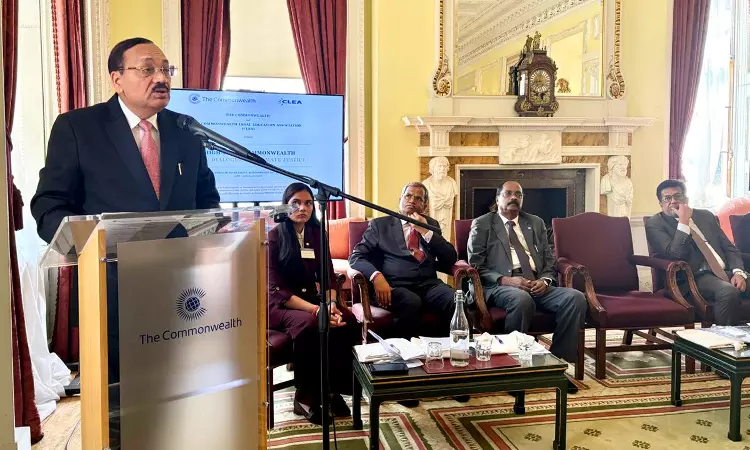
Chief Justice of India Surya Kant recently cited the Supreme Court judgment passed by a bench led by him in the Delhi Ridge illegal tree-felling case as an example of “judicial creativity” to balance environmental protection with developmental needs.Addressing the High-Level Commonwealth Policy Dialogue on Climate Justice at the Commonwealth Secretariat in London on August 28, the...
This is a premium content
Available exclusively to
Our subscribers
Subscribe Premium 
INR 1099+GST
Your support helps us to bring you more content at
an affordable subscription scheme !!!
All payment options available
Chief Justice of India Surya Kant recently cited the Supreme Court judgment passed by a bench led by him in the Delhi Ridge illegal tree-felling case as an example of “judicial creativity” to balance environmental protection with developmental needs.
Addressing the High-Level Commonwealth Policy Dialogue on Climate Justice at the Commonwealth Secretariat in London on August 28, the CJI referred to Bindu Kapurea v. Subhashish Panda & Ors., in which the bench led by him dealt with the illegal felling of protected trees for a road leading to the Central Armed Police Forces Institute of Medical Sciences (CAPFIMS) paramilitary hospital.
The CJI referred to the case while explaining how courts can respond when environmental protection and developmental requirements appear to conflict. “Courts must be willing to search for solutions that protect the environment without losing sight of the legitimate needs of development, and to recognise that the two need not always be cast as choices in which one must defeat the other,” he said.
The CJI said that instead of simply halting the road, the Court ordered extensive compensatory afforestation. He said the Court continued to monitor the afforestation through periodic reports.
“In place of simply halting the road, we ordered extensive compensatory afforestation instead. And I am proud to say that we did not stop there. In fact, we are still monitoring that afforestation today, through periodic reports filed before this Court, because a sapling planted and then forgotten is no remedy at all. It was, I think, a small illustration of a larger ideal that development and preservation do not always have to stand on opposite sides of the scales. Sometimes, the task of a Court is to find the third way to promote both routes through judicial creativity,” he said.
The case arose from the felling of trees in the Delhi Ridge for a road widening project to facilitate access to the Central Armed Police Forces Institute of Medical Sciences (CAPFIMS) paramilitary hospital. The project covered stretches from Main Chhattarpur Road to SAARC Chowk, Gaushala Road and from SAARC Chowk to CAPFIMS Hospital.
The trees were felled in violation of earlier Supreme Court orders requiring permission for such activity, following which the Court initiated contempt proceedings against DDA officials.
An Expert Committee constituted by a bench of Justices Abhay S Oka and Ujjal Bhuyan, which heard the matter in June-July 2024, reported that the trees had been cleared without prior assessments concerning rainwater harvesting, restoration and other issues. The contempt petitioners alleged that the road widening was undertaken to avoid the land acquisition process that would have been required for an alternative route through the Chhattarpur farmhouses.
The bench led by Justice Oka took a tough stance questioning the DDA and its Vice Chairman and observed that materials indicated the role of then Delhi Lieutenant Governor VK Saxena, the ex-officio Chairman of the DDA, in ordering the tree-felling. It also questioned the DDA over “cover-ups” and warned that it could issue a contempt notice to the Lieutenant Governor.
The matter was later referred to the Chief Justice of India after a bench led by Justice BR Gavai noted that it had already issued notice to the DDA in a separate contempt petition concerning the same tree-felling. The matter was subsequently shifted to a bench led by former CJI DY Chandrachud. Later, CJI Sanjiv Khanna recused, following which it came before a bench led by Justice Surya Kant.
The bench led by Justice Kant said it would consider the matter afresh. While acknowledging that illegal tree-felling had taken place, Justice Kant also considered that it was undertaken for a project concerning a hospital for paramilitary personnel.
In its May 2025 judgment, the bench of Justice Surya Kant and Justice N Kotiswar Singh held that the respondents' conduct was contemptuous. It identified two violations – failure to seek the Court's permission and deliberate concealment of the tree-felling. It held that the conscious non-disclosure struck at the heart of the judicial process and fell within the scope of criminal contempt.
At the same time, the Court considered that CAPFIMS catered to paramilitary personnel and their families. “Ensuring access to quality medical care is not a privilege, but necessity,” it said, adding that such personnel remained voiceless and the over-arching public interest weighed in favour of considering the hospital's needs.
The Court closed the contempt proceedings against former DDA Vice Chairman Subhashish Panda, who was no longer associated with the DDA. It imposed an environmental fee of Rs. 25,000 each on the other officials, without prejudice to departmental action, and formally censured them. It called the matter a “classic case of institutional missteps and administrative overreach”.
The Court directed the DDA and Delhi Government to undertake remedial measures. It directed identification of 185 acres for compensatory afforestation and constituted a committee to frame an afforestation plan, to be implemented by the Forest Department under its supervision. The DDA was directed to bear the entire cost. The DDA and Forest Department were also directed to report on the upkeep of the afforested areas and implement further measures prescribed by the Committee to enhance Delhi's green cover.
Subsequently, the Supreme Court permitted diversion of 2.97 hectares of forest land for the road and felling of 152 trees, subject to planting at least five times more saplings as compensatory afforestation. It also permitted translocation of 2,519 saplings under the Expert Committee's supervision and directed the Committee to account for the higher mortality rate in transplantation while deciding the number of additional saplings required to ensure zero eventual mortality. The Court further directed the Committee to ensure that at least about two lakh plants survived as a compensatory measure.
In his address at the Commonwealth Secretariat, the CJI referred to the Delhi Ridge case while discussing the wider role of courts in responding to environmental challenges. He noted that courts were increasingly being asked to draw the line between developmental necessity and ecological survival, often in circumstances where neither legislation nor existing legal categories provided a complete answer.
“Such a role has been placed at our door by citizens who perhaps found their legislatures too slow and their governments too constrained,” he said.
The CJI highlighted that courts had, over time, interpreted the right to life under Article 21 of the Indian Constitution to address such questions. He added that disputes before courts increasingly turned on hydrology and emissions data as much as on law.
“The role of a Judge is therefore changing, it is no longer enough to know what the law says; we must also understand the world to which that law is being applied,” he said.
The CJI referred to MC Mehta v. Kamal Nath, in which it was held that a disturbance of the environment necessary for life is itself hazardous to life under Article 21.
He also referred to MK Ranjitsinh v. Union of India, a case concerning an endangered native bird and overhead power lines in which the Court had recognised the need to combat the adverse effects of climate change, preserve historically and ecologically significant species, and develop cleaner sources of energy for future generations.
He stressed that courts should be willing to borrow ideas, approaches and solutions that had proved useful in other Commonwealth jurisdictions, while adapting them to their own constitutional, social and environmental circumstances.
The CJI also emphasised the need for technical experts to work with courts in environmental cases. Referring to the Central Empowered Committee, he said such experts should remain available throughout the life of a case rather than being called only as witnesses.
He also referred to the National Green Tribunal, where judges and technical experts sit together, and said environmental adjudication could not remain the sole province of judges and lawyers.
Tags

Amisha Shrivastava
Amisha Shrivastava is a Senior Correspondent with LiveLaw, covering the Supreme Court of India. She can be reached at amisha@livelaw.in

