



- Home
- /
- Top Stories
- /
- 'Law Without Equality Is Merely...
'Law Without Equality Is Merely Organized Will Of The Stronger Party' : CJI Surya Kant At Russia Event
Debby Jain
25 Jun 2026 6:52 PM IST
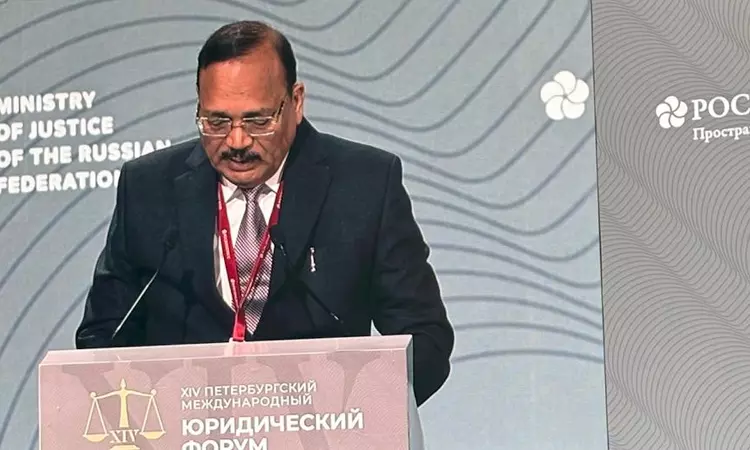
During an event in Russia, Chief Justice of India Surya Kant yesterday remarked that law, without equality, is essentially organized will of the stronger party.The CJI was speaking at the 14th St. Petersburg International Legal Forum. The topic for the plenary session of the same was "Equal Justice, Equal Law: Access as the Measure of International Law's Humanity".At the outset of his...
This is a premium content
Available exclusively to
Our subscribers
Subscribe Premium 
INR 1099+GST
Your support helps us to bring you more content at
an affordable subscription scheme !!!
All payment options available
During an event in Russia, Chief Justice of India Surya Kant yesterday remarked that law, without equality, is essentially organized will of the stronger party.
The CJI was speaking at the 14th St. Petersburg International Legal Forum. The topic for the plenary session of the same was "Equal Justice, Equal Law: Access as the Measure of International Law's Humanity".
At the outset of his address, CJI Kant referred to Falconet's Bronze Horseman, which stands at the centre of St. Petersburg, to draw a parallel between the structure's strong foundation (Thunder Stone) and the foundation of international legal order (Equality).
On the origins of 'Equality', CJI Kant opined that the birthplace of 'Equality' was not the Magna Carta (1215), but rather Kautilya's Arthashastra (4th century) which propounded that "a King who does not hold himself subject to dharma, to law, ceases to be a King, whether morally or actually".
He observed that other territories as well arrived at the foundational concept of Equality in their own manner and underlined that it was not a privilege afforded by the powerful to the deserving. Rather, the CJI said, equality was always the grammar of legality, without which, law would merely be the organized will of the stronger party.
Subsequently, the CJI lamented the present day's need for discussion on the status of international law. "And yet here we are, gathered at a Forum of the world's finest legal minds, still asking whether international law is a privilege of the few or a law among equals. The fact that the question must still be posed is, in my opinion, an indictment in itself."
The test to answer the above question, in the opinion of the CJI, was whether every Sovereign State, and every human being within it, is empowered to access law and obtain the desired remedy?
Reflecting on the Indian experience, he opined that the first step in this regard must be to ensure equal access to law. The CJI explicated that hurdles to equality are manifested in terms of geographical, social and economic disparities, which the Indian Courts have attempted to tackle by providing legal aid, entertaining letters and PILs and "treating procedure as servant of justice, not its master".
"the Indian Constitutional Courts have interpreted and provided a broad and expansive interpretation of constitutional guarantees in order to eliminate all such barriers. This approach ensures that access to law and justice is not just a technical convenience but a non-discriminatory founding principle of governance."
In the global context, the CJI commented that good intentions do not ipso facto ensure equitable outcomes in practice. He referred to key international conventions, like the Convention on Rights of the Child, Convention on Elimination of All Forms of Discrimination Against Women, the International Covenant on Economic, Social and Cultural Rights, etc. to convey that despite the moral ambitions behind them, the international instruments have not been honored and monitored equitably.
The CJI further observed that countries in the Global East and South, some of which are still addressing the repercussions of colonialism, are put to scrutiny and pressure which is not proportionally applied to wealthier nations.
"Indeed, numerous nations within the Global East and South are still in the process of constructing their institutions, addressing the repercussions of colonialism, and tackling poverty on a scale that the original drafters of these international covenants could not have envisioned. These countries frequently endure scrutiny and pressure that are not proportionally applied to wealthier and more influential States, whose own compliance records are not necessarily irreproachable."
Again drawing a parallel between the Thunder Stone supporting the Bronze Horseman and equality (supporting international law), CJI Kant closed his address laying emphasis on the value of equal justice and equal law. They are the conditions under which the legal order may credibly call itself law at all, he said. The CJI lastly added that it is the work of every jurist, and every institution they serve, to ensure that the foundation holds.
Tags

Debby Jain
Debby Jain is a Correspondent with LiveLaw, covering the Supreme Court of India

