



- Home
- /
- Top Stories
- /
- 3-Year Practice Rule | Now Source...
3-Year Practice Rule | Now Source Is Coaching Centres, That's The Entire Problem : Justice Chandran On Judicial Recruitments
Amisha Shrivastava
13 March 2026 5:27 PM IST
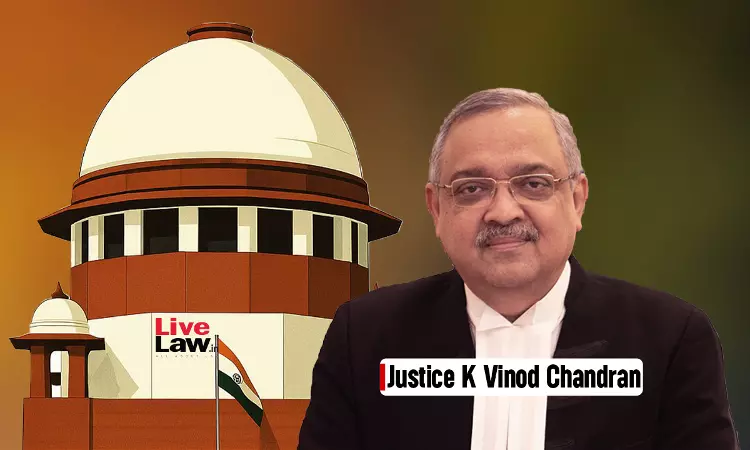
While hearing petitions seeking review of the 3-year practice condition, Justice Vinod Chandran of the Supreme Court remarked that the problem with the judicial recruitment is that "coaching centres have become the source now."Justice Chandran was responding to Senior Advocate Pinky Anand, who argued that the practice requirement could act as a roadblock for aspirants and delay their entry...
This is a premium content
Available exclusively to
Our subscribers
Subscribe Premium 
INR 1099+GST
Your support helps us to bring you more content at
an affordable subscription scheme !!!
All payment options available
While hearing petitions seeking review of the 3-year practice condition, Justice Vinod Chandran of the Supreme Court remarked that the problem with the judicial recruitment is that "coaching centres have become the source now."
Justice Chandran was responding to Senior Advocate Pinky Anand, who argued that the practice requirement could act as a roadblock for aspirants and delay their entry into judicial service, as a couple of additional years are required to prepare for the exams.
“There is a whole difficulty. When I sat in the Constitution Bench also I said. Now the source is the coaching centers. I don't mind saying that in the open court. That is the entire problem. I have been a Chief Justice, I have been a senior judge in the court. I have gone through interviews. We have seen the district judges. It is not, don't say that without any empirical formula. From our experience, we are telling you”, Justice Chandran remarked.
A bench of Chief Justice Surya Kant, Justice Augustine George Masih and Justice K Vinod Chandran was hearing the petitions seeking review of the May 2025 judgment which restored the practice condition to join judicial service.
During the hearing, Senior Advocate Pinky Anand said the condition may not be consistent with the skills required of adjudicators and pointed out that candidates already spend significant time preparing for competitive examinations. According to her, by the time an aspirant completes legal education, undergoes three years of practice and prepares for recruitment tests, the average entry age into the judiciary could reach around 29 years.
She submitted that the objective should be to improve the justice delivery system and encourage talented candidates to join the judiciary rather than divert them to other professional avenues.
She suggested that curated academic and institutional measures could be considered as alternatives, including specialised adjudication-focused programmes in law universities and mandatory practical internships during legal education that could count towards experience requirements.
Chief Justice of India Surya Kant observed that during visits to several top national law schools he had found that many bright students were choosing corporate careers because of the three-year practice condition. He said the rule could have been introduced in a phased manner - beginning with a one-year requirement and gradually increasing to three years - instead of being applied uniformly at once.
“It should have been imposed in a phased manner, the first year it should have been one year, next then 2 years, then 3 years. That is the way court created law is made applicable in the past practices also. We have unfortunately thrusted upon directly. Because of that, there is a lot of hue and cry in all the top law schools. Students are not going to wait for 3 years to waste their time. They are the children who have competed through written exam. A competitive test, a test which is now more rigorous than the NEET or than the Medical and they have got admission as per their merit. Parents have spent a lot of money how they are not in a position to wait. That is the crisis we are facing. How to balance both plus women also”, he said.
At the same time, the Chief Justice emphasised the need for a degree of maturity among candidates entering judicial service, referring to his experience in judicial selection processes at different levels of the judiciary.
Background
The review petitions arise from the Supreme Court's May 20, 2025 judgment which restored the requirement that candidates must have a minimum of three years' practice as advocates to be eligible for recruitment to entry-level judicial service posts such as Civil Judge (Junior Division).
Subsequently, review petitions were filed challenging the ruling. On the ground that the requirement disproportionately affects aspirants from economically weaker and socially disadvantaged backgrounds, including SC, ST and OBC candidates, and excludes law graduates working in non-litigation roles such as law firms, public sector undertakings and corporate legal departments despite their relevant legal experience.
On of the pleas has specifically sought exemption for persons with disabilities from the three-year practice requirement, citing structural barriers in accessing litigation work.
While hearing the matter earlier, the Court directed all High Courts and law universities to submit suggestions on the issue of exempting persons with disabilities from the rule before the Court takes a holistic view.
Pursuant to this direction, responses from several High Courts and legal institutions have now been placed before the Court through a compilation filed by the amicus curiae.
During the hearing of the review petitions last month, the Chief Justice had orally commented that the 3-year rule was disproportionately affecting women candidates.
Also from today's hearing - '3-Year Practice Condition Should Remain, Only Issue Is Modalities': Supreme Court In Review Hearing; Extends Civil Judge Application Dates
Case no. – W.P.(C) No. 001110 / 2025 and connected cases
Case Title – Bhumika Trust v. Union of India and connected cases
Tags

Amisha Shrivastava
Amisha Shrivastava is a Senior Correspondent with LiveLaw, covering the Supreme Court of India. She can be reached at amisha@livelaw.in

