



- Home
- /
- Top Stories
- /
- Constructive Res Judicata Bars...
Constructive Res Judicata Bars Grounds Omitted Due To Negligence : Supreme Court Summarises Principles
Amisha Shrivastava
15 Jun 2026 11:18 AM IST
Constructive Res Judicata Applies Even To Grounds Omitted Due To Negligence, Inadvertence: Supreme CourtThe Supreme Court has summarised the governing principles of the doctrine of constructive res judicata, reiterating that parties are required to raise all grounds that "might and ought" to have been raised in earlier proceedings and cannot avoid the doctrine by attributing omissions...
This is a premium content
Available exclusively to
Our subscribers
Subscribe Premium 
INR 1099+GST
Your support helps us to bring you more content at
an affordable subscription scheme !!!
All payment options available
Constructive Res Judicata Applies Even To Grounds Omitted Due To Negligence, Inadvertence: Supreme Court
The Supreme Court has summarised the governing principles of the doctrine of constructive res judicata, reiterating that parties are required to raise all grounds that "might and ought" to have been raised in earlier proceedings and cannot avoid the doctrine by attributing omissions to negligence, inadvertence or accident.
Explaining the rationale behind the doctrine, the Court observed that constructive res judicata is intended to prevent multiplicity of proceedings by mandating that all grounds available to a litigant should be urged at the appropriate stage itself.
The Court noted that the principle is a deeming fiction in law, but its application is not uniform and depends upon the facts and circumstances of each case. Its applicability must be determined with due regard to the ambit of the earlier proceedings and the nexus between the omitted issue and the controversy involved in those proceedings.
The Bench emphasised that the doctrine is founded on public policy and is aimed at ensuring that a person is not vexed twice over for the same kind of litigation. For this reason, the principle applies not only to civil proceedings but also to writ proceedings under Articles 226 and 32 of the Constitution.
Clarifying the scope of the expression "ought" in the phrase "might and ought", the Court observed that the threshold is higher than mere possibility. Whether a ground ought to have been raised has to be assessed from the perspective of reasonable diligence and the legitimate scope of the litigation.
"The parties while conducting litigation are expected to apply reasonable diligence," the Court said, adding that courts must examine whether all issues properly arising from the dispute and which ought to have been raised were in fact raised.
Importantly, the Court held that the doctrine applies with equal force even when a ground was omitted due to negligence, inadvertence or accident. In such situations, the litigant bears the consequences of the omission.
"The party therefore commits these errors at their own peril," the Court observed, underscoring that the requirements of "might" and "ought" operate cumulatively and without exception.
Summarising the position, the Court held that constructive res judicata bars not only issues that were actually raised and decided earlier, but also those which could and should have been raised in the earlier proceedings.
The Court summarised the principles as follows :
1 Constructive res judicata mandates that all grounds that might and ought to have been employed in the proceedings, should be employed to avoid multiplicity of proceedings.
2 It is a deeming fiction of law, but its application is not uniform and instead is dependent on the facts and circumstances of a particular case with 'due regard to ambit of the earlier proceedings' and 'the nexus which the matter bears to the nature of the controversy' .
3 This principle is founded on public policy. It is a generally acceptable rule that one person should not be “vexed twice over” for the same kind of litigation. As such, it also applies to the proceedings under Article 226/32 of the Constitution of India.
4 In respect of 'ought' referred above, the said word implies the threshold to be above mere possibility.
5 The parties while conducting litigation are expected to apply 'reasonable diligence', 'legitimate purview'. It is from this lens that it shall be adjudicated whether all issues that were properly arising to the litigation; which ought to have been raised; were raised or not?
6 The principle applies with equal force in cases where the ground that might and ought to have been raised was not done, on account of negligence, inadvertence or accident. In other words, might and ought to apply cumulatively with full force, without exception. The party therefore commits these errors at their own peril.
The Court set aside a Chhattisgarh High Court judgment which had dismissed a suit for declaration of title on the ground of constructive res judicata. The Court noted that there was no occasion in earlier proceedings arising out of specific transactions for the plaintiff-appellant to seek declaration of title.
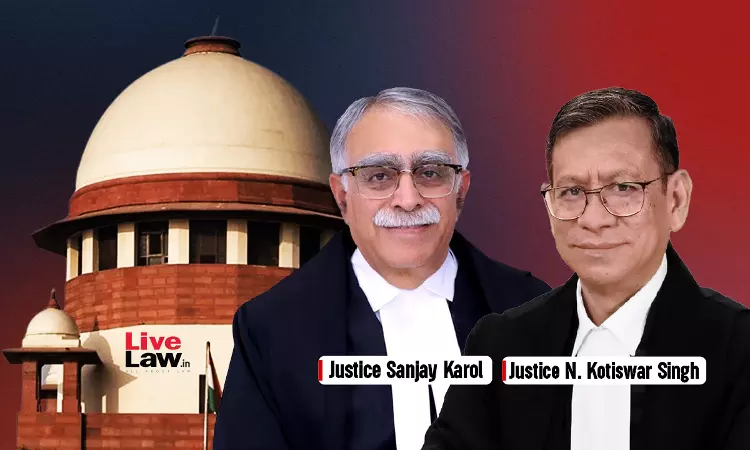
A bench of Justice Sanjay Karol and Justice N. Kotiswar Singh delivered the judgment in a property dispute originating from transactions dating back to the 1960s.
The dispute concerned land originally belonging to one Mahabir Rai. In July 1960, he transferred 95.80 acres of land to his mother Raj Mohani alias Roopjhari and his son Makardhwaj Ram.
Later, in April 1962, Mahabir Rai, his wife Gulmati and his mother executed a General Power of Attorney in favour of Mahabir's cousin Rambhajan. Using that authority, Rambhajan sold 21.43 acres of land to one Prem Prakash in January, 1969 and 33.76 acres to one Chandra Sao in February 1969. The power of attorney was subsequently cancelled in June 1969.
Two suits challenging the two sale deeds were dismissed. Later, when Rambhajan sought mutation of his name in the revenue records, Mahabir's son Makardhwaj Ram instituted a fresh suit seeking declaration of title and possession.
The trial court partly decreed the suit in May 1993 and held that Makardhwaj Ram was entitled to 43.69 acres out of the claimed 95.80 acres. Rambhajan's son Jagdish filed an appeal. The High Court, in a second appeal, set aside the judgment and dismissed the suit as being barred by constructive res judicata.
Before the Supreme Court, appellant Makardhwaj Ram argued that the earlier suits had challenged specific sale deeds and sought recovery of lands covered by those transactions, whereas the present suit concerned declaration of title and possession over the remaining land. Therefore, the subject matter of the litigation was different.
The respondents contended that Makardhwaj Ram could have asserted ownership based on the 1960 transfer deed in the earlier proceedings and, having failed to do so, was barred from raising that ground later.
The Court Supreme Court referred to several precedents examining Section 11 of the Code of Civil Procedure and Explanation IV dealing with constructive res judicata.
The Court summarised the governing principles, observing that constructive res judicata requires parties to raise all grounds that “might and ought” to have been raised in earlier proceedings. At the same time, its application depends on the facts of each case and the connection between the omitted ground and the earlier controversy.
The Court reiterated principles governing constructive res judicata. It observed that the doctrine is founded on public policy, aims to prevent repeated litigation, applies even to writ proceedings, and requires courts to examine whether a litigant exercising reasonable diligence ought to have raised a particular issue in earlier proceedings. It also noted that negligence, inadvertence or accident would not ordinarily prevent the doctrine from operating where the requirements are otherwise satisfied.
Applying those principles, the Court disagreed with the High Court's reasoning.
“The High Court proceeds on the premise that in both the earlier suits the appellant-plaintiff could have claimed the right over subject land to be flowing from the 1960 deed executed in his favour by Mahabir Rai. Since he did not do that and instead chose to pursue an inferior claim of cancellation of sale deed, the stronger one stood given up by application of constructive res judicata. On first blush, this reasoning appears attractive but, in our view, cannot be countenanced for it perhaps misses the mark”, the Court observed.
It held that Makardhwaj Ram's ownership over a substantial portion of the land flowed from the 1960 deed and was not in dispute. The earlier suits were directed against specific alienations made by Rambhajan under the power of attorney. Therefore, there was no occasion in those proceedings to seek a declaration regarding the larger parcel of land that already stood in Makardhwaj Ram's favour, the Court said.
The Court observed, “The appellant-plaintiff by virtue of 1960 deed was the owner of a large portion of land. According to him Rambhajan, had wrongly sold off parts thereof in two independent transactions therefore, acting through his parents, he challenged both those transactions. Where and how does the question of asserting his right over the larger parcel of land emerge when the same already rests undisputedly in his favour by virtue of the 1960 deed?”
The Court noted that the need to assert title over the larger property arose only when Rambhajan sought mutation of his name in the revenue records in respect of land beyond what was covered by the sale transactions.
The Court further held that accepting the High Court's approach would effectively deprive the appellant of the entire property transferred to him by Mahabir Rai.
The Court added that applying constructive res judicata in the facts of the case would lead to an unduly harsh and unjust consequence and would be offensive to both law and equity. It therefore set aside the High Court's judgment and allowed the appeal.
The Court also observed that courts dealing with family property disputes should not rigidly apply legal principles without considering the surrounding facts and circumstances, while deciding an appeal in a property dispute that is over five decades old.
“The application of law, especially when it comes to inter family disputes is not akin to enforcing the black letter of the law but calls upon the Judge to understand the surrounding facts and circumstances and in the light thereof come to a conclusion in accordance with law”, the Court observed.
Case no. – Civil Appeal No. 2950 of 2011
Case Title – Makardhwaj Ram v. Jagdish Rai (Dead) Th. Lrs. & Anr.
Citation : 2026 LiveLaw (SC) 626
Click Here To Read/Download Order
Tags

Amisha Shrivastava
Amisha Shrivastava is a Senior Correspondent with LiveLaw, covering the Supreme Court of India. She can be reached at amisha@livelaw.in

