



- Home
- /
- Top Stories
- /
- Conversion To Religion Other Than...
Conversion To Religion Other Than Hinduism, Buddhism Or Sikhism Results In Loss Of Scheduled Caste Status : Supreme Court
Gursimran Kaur Bakshi
24 March 2026 11:11 AM IST
A converted Christian cannot claim SC status and cannot invoke the SC/ST Prevention of Atrocities Act.
The Supreme Court today(March 24) upheld the Andhra Pradesh High Court's order, which held that once an individual converts to Christianity and actively professes and practices the same, he cannot be regarded as a member of the Scheduled Caste community.The Court held that no person who professes a religion other than Hinduism, Sikhism or Buddhism can be regarded as a member of a Scheduled...
This is a premium content
Available exclusively to
Our subscribers
Subscribe Premium 
INR 1099+GST
Your support helps us to bring you more content at
an affordable subscription scheme !!!
All payment options available
The Supreme Court today(March 24) upheld the Andhra Pradesh High Court's order, which held that once an individual converts to Christianity and actively professes and practices the same, he cannot be regarded as a member of the Scheduled Caste community.
The Court held that no person who professes a religion other than Hinduism, Sikhism or Buddhism can be regarded as a member of a Scheduled caste. Conversion to any other religion results in the immediate and complete loss of Scheduled Caste Status, the Court added.
The Court noted that the Constitution (Scheduled Caste) Order, 1950, made this clear, and the bar under this Order was absolute. Conversion to any religion not specified in Clause 3 of the 1950 order results in immediate loss of Schedule caste status, regardless of birth, the Court clarified.
"No statutory benefit, protection or reservation or entitlement under the Constitution or enactment of Parliament or state legislature can be claimed by or extended to any person who, by operation of clause 3, is not deemed to be a member of the Scheduled Caste. This bar is absolute and admits no exception. A person can't simultaneously profess and practice a religion other than the one specified in clause 3 and claim membership of the Scheduled caste," the Court held.
This order was passed in the context of a person, who had converted to Christianity and acted as a Pastor, but had filed a case under the Scheduled Caste, Scheduled Tribe (Prevention of Atrocities) Act against certain persons who had allegedly subjected him to assault. He claimed protection under the SC&ST Act, which was challenged by the accused persons as bad in law since the pastor had converted and was actively professing Christianity.
By an order dated April 30, 2025, the Andhra Pradesh High Court held that the caste system is alien to Christianity and is consequently barred from invoking the provisions of the Scheduled Caste, Scheduled Tribe (Prevention of Atrocities) Act. Justice Harinath N of the High Court had quashed charges filed by a complainant who had converted to Christianity and had invoked the SC & ST Act. Against this, the pastor filed a special leave petition.
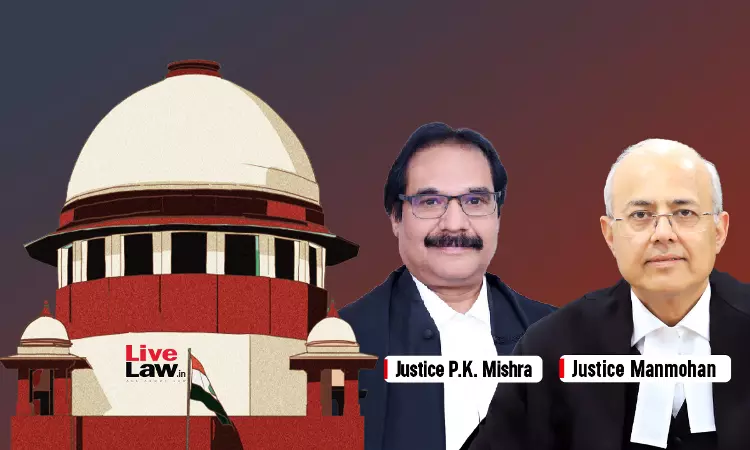
At the Supreme Court, the bench comprising Justice Prashant Kumar Mishra and Justice Manmohan held: "In the present case, it is not the case of the petitioner that he re-converted from Christianity to his original religion or has been accepted back in the folds of the Madiga community. On the contrary, the evidence establishes that the appellant continued to profess Christianity and has been functioning as a pastor for more than a decade, conducting regular Sunday prayers at the houses of the village. It is also admitted that at the time of the alleged incident, he was conducting prayer meetings at the house. These concurrent facts leave no room for doubt that he continued to remain a Christian on the date of the occurrence."
What does Constitution 1950 order say?
The Constitution (Scheduled Castes) Order 1950, issued by the President as per Article 341, says as follows :
“1. This Order may be called the Constitution (Scheduled Castes) Order, 1950.
2. Subject to the provisions of this Order, the castes, races or tribes or parts of, or groups within, castes or tribes specified in Parts to [XXV] of the Schedule to this Order shall, in relation to the States to which those Parts respectively relate, be deemed to be Scheduled Castes so far as regards member thereof resident in the localities specified in relation to them in those Parts of that Schedule.
3. Notwithstanding anything contained in paragraph 2, no person who professes a religion different from the Hindu, the Sikh or the Buddhist] religion shall be deemed to be a member of a Scheduled Caste.
4..."
The judgment authored by Justice Mishra summarised the principles relating to th 1950 order as follows :
a) The claimant must demonstrably belong to a caste or tribe which is specifically notified and recognised under Clause 2 of the Constitution (Scheduled Castes) Order, 1950 and Constitution (Scheduled Tribes) Order, 1950, and such status must be established by clear, cogent, and unimpeachable evidence.
b) No person who professes a religion other than Hindu, Sikh or Buddhist shall be deemed to be a member of a Scheduled Caste. This bar under Clause 3 of the Constitution (Scheduled Castes) Order, 1950 is categorical and absolute. Conversion to any religion not specified in Clause 3 results in immediate and complete loss of Scheduled Caste status from the moment of conversion regardless of birth.
c) No statutory benefit, protection, reservation, or entitlement under the Constitution or under any enactment of Parliament or State Legislature that is predicated upon the membership of a Scheduled Caste can be claimed by or extended to any person who, by operation of Clause 3 of the Constitution (Scheduled Castes) Order, 1950, is not deemed to be a member of a Scheduled Caste. This bar is absolute and admits no exception.
d) A person cannot simultaneously profess and practice a religion other than the ones specified in Clause 3 of Constitution (Scheduled Castes) Order, 1950 and claim membership of a Scheduled Caste at the same time. A person who professes and practices such religion for personal, social and spiritual purposes cannot in law, assert membership of a Scheduled Caste for the purpose of securing statutory benefits. The two positions are mutually exclusive and contrary to the Constitutional scheme.
e) In cases where a person claims to have reconverted from a religion not specified in Clause 3 of the Constitution (Scheduled Castes) Order, 1950 back to Hindu, Sikh or Buddhist religion, the following three conditions must be cumulatively and conclusively established:
i. There must be a clear proof that the person originally belonged to a caste notified under the Constitution (Scheduled Castes) Order, 1950.
ii. There must be credible and unimpeachable evidence of bona fide reconversion to the original religion, accompanied by complete and unequivocal renunciation of the religion to which conversion had taken place, total dissociation therefrom, and actual adoption and observance of the customs, usages, practices, rituals, and religious obligations of the original caste.
iii. There must be satisfactory and credible evidence establishing acceptance and assimilation by the members of the original caste and the concerned community. Mere self-proclamation is insufficient i.e., the community must recognize and accept the person as one of their own. All the above three conditions are mandatory and cumulative. The burden of proving reconversion lies entirely on the claimant, to be proven through unimpeachable evidence. Failure to establish even one condition renders the claim unsustainable.
f) Where a person ceases to be a member of a Scheduled Caste by virtue of Clause 3 of the Constitution (Scheduled Castes) Order, 1950, the loss of such status carries with it the automatic and immediate termination of all eligibility for statutory benefits, protections, reservations, preferences and entitlements that are predicated upon or flow from such membership.
g) With respect to Scheduled Tribes, this Court clarifies that unlike the Constitution (Scheduled Castes) Order, 1950, the Constitution (Scheduled Tribes) Order, 1950 does not prescribe religion-based exclusion. The determination of Scheduled Tribe status, therefore, cannot rest on conversion alone, but must turn on whether the claimant continues to possess and is recognised for the essential attributes of tribal identity, including customary practices, social organisation, community life, and acceptance by the concerned tribal community. Where conversion or subsequent conduct results in a complete severance from the tribal way of life and loss of community recognition, the foundational basis for Scheduled Tribes status will stand eroded. Conversely, where such attributes demonstrably subsist or are genuinely re-established and accepted by the tribal community, the claim cannot be rejected mechanically. The assessment in such cases is necessarily fact-specific and is left to the competent authority to decide in accordance with Constitutional principles.
Background
The ruling stemmed from a Criminal Petition where the petitioner was accused of offences punishable under Sections 3(1)(r), 3(1)(s), 3(2)(va) of the SC&ST Act and Sections 341, 506, 323 read with 34 of the Indian Penal Code.
It was stated in the initial complaint filed by Respondent 2 (complainant), who was a Pastor conducting Sunday Prayers in Pittalavanipalem Village, that he was subjected to multiple assaults from the petitioner and had received repeated life threats for himself and his family and was also abused in the name of caste. In lieu of this, he had registered a case against the petitioner. The investigation was complete and the charge sheet was also filed. Aggrieved by this, the petitioner approached the High Court for quashing of charges against him.
It was the case of the petitioner that the registration of the FIR under the SC&ST Act was bad in law as the complainant had converted to Christianity and was working as a Pastor and thus, he could not claim to be a member of the Scheduled Caste community. The petitioner reasoned that the Constitution (Scheduled Castes) Order, 1950, categorically made it clear that no person who professes a religion different from Hinduism shall be deemed to be a member of a Scheduled Caste.
On the contrary, the respondents argued that the investigation was complete and the chargesheet was filed alongwith the witness statements of as many as 10 witnesses. With respect to the application of the SC&ST Act, it was argued that Respondent 2 cannot be denied protection under the SC&ST Act as the Tahsildar of Pittalavanipalem Mandal (witness 12) had confirmed that the respondent 2 was a member of the SC community belonging to Hindu-Madiga by Caste. It was also submitted that the respondent possessed a caste certificate which was issued by Tahsildar of Pittalavanipalem Mandal (witness 12).
With respect to the argument that Respondent 2 continues to hold a Scheduled Caste Certificate, the Court held that the same was a matter to be dealt under Section 5 of the Andhra Pradesh (Scheduled Castes, Scheduled Tribes and Backward Classes) Regulation of Issue of Community Certificates Act, 1993, by the appropriate authority under the Act. However, the Court added that mere non-cancellation of caste certificate does not entitle Respondent 2 to be protected by the SC & ST Act after conversion.
Headnote
Scheduled Castes and Scheduled Tribes (Prevention of Atrocities) Act, 1989 — Section 3 — Constitution (Scheduled Castes) Order, 1950 — Clause 3 — Effect of conversion to Christianity on Scheduled Caste status —The Supreme Court upheld the High Court's decision to quash criminal proceedings under the SC/ST Act initiated by a person who had converted to Christianity and was practicing as a Pastor - Held, that as per Clause 3 of the Constitution (Scheduled Castes) Order, 1950, no person who professes a religion different from the Hindu, Sikh, or Buddhist religion shall be deemed to be a member of a Scheduled Caste - Since the appellant indubitably professed Christianity by performing pastoral duties for over a decade, his caste status as a member of the Madiga community stood "eclipsed in the eyes of law" upon conversion - once the foundational requirement of caste status is extinguished, the statutory protection under the SC/ST Act is no longer available.
Scheduled Castes and Scheduled Tribes (Prevention of Atrocities) Act, 1989 — Statutory vs. Non-Statutory Benefits — Reliance on State Government Orders (G.O.Ms. No. 341) extending benefits to converts is misplaced regarding central statutory enactments - Held, that such executive orders only apply to "non statutory concessions" like economic support schemes and cannot override the Presidential Order or apply to statutory benefits/protections under Central Acts like the SC/ST Act.
Indian Penal Code, 1860 — Sections 323, 341, 506, and 34 — Quashing of Proceedings — Code of Criminal Procedure, 1973 — Section 482 — Where allegations of assault and criminal intimidation rest solely on the statement of the complainant without independent corroboration and are contradicted by other witness statements, the basic foundation for the offences is missing - Held, that continuing such proceedings would amount to an abuse of the process of law. [Relied on Punjabrao vs. D.P. Meshram 1964 SCC OnLine 76; State of Haryana vs. Bhajan Lal 1992 Supp 1 SCC 335; K.P. Manu vs. Scrutiny Committee forVerification of Community Certificate 2015 4 SCC 1; Paras 40-60]
Case Details: CHINTHADA ANAND v STATE OF ANDHRA PRADESH AND ORS.|SLP(Crl) No. 9231/2025
Citation : 2026 LiveLaw (SC) 288
Click here to read the judgment
Appearances:
For the Appellant(s), Mr. Shashibhushan P. Adgaonkar, Advocate-on-Record, appeared.
For the Respondent(s), Mr. D.V.S.S. Somayajulu and Mr. Nachiketa Joshi, Senior Advocates, appeared along with Mr. Santosh Kumar, Mr. Tadimalla Bhaskar Gawtham, Mr. Alabhya Dhamija, Ms. Aditi, Ms. Gautam Singh, Mr. Aditi Tripathi, Mr. Sai Shashank, Mr. Vikash Shukla, Mr. Pankaj Singhal, Mr. Chanakya and Mr. Mohiteshwari Prasad, Advocates, with Mr. Aditya Sharma, Advocate-on-Record.
Tags

Gursimran Kaur Bakshi
Gursimran is the Principal Correspondent with LiveLaw for the Supreme Court. She can be reached out at: simrankaurbakshi@livelaw.in

