



- Home
- /
- Top Stories
- /
- 'Cost Of Demolition Catastrophic' :...
'Cost Of Demolition Catastrophic' : Supreme Court Rules Against Demolition Of Navi Mumbai Mall, Allows Regularisation On Cost Payment
LIVELAW NEWS NETWORK
1 Jun 2026 10:45 AM IST
"A Court must weigh not only the wrong that has been committed but also the reality as it now stands."
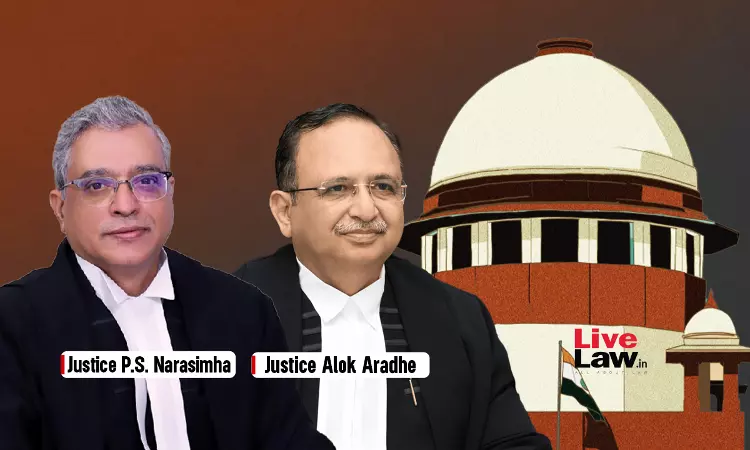
The Supreme Court has held that demolition of a shopping mall and hotel built on a plot allotted through an irregular process would be against public interest where the illegality can be remedied through a stringent financial recovery mechanism.A Bench of Justice PSi Narasimha and Justice Alok Aradhe set aside a Bombay High Court direction requiring restoration of the land to its...
This is a premium content
Available exclusively to
Our subscribers
Subscribe Premium 
INR 1099+GST
Your support helps us to bring you more content at
an affordable subscription scheme !!!
All payment options available
The Supreme Court has held that demolition of a shopping mall and hotel built on a plot allotted through an irregular process would be against public interest where the illegality can be remedied through a stringent financial recovery mechanism.
A Bench of Justice PSi Narasimha and Justice Alok Aradhe set aside a Bombay High Court direction requiring restoration of the land to its original condition, observing that demolition of a fully operational commercial complex after 17 years would cause catastrophic and irreparable social and economic harm.
"Demolition of a fully operational commercial complex after seventeen years, Rs. 450 crores of investment, 8,000 livelihoods, and Rs. 100 crores of annual tax revenue would not vindicate the public interest. The financial prejudice caused to CIDCO by the irregularity of the original allotment is entirely capable of being remedied through a rigorous financial recovery mechanism.
The social and economic harm caused by demolition, by contrast, would be catastrophic and irreparable. Public law must be sensitive to the distinction between remedies that restore public welfare and remedies that merely punish, when punishment comes at the cost of the very public the law seeks to protect," the Court observed.
The case arose from the allotment by the City and Industrial Development Corporation (CIDCO) of a plot in Sector 30A, Vashi, Navi Mumbai, to K. Raheja Corp in 2003. The plot, originally earmarked for Information Technology use, was allotted at ₹10,250 per sq. metre. Subsequent inquiries found that the allotment should have been made through a competitive process and had caused a substantial financial loss to CIDCO.
In 2014, the Bombay High Court held the allotment to be illegal and arbitrary and directed the developer to restore the plot to its original condition and hand over vacant possession to CIDCO. The High Court, however, left open the possibility of regularisation.
Before the Supreme Court, the developer pointed out that it had invested about ₹450 crore in constructing a shopping mall and hotel spread over about 10.5 lakh square feet. The complex has been operational since 2009, houses around 150 retailers and supports the livelihoods of nearly 8,000 persons.
Holding that the doctrine of proportionality must guide the choice of remedy, the Court said that adjudication cannot take place in a vacuum divorced from subsequent realities.
"A Court must weigh not only the wrong that has been committed but also the reality as it now stands.The doctrine of proportionality, deeply embedded in constitutional jurisprudence, demands that the severity of a remedial measure must bear a rational and proportionate relationship to the nature and magnitude of the wrong sought to be remedied. A remedy that causes public harm disproportionate to the public benefit it achieves is not a remedy that law ought to countenance," the judgment authored by Justice Aradhe said.
The Court noted that third-party rights of retailers, hotel operators, employees and consumers had crystallised over 17 years of commercial operation. It accepted the recommendation of the Banthia Committee that the illegality should be addressed through a heavily penalised regularisation rather than demolition.
Rejecting CIDCO's proposal to regularise the allotment on payment of about ₹262.87 crore based on the Sankaran Committee's methodology, the Court held that the appropriate basis for regularisation was the fair market value of the land as on the date of the High Court's judgment in 2014.
The Bench observed that once an allotment has been judicially declared illegal, regularisation amounts to a fresh grant of legal legitimacy and the beneficiary must pay the full cost of such legitimacy. It therefore directed K. Raheja Corp to pay the 2014 ready reckoner value of the plot at ₹54,400 per sq. metre together with interest at 8% from December 2014 till April 2026.
The Court computed the total amount payable at ₹318.31 crore, subject to adjustment of the amount already paid towards the original allotment. It also directed payment of an additional ₹1 crore towards an unfulfilled obligation to develop a garden on an adjoining plot. Upon payment within four months, the allotment will stand regularised.
Accordingly, the Court modified the High Court's judgment and quashed the direction requiring restoration of the plot and delivery of vacant possession to CIDCO.
Headnote
Constitution of India, 1950 — Article 14 — Public Interest Litigation — Regularisation vs. Demolition — Doctrine of Proportionality and Irreversibility — Irregular allotment of land by City and Industrial Development Corporation Limited (CIDCO) to a private developer without a competitive tender process - The High Court declared the allotment illegal and ordered restoration/demolition but granted liberty to apply for regularisation – Held that demolition of a fully operational commercial complex (shopping mall and hotel) after 17 years, an investment of ₹450 crores, 8,000 livelihoods, and ₹100 crores of annual tax revenue would not vindicate public interest - The severity of a remedial measure must bear a rational and proportionate relationship to the nature and magnitude of the wrong - Financial prejudice to the public authority can be remedied through a rigorous financial recovery mechanism, whereas demolition causes catastrophic and irreparable socio-economic harm - Public law must distinguish between remedies that restore public welfare and those that merely punish at the cost of the public - Demolition order set aside. [Paras 22, 23, 24, 26]
Land Disposal/Allotment Policy — New Bombay Disposal of Lands Regulations, 1975 — Regulation 4 — Modes of Disposal — Mode of allotment through individual application – Held that since Regulation 4 permits disposal of CIDCO plots not only by auction or tender but also by considering individual applications as determined from time to time, an allotment on an individual application where earlier tender attempts had failed was not per se illegal - The legal infirmity lay in the pricing mechanism and the absence of a transparent competitive process, not in the mode of allotment itself. [Paras 18 - 21]
Administrative Law — Regularisation Terms and Pricing — Methodology for Financial Restitution — Rejection of Parity Principle — Computation of regularisation premium for an illegal allotment - Developer sought parity with other co-operative housing societies and individual allottees regularised under a 2005 policy based on historical rates – Held - The principle of equality under Article 14 does not require unequals to be treated as equals - A large commercial enterprise developing a 10,50,000 sq. feet complex cannot claim parity with housing societies or individuals - historical valuations frozen at the time of the irregular allotment (2005 Sankaran Committee methodology) cannot form the baseline for regularisation decades later, as it allows the wrongdoer to benefit from frozen lower land values. [Paras 30 - 33]
Administrative Law — Public Trust Doctrine — Prospective Regularisation based on Market Value — Reference date for valuation – Held that accepting the Banthia Committee's methodology, once an allotment is judicially declared illegal, the original concessional price becomes entirely irrelevant - Regularisation is not a continuation of the original transaction but a prospective fresh grant of legal legitimacy - The entity seeking regularisation must bear the full cost of legality based on the fair market value (Ready Reckoner rate) as on the date of the High Court's judgment declaring the illegality (November 2014), along with interest, rather than a discounted historical price. [Paras 34 - 37]
Case: K. Raheja Corp. Private Limited v. State of Maharashtra & Ors.
Citation : 2026 LiveLaw (SC) 575
Click here to read the judgment
For the Appellant(s): Senior Advocates Mukul Rohatgi, Niranjan Reddy, and Amar Dave; Siddharth Singla, AOR; Ranjeeta Rohatgi, AOR; Yuvraj Kashyap, Mahesh Agarwal, Hemlata Jain, Rubi Singh Ahuja, Bindi Dave, Ankur Saigal, Pranaya Goyal, Victor Das, Dharav Shah, Aayush Maheshwari, Rajshree Jaiswal, Nidhi Sri, Sana Jain, Megha Dugar, Jappanpreet Hora, Shagun Parashar, Vedant Singh Choudhary, Advocates; and E. C. Agrawala, AOR.
For the Respondent(s): Senior Advocates Sanjay Kharde, Shekhar Naphade, and Aniruddha Joshi; Shubhangi Tuli, AOR; M/s S. M. Jadhav and Company, AOR; Abha R. Sharma, AOR; Nishant Ramakantrao Katneshwarkar, AOR; Siddharth Dharmadhikari, Advocate; Aaditya Aniruddha Pande, AOR; Shrirang B. Varma, Advocate; Samir Malik, AOR; Tushar Mathur, Mahip Singh Sikarwar, Snehal Kaila, Advocates; Nitin Bhardwaj, AOR; Sanjay Kumar Visen, AOR; M/s Black & White Solicitors, AOR; Suhaskumar Kadam, Harshit Bahal, Salonee Paranjape, Karan Bishnoi, Anoop Raj, Chirag Zanwar, and Shambhavi Kanade, Advocates; and Shashibhushan P. Adgaonkar, AOR.
Tags


