'Courtroom Sees The Case, Academia Sees The Pattern; Justice Needs Both' : CJI Surya Kant At Madhava Menon Memorial Lecture
Gursimran Kaur Bakshi
6 Oct 2026 10:32 AM IST
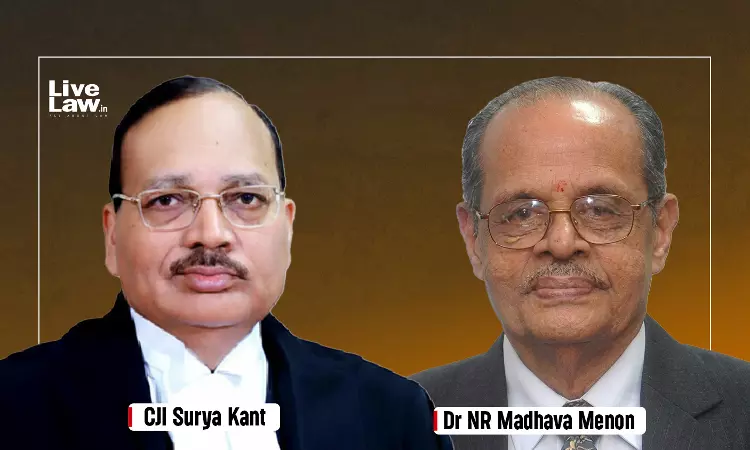
Chief Justice of India Surya Kant stated that for justice to be wise, it needs both courtroom experience and academic scholarship. This is because while courtrooms pronounce judgments, those don't stay within a file. They go on to work in people's lives long after the file has been closed, and that's where academic scholarship identifies similar patterns in whether justice has truly been rendered.
"The Courtroom sees the case, while academia sees the pattern. And justice, if it is to be wise as well as correct, needs both."
Addressing the 2nd Prof. (Dr) N.R. Madhava Menon Memorial Lecture on "Judging with Compassion: Human Understanding in the Practice of Law," the CJI added that Courts, for instance, may pronounce orders awarding compensation, but it is the scholarship that puts it together and studies whom the well-meant judgment has left behind.


"No single case is designed to show that larger picture; this is where scholarship becomes indispensable. It is the scholar who follows the victim beyond the Courtroom, asking whether the compensation awarded is actually paid, whether a bereaved family receives the support it needs, and whether victims are truly heard, as Professor Menon always urged."
At the same time, the CJI remarked that research scholarship shouldn't be cut off from reality. In the same vein, the judge also emphasised the need for compassionate judging. He stated that compassionate judging doesn't mean that the Court is doing charity to the parties; it simply means it is acknowledging the whole human situation behind a case that may appear engulfed in facts and law.
CJI added that compassion must reach those "invisible victims" of our justice system, such as survivors of gender-based violence, family of an undertrial, or a person with disability. He pointed out that for many of them, justice feels like a long journey because they often have to go through difficult processes. For instance, a survivor would have to relive her trauma in the witness box, or a litigant who can't follow the language of the proceedings.
That is where, he said, the role of compassionate lawyers comes into play.
"Much of that process is shaped before a Judge sees the file, which brings me to the fourth question: the practice of law. The compassionate lawyer, who often meets a person in the worst season of life, counsels candidly, never trades on that vulnerability, and makes time for those who cannot pay."
Concluding, CJI said that merely inducing compassion in courtrooms and lawyers would not be enough without making the system compassionate itself. For instance, the system can be made compassionate if legal aid is available to persons at the police station itself, or in spaces where the child or a survivor can testify without facing the accused. Or litigants can access the Court and judgments in their own language.
"Every judgment, in the end, is a translation made twice over: a human story rendered into the language of law, and the law rendered back into a human life. Compassion is simply the discipline of ensuring that nothing essential is lost on either journey."