



- Home
- /
- Top Stories
- /
- Cybercrime Operates Through...
Cybercrime Operates Through Organised Ecosystems; Response Must Be Real-Time &Collaborative : CJI Surya Kant
Gursimran Kaur Bakshi
21 April 2026 6:37 PM IST
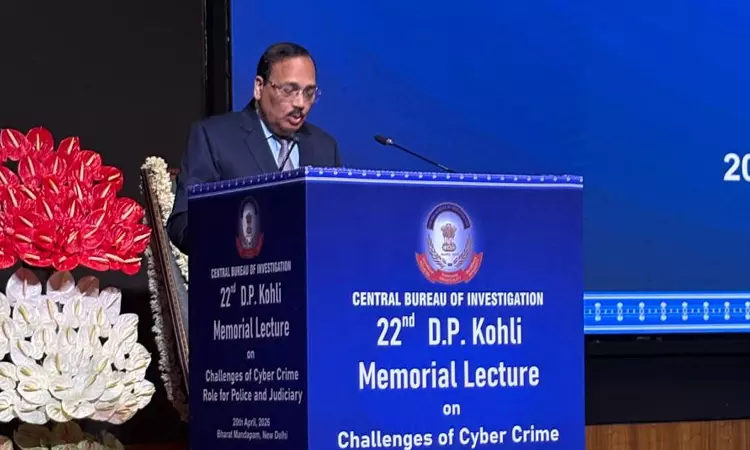
Chief Justice of India Surya Kant recently spoke of the importance of having a victim-centric approach towards rising cases of cybercrime. He stressed that victims of cyber fraud are often retired persons and senior citizens, many of whom lose their entire life savings accumulated over decades of honest work. Addressing the 22nd D.P. Kohli Memorial Lecture by the Central Bureau of...
This is a premium content
Available exclusively to
Our subscribers
Subscribe Premium 
INR 1099+GST
Your support helps us to bring you more content at
an affordable subscription scheme !!!
All payment options available
Chief Justice of India Surya Kant recently spoke of the importance of having a victim-centric approach towards rising cases of cybercrime. He stressed that victims of cyber fraud are often retired persons and senior citizens, many of whom lose their entire life savings accumulated over decades of honest work.
Addressing the 22nd D.P. Kohli Memorial Lecture by the Central Bureau of Investigation on "Challenges of Cyber Crime: Role of Police and Judiciary," CJI Kant said that a challenge which confronts the CBI, police and the judiciary is the recurring forms of cybercrimes, including "digital arrests" where individuals are psychologically coerced into compliance through fabricated claims of legal authority.
CJI remarked that cyber fraud reveals a deeply unsettling reality because it is often preceded by meticulous data harvesting of personal information, behavioural patterns, and financial habits. All of this is followed by profiling the victim, who often doesn't speak out due to embarrassment, hesitation, or the stigma that comes with it. In this context, CJI termed cyber fraud as a crime against human dignity as it strips them of their agency:
"It is therefore imperative that we begin to understand cybercrime not merely as an economic offence, but as a crime against human dignity. It disrupts the sense of agency that individuals have over their own decisions. It converts everyday digital interactions, namely, banking, communication, and even social engagement, into sites of vulnerability. And in an increasingly digital society, this vulnerability is not marginal, but universal."
Cybercrimes Operate In Structured Ecosystem, Individuals Operating Are Often Victims
CJI Kant further told the audience that the cybercrime ecosystem can be traced from organised scam compounds located all across parts of Southeast Asia. But what lies within these structured ecosystems is a ghastly reality that many individuals working in these networks are actually trafficked victims themselves.
But it is hardly traceable since one single fraudulent transaction may involve a victim in one country, a server in another, financial routing through a third, and operators located elsewhere.
"Between these structural features lies an even more ghastly reality. I am told that a significant number of individuals operating within these networks are not willing participants but trafficked victims themselves who are confined within these cyber scam compounds. Subjected to coercion, surveillance, and often physical intimidation, they are compelled to perpetrate fraud against others, becoming both instruments and victims of an exploitative criminal enterprise."
Challenges For Enforcement, Faith Of Victim Depends On Multiple Institutions
CJI Kant stated that law enforcement agencies such as CBI need a shift in their approach towards anticipation, preparedness and adaptability. It requires capacity building, collaboration, and technology-led governance.
He remarked that the diffusion of location creates a profound challenge for the enforcement because traditional concepts of jurisdiction are limited. This equally creates conceptual challenges to the judiciary as well, CJI Kant added.
In such unique circumstances, the offences committed raise questions such as where the legal framework will govern it, which agency will have primacy, and how evidence will be lawfully accessed and preserved. Moreso, it raises questions relating to digital evidence, whose authenticity rests on metadata, chain of custody, and technical validation.
CJI Kant suggested that the Courts must therefore: "engage with evolving standards of admissibility, ensuring reliability without imposing impractical burdens. They must also be equipped to address cross-border evidence requests, questions of admissibility of foreign digital material, and the timelines governing international cooperation."
CJI added that if enforcement agencies are able to get over these challenges, the network often shifts its operation to another region. In such circumstances, he said, our approach is often a response in multi-stages, whereas the crime is executed with speed and coordination.
For instance, when a fraudulent transaction takes place, the bank processes it as a normal transaction. While telecommunication networks hold data that could help identify the source of communication, and may hold the digital platform to detect similar patterns of fraudulent behaviour, such data is not often shared.
By the time the victim approaches the enforcement agency, the transaction has been broken into smaller accounts and routed through multiple accounts. Law enforcement agencies investigate in a conventional manner.
"When the victim approaches law enforcement, the investigation begins with a conventional approach and more often than not, its fate would depend on inputs from several institutions, each following its own procedures. The result is that while the crime is executed with speed and coordination, the response unfolds in stages, creating a gap that is often exploited by those hardcore professional criminals. This successional response stands in stark contrast to the real-time, coordinated execution of cybercrime itself."
He also addressed that when Courts deal with cases involving cyber fraud networks, their bail assessment can't be confined to the individual's complaint. Courts must look at the broader architecture of organised criminal activity
CJI has suggested that we need to have a systemic and anticipatory approach, which includes:
-sharing real-time information where alerts generated by one institution are immediately communicated to others
-to geographically identify whether a receiving bank account is operated within the country or across the order. This would help briefly pause to allow verification of the account holder, and what would follow is the automated freezing of such transactions
-sharing the geographical location of any suspicious receiving account to relevant enforcement agency
-integration of command structures
-need for standardised protocols ensuring consistency, clarity, and accountability in action
-lastly, technological interoperability to allow systems across institutions to communicate seamlessly with one another-here CJI stressed that Courts must be equipped not only with legal knowledge but technological understanding as well
CJI added that it's equally important to acknowledge responsibility of addressing cybercrime is inherently shared.
"No single institution, however capable, can claim exclusivity over either the problem or its solution. Banks, Telecommunications Providers, Digital Platforms, Law Enforcement Agencies, and Investigative Bodies each occupy a vital space within this ecosystem. Their effectiveness, however, depends not merely on their individual strength but on their ability to function as part of a coordinated whole. The success of our response will therefore lie in building cohesion across these actors, fostering trust, and creating mechanisms through which collective responsibility can translate into collective, timely, and effective action."
Launch of "ABHAY" Helpbot
In order to fulfil these aspects, CJI Kant commended that the launch of "ABHAY-AI Based Helpbot for Authentication of Your Notices" is a pivotal initiative. It is a chatbot-driven verification which enables individuals to authenticate notices issued by the CBI. thereby vitalising public trust and addressing concerns of misuse and impersonation.
"Importantly, such a mechanism can serve as an effective safeguard against fraudsters who masquerade as CBI officials and circulate fabricated notices through instant messaging platforms, often invoking the threat of so-called “digital arrest” to coerce and browbeat unsuspecting individuals."
He suggested that in order for ABHAY to achieve its impact, its widespread accessibility and adoption should be ensured. For instance, like pre-installed applications on mobile phones, this could be integrated by default to enhance public utility.

Gursimran Kaur Bakshi
Gursimran is the Principal Correspondent with LiveLaw for the Supreme Court. She can be reached out at: simrankaurbakshi@livelaw.in

