



- Home
- /
- Top Stories
- /
- Delhi SIR | 'Notices Seem To Be...
Delhi SIR | 'Notices Seem To Be Mechanically Issued, Logical Discrepancy Needs Clarification': Supreme Court Tells ECI
Debby Jain
22 Sept 2026 1:19 PM IST
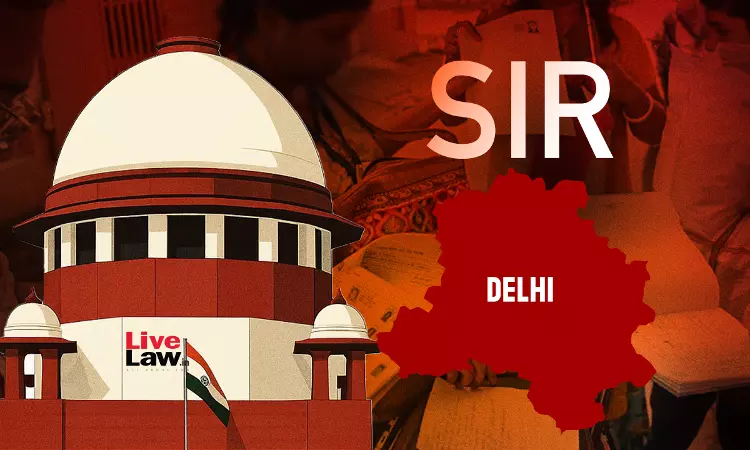
Noting that over 30 lakh notices have been issued, the Court sought the details of manpower deployed for the process.
The Supreme Court on Tuesday told the Election Commission of India that notices to voters during the Special Intensive Revision (SIR) of Delhi's electoral rolls appeared to have been issued "almost mechanically", and that the basis for identifying a "logical discrepancy" required clarification.A bench comprising Chief Justice of India Surya Kant, Justice Joymalya Bagchi and Justice V Mohana...
This is a premium content
Available exclusively to
Our subscribers
Subscribe Premium 
INR 1099+GST
Your support helps us to bring you more content at
an affordable subscription scheme !!!
All payment options available
The Supreme Court on Tuesday told the Election Commission of India that notices to voters during the Special Intensive Revision (SIR) of Delhi's electoral rolls appeared to have been issued "almost mechanically", and that the basis for identifying a "logical discrepancy" required clarification.
A bench comprising Chief Justice of India Surya Kant, Justice Joymalya Bagchi and Justice V Mohana was hearing a petition alleging the failure of the Election Commission of India (ECI) and the Delhi Chief Electoral Officer to adequately disclose the names of voters issued notices and the specific reasons for issuing them. The petition, filed by Anjali Bhardwaj and Amrita Johri, also seeks disclosure of the criteria, definitions, algorithmic parameters and operational guidelines governing the classification of voters under the category of 'Logical Discrepancies'.
At the outset, Advocate Prashant Bhushan, for the petitioners, submitted that the process was going on in a "shocking" manner as over 33 lakh voters got notices on flimsy reasons.
Justice Bagchi expressed prima facie agreement with the submission. "Almost mechanically notices are going. In all probability they are machine-generated notices..." Justice Bagchi remarked.
"You need to clarify 'logical discrepancy' a little," CJI Surya Kant told the ECI.
The petitioners have raised concerns over the manner in which notices have been issued to a large number of voters, particularly those categorised as having "logical discrepancies" or whose details could not be mapped to the previous electoral roll. The ECI had identified around 33.13 lakh electors for notices.
Bhushan submitted that the notices create practical difficulties for voters because they require them to produce documents to address discrepancies which, according to him, may not be capable of being established through the documents specified by the ECI.
"Problem is if you receive a notice, you are supposed to go with documents," Bhushan said.
He gave the example of a notice stating that the age difference between a voter and their parents was less than 15 years. He questioned how a voter could establish the reason for such an age difference when the 12 documents specified by the ECI did not contain information concerning the parents.
Responding to the concerns, Senior Advocate Dama Seshadri Naidu, for the ECI, said that it has increased manpower to deal with the workload and that reasons had been assigned in the notices. He said the relevant information was also being displayed.
The bench asked how many Booth Level Officers (BLOs) had been deployed to deal with the large number of notices. "You sent about 30 lakh notices. How many BLOs are deployed?" Justice Bagchi asked.
Naidu said around 14,000 BLOs and 1,200 Electoral Registration Officers (EROs) had been deployed. He added that October 29 was the deadline and that the ECI was open to an extension if the process was not completed.
He also assured the Court that "not even a single voter could be deleted", referring to the verification process and the safeguards being followed.
The Chief Justice observed that with 14,000 BLOs deployed, they could assist voters in responding to the notices.
CJI Surya Kant also asked what information would be sufficient for a voter to answer the questions raised in the notices.
Naidu submitted that the 12 documents referred to in the notices were not exhaustive.
The CJI, referring to samples of notices shown to the Court, observed that reasons had been mentioned in each notice. He said BLOs should assist voters and indicated that, in cases involving the old 2002 electoral roll, identification of the relevant name could be sufficient.
Bhushan, however, questioned why a person who had already submitted an enumeration form and produced proof of age and residence should be required to furnish further material.
The Chief Justice observed that the Delhi situation could be unique because of its large migrant population.
"In Delhi, problem would be unique. Vast population would be of original Delhiites. But a person like my brother, my sister... we are coming here... we are migrant workers here. I will have to tell I was in Chandigarh, now I am in Delhi. It will ensure there is no double vote," the CJI said.
Senior Advocate Kapil Sibal highlighted another practical concern, pointing out that Delhi has multi-storeyed buildings and asking whether BLOs would visit every house.
Justice Bagchi observed that Delhi was a much easier task compared to West Bengal, where the exercise had been more difficult.
Naidu said the ECI was conducting camps and sensitisation programmes and had created WhatsApp groups to assist voters.
Justice Bagchi suggested that BLOs could be made available at ward offices so that voters could approach them directly. Naidu said such arrangements had already been made.
Sibal, however, pointed out that some notices merely stated that the voter could meet an officer without specifying where the officer could be found.
The CJI also suggested that the electoral authorities should undertake some orientation measures to inspire confidence among voters.
"Maybe little bit orientation is required. How to inspire confidence.. One helping step can be... there are 15-20 types of queries/objections. You can prepare a standard response to that and circulate to all. Wherever mobile nos. are there. You can say this much info. will be sufficient," CJI Surya Kant suggested.
Bhushan further submitted that voters were facing difficulties even in checking whether their names figured in the electoral roll because they were required to specify the part number and constituency, details which many ordinary voters may not know.
The CJI observed that the issue could be addressed through the notices themselves.
Sibal also raised concerns over the adequacy of the information being provided to voters through the notices.
Bhushan submitted that Aadhaar was the only document available with many poor and ordinary citizens and argued that it should be sufficient for enrolment as a voter, as it contains details relating to name, age and address.
He further alleged that large numbers of voters had been categorised as "shifted" and that such persons were being prevented from filing enumeration forms and instead being required to file another form containing a declaration that they had not voted elsewhere.
At the conclusion of the hearing, the CJI referred to interim orders passed by the Court in the Bihar and West Bengal SIR matters and directed the authorities to follow those directions. Those interim directions mandated the publication of the names of excluded persons, along with reasons.
The Court issued notice in the petition and directed the authorities to file a first status report setting out the steps taken in the matter.
The petition has been drawn by Neha Rathi and Kajal Giri Advocates.
Case : Anjali Bharadwaj & another v. Election Commission of India and others | W.P.(C) No. 1188/2026
Tags
Debby Jain
Debby Jain is a Correspondent with LiveLaw, covering the Supreme Court of India

