Detained Protesters Get Fewer Safeguards Than Those Arrested For Heinous Crimes: Senior Advocate Rebecca John
Manu Sebastian
18 Oct 2026 11:12 AM IST
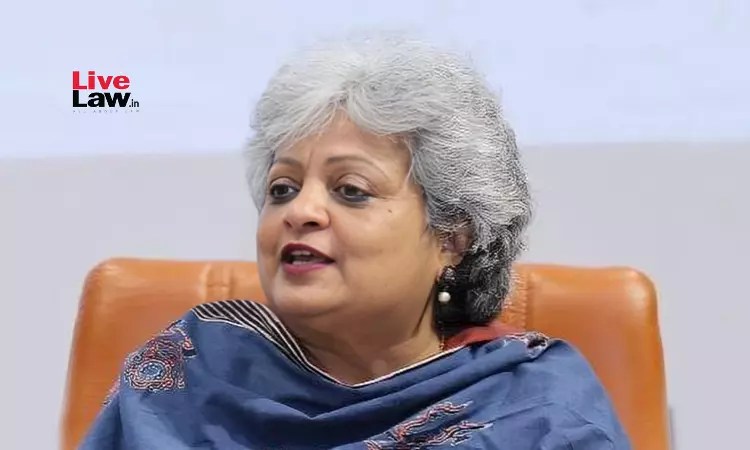
Provisions of the BNSS and the Delhi Police Act are designed to make protests unpalatable and to trouble peaceful protesters, John said.
Senior Advocate Rebecca John has criticised the legal framework governing police action against protesters, saying that people detained during peaceful demonstrations are deprived of safeguards available to even those arrested for heinous offences such as murder and rape.
In a conversation with LiveLaw against the backdrop of the ongoing protests in Delhi against Chief Election Commissioner Gyanesh Kumar, John said a combination of provisions under the Bharatiya Nagarik Suraksha Sanhita (BNSS), the Delhi Police Act and police standing orders gives the police extensive powers to detain protesters without registering a criminal case.
She argued that the framework allows the police to exercise coercive powers without the judicial supervision and procedural safeguards that ordinarily accompany a formal arrest.
"A person who is accused of a very heinous crime, like murder or rape, when that person is arrested, they would be having better rights," John said.
She pointed out that a person formally arrested in a criminal case would have the arrest recorded, be informed of the grounds of arrest, have access to a lawyer and undergo a medical examination before being produced before a magistrate. The magistrate would also examine the case diaries and consider whether the person had been subjected to torture.


However, protesters detained without registration of an FIR or a formal arrest, she said, are often left without comparable safeguards.
"For a person against whom there's no FIR, there's only a bond at best, none of these safeguards are there," John said, adding that such persons fall outside the conventional framework of criminal law protections.
'Entire basket of provisions' enables arbitrary detentions
John said the detention of protesters cannot be understood by examining any one provision in isolation. Instead, she pointed to what she described as an "entire basket" of provisions that collectively empower the police to restrict the movement of protesters and detain them.
She referred to Section 163 of the BNSS(erstwhile Section 144 CrPC), which empowers executive magistrates to issue orders in urgent cases of apprehended danger, and Sections 126 and 170, which deal with proceedings to prevent breaches of peace and preventive arrests, respectively.
She also flagged Section 172 of the BNSS, which empowers police officers to detain or remove persons who resist, refuse or disregard directions of the police.
John said Section 172 was a new provision that had no equivalent in the earlier Code of Criminal Procedure. She questioned the breadth of the power, particularly when a person could be detained for up to 24 hours without a criminal case being registered.
She said these provisions confer "arbitrary, wholly unconstitutional powers" in the police to arbitrarily detain persons.
The senior advocate also referred to provisions of the Delhi Police Act (Sections 28, 36) that allow the police to regulate assemblies and processions, restrict access to public places and impose conditions on demonstrations.
The idea is to trouble the protesting citizens
John raised concerns over the absence of formal recording and judicial oversight during the period of detention, particularly when protesters are transported to locations far from where they were picked up.
She said that although the law prescribes a 24-hour limit for detention, there is no effective mechanism to ascertain how long a person has actually been detained when the period of transportation is not formally recorded.
"The formal recording will start once you're placed in the detention centre, not before the journey takes," she said.
John questioned the practice of taking protesters to remote police stations or stadiums instead of nearby police stations, arguing that the transportation itself becomes a means of imposing additional hardship. An arrested person would be taken to an identifiable police station; however, a detained person will be taken to unknown locations and might be dropped off at faraway places. This can expose female protesters to grave risk when they are dropped off at remote locations during wee hours.
"The idea is to trouble the citizen, the protesting citizen," she said.
She added that the absence of formal arrest records, access to lawyers and judicial supervision leaves protesters vulnerable to arbitrary treatment.
'Architecture of law designed to make protests unpalatable'
John also criticised the Delhi Police's standing orders(10/2018, 48/2022) governing demonstrations, which require prior applications and police permission for protests at designated locations.
She said the guidelines impose restrictions on the number of protesters, the use of loudspeakers, the timing of demonstrations and the routes that processions may take.
Under the framework she described, applications for demonstrations must be made in advance, and the Deputy Commissioner of Police decides whether permission should be granted and on what conditions.
John questioned how the right to protest could be meaningfully exercised when its enjoyment was subject to the discretion of police officers.
"The architecture of law is designed to make protests as unpalatable as possible," she said, describing the effect of the restrictions.
She added that the authorities could not claim to recognise protest as a fundamental right while putting in place an architecture that makes its exercise increasingly difficult.
"You're mocking that fundamental right," John said.
No excuse for police not to wear name tags
John also raised concerns about police officers acting without visible name tags or identification during protest-related operations.
She said that even if the police version of events were accepted, including the possibility that officers had to resort to force to control a crowd, they should remain identifiable.
"The fact that you're concealing your identity should itself raise red flags," she said.
John argued that the lack of identification becomes particularly concerning when allegations of assault or mistreatment arise during detention.
She said the problem was not merely whether the police had the power to control public assemblies, but whether the exercise of that power was subject to adequate accountability.
The senior advocate said the larger issue was the right of citizens to protest without being subjected to arbitrary detention or treatment that places them outside the safeguards ordinarily associated with criminal law.