



- Home
- /
- Top Stories
- /
- Different Problems Require...
Different Problems Require Different Solutions, Legal Aid Must Be Rooted In Local Realities: CJI Surya Kant
Amisha Shrivastava
8 Aug 2026 7:37 PM IST
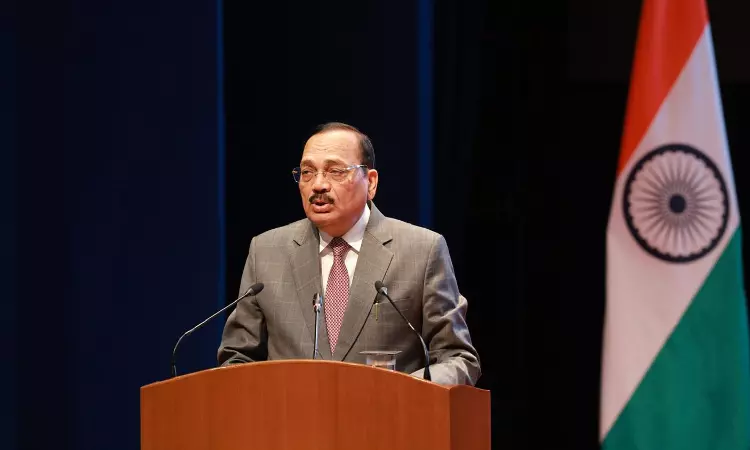
Chief Justice of India Surya Kant on Saturday said that legal aid cannot follow a "one-size-fits-all" approach, stressing that solutions must be rooted in local realities and developed after understanding the specific needs of different communities.The CJI was addressing the West Zone Regional Conference on "Strengthening Access to Justice through Legal Aid: United Voice, Stronger...
This is a premium content
Available exclusively to
Our subscribers
Subscribe Premium 
INR 1099+GST
Your support helps us to bring you more content at
an affordable subscription scheme !!!
All payment options available
Chief Justice of India Surya Kant on Saturday said that legal aid cannot follow a "one-size-fits-all" approach, stressing that solutions must be rooted in local realities and developed after understanding the specific needs of different communities.
The CJI was addressing the West Zone Regional Conference on "Strengthening Access to Justice through Legal Aid: United Voice, Stronger Tomorrow" organised by the National Legal Services Authority (NALSA) in Indore.
The CJI stressed that access to justice begins with dialogue and requires institutions to listen to people in their own language before attempting to resolve their problems.
Illustrating the point, he highlighted, “The legal needs for a tribal family in Madhya Pradesh, a fisher folk community in Goa, a migrant worker in Gujarat or a woman seeking legal assistance in Mumbai are unlikely to be identical... When the problems are different, there cannot be a single solution. Therefore, it must be rooted in local realities. You will have to solve the local problem with the local solution,” he said.
Understanding those problems, he noted, begins with communicating in the language of the people themselves. Unless institutions speak to citizens in their local language or dialect, listen to their grievances in their own words and understand their pain, the gap between identifying a problem and resolving it will remain, he said.
“Until we don't speak their language, don't talk to them, don't interact with them, don't listen to their problems in their own words, there will be a big difference in understanding the whole problem and solving it,” he said.
The conference theme of dialogue, dignity and inclusion, he said, captures what an effective legal aid system should look like in practice rather than serving as a set of aspirational slogans.
“I do not read these three words as slogans for a banner. I read them as an accurate description of what legal aid looks like when it actually works. People spoken to and not merely spoken at, treated as citizens and not mere case numbers and reached wherever they are rather than expected to find their own way to us”, he said.
Describing dialogue as the starting point of access to justice, the CJI observed that justice has never been built by laws alone but begins with conversation. Every legal aid application starts with someone narrating a problem, every mediation begins with parties agreeing to listen, and every legal awareness programme succeeds only when institutions first understand the realities of the people they seek to serve.
He added that dialogue must also flow in the opposite direction. While legal services institutions have a responsibility to make citizens aware of their rights, they must also learn from the communities they serve, he said. Drawing an analogy with the medical profession, he pointed out that no doctor can effectively treat a patient without first understanding the illness, and the same principle applies to legal aid.
The CJI described dignity as justice recognising the individual and not merely the dispute before the court. “Justice that sees the person, not just the case. The case will be resolved, but how to bring back the dignity of the person who has been hurt, who has been hurt emotionally, how to bring them back to life, how to bring back their dignity? This is a very big issue for us to think about. We often evaluate access to justice by looking at the outcome of the case. We think that if the case is resolved, everything is fine. That is not the case. We also think that the case was granted relief, compensation was given, or the case was acquitted or punished. That is not the case. These are undoubtedly important factors. Yet for the ordinary citizen, the experience of justice begins much earlier”, he said.
He highlighted that public confidence in the justice system is shaped much before the pronouncement of a judicial order. The experience begins the moment a person walks into a legal aid clinic, court complex or Taluka Legal Services Authority office, where the manner in which they are received, heard and treated determines their perception of the justice delivery system.
He urged paralegal volunteers and legal aid counsel to focus on these aspects. Comparing legal aid institutions with hospitals, he said that just as a patient's confidence is influenced by the conduct of nurses, technicians and doctors, a litigant's faith in the justice system depends upon the empathy and respect shown by those who first interact with them.
The CJI also underlined that extending legal assistance to vulnerable sections is not an act of benevolence but the discharge of a constitutional obligation. “When we help the tribal community, the socially backward class, those who are financially backward, specially abled persons, women and children, it is not a matter of charity. It is a matter of constitutional entitlement”, he said.
On the final pillar of inclusion, the CJI stressed that the real measure of legal services institutions lies not in how effectively they serve those who can approach them, but in their ability to reach those who remain outside the justice system.
The real test of an institution is not how well it serves those who are able to reach it. The real test is those who cannot come to you, and how you reach out to them."
The CJI also congratulated Justice Vikram Nath, Executive Chairman of NALSA, on the launch of new initiatives during the conference, including the Justice for Children Fellowship Programme, a collaborative initiative of the Madhya Pradesh State Legal Services Authority, UNICEF and National Law University, Delhi. He also referred to existing legal services initiatives such as Tele-Law and Nyaya Bandhu, stressing that their success would depend on effective implementation at the grassroots level.
He observed that inclusion cannot be measured merely by the number of schemes introduced or statistics compiled. Instead, institutions must constantly ask whether another village remains unreached, another vulnerable community unheard, another language unexplored for legal awareness or another barrier preventing citizens from accessing justice.
Concluding his address, the CJI reminded judicial officers, legal aid counsel and paralegal volunteers of the constitutional mandate under Article 39A, and said that the conference would achieve its purpose only if its outcomes reached the households they were intended to serve.
Union Minister of State (Independent Charge) for Law and Justice Arjun Ram Meghwal, Madhya Pradesh Chief Minister Mohan Yadav, Supreme Court judges Justice Vikram Nath and Justice Manmohan also addressed the event. Justice Manmohan launched the Justice for Children Fellowship Programme, while Meghwal released “Nyay Ke Swar”, a collection of artworks, poems and creative expressions inspired by the mission and values of legal services.
Tags

Amisha Shrivastava
Amisha Shrivastava is a Senior Correspondent with LiveLaw, covering the Supreme Court of India. She can be reached at amisha@livelaw.in

