



- Home
- /
- Top Stories
- /
- 'Disappointing' : Ex-SC Judges...
'Disappointing' : Ex-SC Judges Criticise Supreme Court's Judgment Denying Bail To Umar Khalid & Sharjeel Imam
LIVELAW NEWS NETWORK
12 Jan 2026 8:31 PM IST
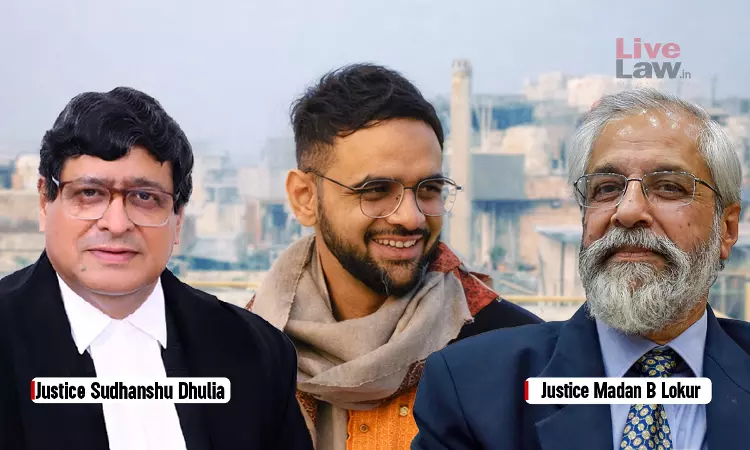
The judges opined that the Supreme Court misinterpreted the precedent in the 'Najeeb' case.
Justices Madan B Lokur and Sudhanshu Dhulia, former Supreme Court Judges, criticised the recent judgment of the Supreme Court, which denied bail to Umar Khalid and Sharjeel Imam in the Delhi riots larger conspiracy case.While Justice Lokur said that he was "sad" at the bail denial, Justice Dhulia said that the decision was "disappointing". They were attending a talk show hosted by Senior...
This is a premium content
Available exclusively to
Our subscribers
Subscribe Premium 
INR 1099+GST
Your support helps us to bring you more content at
an affordable subscription scheme !!!
All payment options available
Justices Madan B Lokur and Sudhanshu Dhulia, former Supreme Court Judges, criticised the recent judgment of the Supreme Court, which denied bail to Umar Khalid and Sharjeel Imam in the Delhi riots larger conspiracy case.
While Justice Lokur said that he was "sad" at the bail denial, Justice Dhulia said that the decision was "disappointing". They were attending a talk show hosted by Senior Advocate Kapil Sibal, who represented Khalid in the Supreme Court. Senior Advocate Dushyant Dave was also present in the discussion.
Justice Lokur said that the judgment was particularly erroneous in not considering the aspect of delay in trial and the long incarceration of the appellants. Although Khalid and Imam were arrested in 2020, they were given the prosecution materials in terms of Section 207 of the Code of Criminal Procedure only in 2023, after three years. "I am not at all happy with the judgment. On the question of delay, the judgment is completely wrong" Justice Lokur said. He wondered how the appellants could be held responsible for the delay of three years in the handing over of the materials. He highlighted that the records showed that Khalid and Imam were always ready for arguments on charges.
Justice Lokur also questioned the basis of invoking the terrorism offence under Section 15 of the Unlawful Activities Prevention Act against the accused. "What did they do? Attended some meetings, created WhatsApp groups, gave speeches, and circulated pamphlets. How is this terrorist activity?" Justice Lokur asked.
Supplementing Justice Lokur's views, Justice Dhulia said that the judgment was "disappointing for me as a citizen of this country." Justice Dhulia said that the judgment had misinterpreted the judgment in Union of India v. KA Najeeb rendered by a three-judge bench. Justice Dhulia said that Najeeb held that long incarceration and the unlikelihood of early completion of trial are grounds to grant bail despite the rigours of Section 43D(5) of the UAPA. However, the judgment in the Umar Khalid case has only considered the aspect of long incarceration, and there was no discussion on the likelihood of completion of the trial. He said that in the Najeeb case, there were 200 witnesses to be examined, whereas in this case, 900 witnesses are to be examined, and hence, the completion of trial in the near future was totally impossible. Sibal added that the chargesheet ran into 3000 pages, and documents were over 30,000 pages.
Justice Dhulia also questioned the basis of the Supreme Court imposing a one-year embargo on Imam and Khalid in applying for fresh bail. "Where did this come from?" he asked.
Dushyant Dave opined that the "judges had made up their minds first and then they tried to fish for reasons." He criticised the judgment for ignoring the binding precedent in Najeeb. Dave added that on the same day of pronouncment of the verdict in the Umar Khalid case, the same bench had pronounced the verdict in the Adani Power case, where it criticised the Gujarat High Court for ignoring a precedent and emphasised the importance of the stare decisis principle.
"The Supreme Court is consistently inconsistent. Getting justice is a matter of toss of coin. It depends on which bench your matter is listed. These boys should not have been even arrested in the first place. I don't understand how can there be even a prima facie case against them. They have not used any bombs, explosives, they have not caused violence, or deaths. So what is this case about?" Dave said.
Dave added that there were many BJP leaders who made provocative statements which actually led to riots, but were not proceeded against. "Where did these students provoke riots? I'm surprised the Supreme Court is so naive to accept the submission of the prosecution. It hurts. You have ruined their future; judges are responsible for this. It is a matter of sadness."
Sibal said that there are 750 FIRs filed in respect of actual violence in the Delhi riots, and in none of them, Umar Khalid and Sharjeel Imam are named as the accused. He added that there are so far 97 acquittals and 16 convictions in the riots cases, and while acquitting the accused, the trial courts have lambasted the Delhi police for "cooking up case diaries, fabricating evidence."
Sibal said that the case is only an instance of the "Government wanting to teach them a lesson." Agreeing, Justice Lokur said, "It appears to be so."
Justice Dhulia criticised the principle formulated in the judgment that the fundamental right to liberty under Article 21 is circumscribed by the statutory rigours of the UAPA. "This logic I am hearing for the first time. This is the Supreme Court. There is Article 21. And there is 43D(5). The Supreme Court does not see the ambit of Article 21," he said.
Dave interjected to add that the judgment uses the words, "Article 21 cannot be seen in isolation." "If this is the comprehension of Article 21, then none of us are safe," he exclaimed.
Dave said that the principle "bail is the rule, jail is the exception" is applied selectively in the country, and the rich and powerful are easily getting bail. He referred to the 2020 order of the Supreme Court granting bail to the convicts in the Sardarpura massacre case related to the 2002 Gujarat riots. He also cited the Supreme Court's order granting bail to Ashish Mishra in the Lakhimpur Kheri case citing his one-year custody in jail and the unlikelihood of early completion of trial. "These are the reasons which raise questions in the minds of persons who love the judiciary," he said.
Justice Dhulia expressed agreement with Dave's view that the public faith in the judiciary has eroded to an extent. "This institution is standing on the trust of the people. And as Mr Dave said, usme kayi chhott pahunchi hain(some injury has been caused to the public trust in judiciary),” the former judge said.


