



- Home
- /
- Top Stories
- /
- Dowry Has Diffused Into Muslim...
Dowry Has Diffused Into Muslim Marriages Hollowing Out Mehr's Protection : Supreme Court
Gursimran Kaur Bakshi
16 Dec 2025 12:01 PM IST
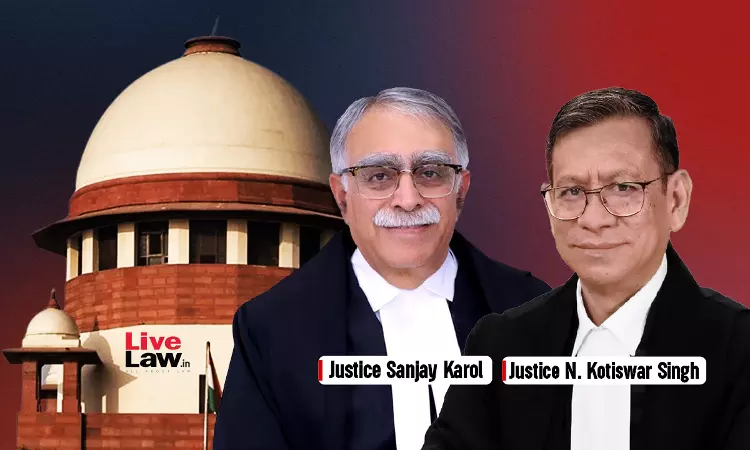
Dowry and mehr now co-exist in Muslim marriages, the Court lamented.
The Supreme Court today(December 15) issued general directions to contain the social evil of dowry death in society. It also quashed an order of the Allahabad High Court, which acquitted the accused husband and her mother contrary to the Trial Court's finding that they burnt a 20-year-old alive because she could not fulfil their demand of a coloured television, a motorcycle and Rs. 15,000.A...
This is a premium content
Available exclusively to
Our subscribers
Subscribe Premium 
INR 1099+GST
Your support helps us to bring you more content at
an affordable subscription scheme !!!
All payment options available
The Supreme Court today(December 15) issued general directions to contain the social evil of dowry death in society. It also quashed an order of the Allahabad High Court, which acquitted the accused husband and her mother contrary to the Trial Court's finding that they burnt a 20-year-old alive because she could not fulfil their demand of a coloured television, a motorcycle and Rs. 15,000.
A bench comprising Justice Sanjay Karol and Justice NK Singh passed the order. In a judgment authored by Justice Karol, he traced the history of dowry, which originally began as a voluntary gift-giving practice to the daughter upon her marriage, for her own use and financial independence.
The judgment also explained it was morphed into an "institutionalised practice" which ended up becoming an essential aspect of hypergamy, which is a practice of marrying 'higher up' in terms of caste, etc, to maintain a lineage. Not just this, due to cross-fertilisation of cultural practices, how it has also penetrated the Muslim community leaving the protection of mehr hallow.
Marrying up and 'baggage of samaj
"This practice of marrying 'higher up' traces its origins to caste and kinship along with, to use a colloquial term, the 'baggage of the samaj' that comes with it. Since lineage is traced through the patriarchal line, the desire to marry daughters into equal or higher-status families ensured that their offspring retained or enhanced the family's standing. Hypergamy thus became both a social strategy and a religiously sanctioned norm."
Justice Karol states that this practice is very rigidly followed among the upper caste, where daughters were "married up" to families of higher ritual or political rank, which often necessitated larger dowries as inducements. With this, this became a widespread cultural practice in Hindu communities.
"Over time, hypergamy was not just about varna but also about wealth, landholding, and political influence. Medieval royal families practiced hypergamy to forge alliances, and landed elites followed suit to consolidate power. By the early modern and colonial periods, hypergamy had become a widespread cultural pattern across many Hindu communities, entrenching the link between dowry and upward mobility."
Groom price theory and systematic bias against women
He notes that even today, although dowry is outlawed, this practice continues, and it is completely divorced from the well-being of the female. Now, it is referred to as 'groom price theory'-i.e., the amount of dowry being determined by the particulars of the groom, such as social and educational background, earning capacity etc, which has resulted in systematic bias against women.
"What all of this translates to, is a systemic bias against women - pervasive across all sections of society - undervaluing them grossly. The amount of dowry the woman brings into the marital home directly corresponds to the value of the groom, which the woman, just as herself, is condemned to be unable to meet, or is otherwise unworthy, sans the dower."
Mehr has now become another name for dowry
Justice Karol stated that while dowry is prohibited in the Muslim community, mehr is a compulsory gift which the groom is required to give to the wife at the time of nikah. It is defined as that it belongs solely to the bride and the husband, and his family can't take it away.
Justice Karol notes that the cross-fertilisation of culture, economics and institutional factors have made dowry prevalent in the Muslim community as well.
"Historically, dowry was most closely associated with Hindu caste society, but over a time it diffused into Muslim practices through processes of cultural assimilation, social emulation, and inter-community influence. Scholarly undertakings trace how Muslim families, particularly in urban centers, began adopting dowry as a status marker and as part of competitive marriage negotiations. At the same time, marriage market pressures - including imbalances in sex ratios, rising educational aspirations, and competition for higher-status grooms - encouraged families to provide substantial dowry payments."
Dowry and mehr now coexist
Justice says that mehr and dowry now co-exist, but in a complex way because of which the very idea and the protection offered by mehr has been hollowed.
"As a result, mehr and dowry have come to coexist in complex ways. In many Muslim marriages in India, mehr continues to be stipulated, but often only in nominal terms. The real financial transfers flow from the bride's family to the groom, effectively hollowing out the protective function of mehr. This undermines the original Islamic intention of empowering women through property ownership, as the dowry frequently ends up under the control of the husband or his family"
He remarks that where dowry replaces or overshadows mehr, women lose an important bargaining tool and face greater economic vulnerability.
"Scholars note that this dual system - nominal mehr alongside substantial dowry - illustrates how religious norms have been reshaped by social and economic forces. The consequences of this shift are serious. Dowry places a heavy financial burden on the bride's family, sometimes delaying or preventing daughters' marriages. It has also been linked to harassment, domestic violence, and even dowry deaths - problems that affect not only the Muslim households but cut across all religions. By contrast, the neglect of mehr erodes women's financial security, leaving them less protected in cases of divorce or widowhood."
The Court reminds that the eradication of dowry is an urgent constitutional and social necessity.
Case Details: STATE OF U.P. v. AJMAL BEG ETC.|CRIMINAL APPEAL NOS. 132-133 OF 2017
Also from the judgment - 'Sensitise Future Generation About Equality In Marriage' : Supreme Court Issues Directions To Tackle Dowry Evil
Gursimran Kaur Bakshi
Gursimran is the Principal Correspondent with LiveLaw for the Supreme Court. She can be reached out at: simrankaurbakshi@livelaw.in

