



- Home
- /
- Top Stories
- /
- Election Commissioners' Appointment...
Election Commissioners' Appointment | Can't Presume Prime Minister Will Act Against Democracy : Union Tells Supreme Court
Amisha Shrivastava
30 July 2026 4:16 PM IST
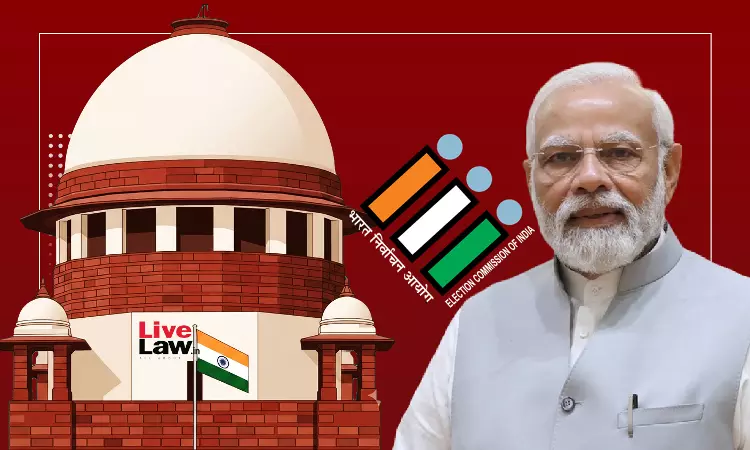
The Union said that the Court cannot begin with an assumption that the PM will act in bad faith.
During the hearing of the petitions challenging the law governing the appointment of Election Commissioners, the Union government on Wednesday argued before the Supreme Court that a constitutional court cannot begin with an assumption that the Prime Minister would act against democratic principles.Appearing before a Bench of Justice Dipankar Datta and Justice Satish Chandra Sharma,...
This is a premium content
Available exclusively to
Our subscribers
Subscribe Premium 
INR 1099+GST
Your support helps us to bring you more content at
an affordable subscription scheme !!!
All payment options available
During the hearing of the petitions challenging the law governing the appointment of Election Commissioners, the Union government on Wednesday argued before the Supreme Court that a constitutional court cannot begin with an assumption that the Prime Minister would act against democratic principles.
Appearing before a Bench of Justice Dipankar Datta and Justice Satish Chandra Sharma, Solicitor General Tushar Mehta contended that invalidating the composition of the selection committee on the premise that the Prime Minister and the executive would act in bad faith would undermine the constitutional trust reposed in elected institutions.
The Bench was hearing petitions challenging the Chief Election Commissioner and Other Election Commissioners (Appointment, Conditions of Service and Term of Office) Act, 2023, which provides that the selection committee for appointing the Chief Election Commissioner and Election Commissioners shall comprise the Prime Minister, a Union Cabinet Minister nominated by the Prime Minister, and the Leader of the Opposition in the Lok Sabha. The law was enacted after the Supreme Court in March 2023, in Anoop Baranwal v. Union of India, directed that until Parliament enacted a law, the Election Commissioners must be elected by a panel comprising the PM, the Opposition Leader and the Chief Justice of India. The petitioners have challenged the law on the ground that it was not an independent appointment process since the executive has a greater say in picking up the ECI members.
At the outset, Attorney General for India R Venkataramani submitted that the issues arising from the Anoop Baranwal judgment involved important constitutional questions that warranted consideration by a larger Bench.
Taking the court through the judgment, the Attorney General argued that there was no case that the Parliament had no power to enact the law. He added that any allegation of abuse of office or surrender of the Election Commission's independence would have to be established on facts.
Justice Datta, however, pointed out that the Chief Justice of India forms part of the selection panels for offices such as the CBI Director.
"The thought process was that the Chief Election Commissioner occupies one of the most important offices in a democracy," Justice Datta observed. He asked whether Parliament's decision to exclude the Chief Justice from the Election Commission selection panel could be questioned in light of its approach to other high constitutional offices.
Responding, the Attorney General cautioned against treating Parliament's legislative choice as impermissible merely because another model was possible. The AG submitted that the "Parliament cannot be gagged".
The Solicitor General pressed for the matter to be referred to a Constitution Bench, contending that Anoop Baranwal only prescribed an interim arrangement and did not lay down binding constitutional law limiting Parliament's legislative competence under Article 324.
He framed several constitutional questions, including whether a law enacted under Article 324 could be invalidated merely because Parliament did not include an "outsider" such as the Chief Justice in the selection committee, whether implied limitations could be read into Parliament's legislative power, and whether courts could presume abuse of power or mala fides on the part of constitutional functionaries while testing the validity of legislation.
Prime Minister's Office has a sanctity attached : SG
"The office of Prime Minister has a sanctity attached," Mehta submitted.
"If his decision is not to be trusted and is to be seen as necessarily a bad-faith exercise, then why not have a provision that even while selecting his Cabinet he must consult some former judge or outsider?" he argued.
Developing the argument further, Mehta said the issue was whether one organ of the State could assume that decisions of another constitutional organ would necessarily be taken in bad faith merely because the executive enjoyed a numerical majority in the selection committee.
"My question is whether one organ of the State can proceed on the basis that the Prime Minister and the other ministers would act in bad faith, would not act in the interest of democracy, would not act in furtherance of constitutional principles because they have a numerical majority," he submitted.
According to Mehta, once the court holds that the statutory committee is inadequate, "two things are being done: the wisdom of Parliament is being doubted, and the constitutional trust doctrine is also being doubted."
He stressed that the executive and legislature are directly accountable to the people, unlike other organs of the State.
Justice Datta responded that the issue was not one of distrusting the Prime Minister.
"Why wouldn't we trust the Prime Minister? Of course we would trust the Prime Minister," Justice Datta observed.
The judge added that the Supreme Court in earlier cases had trusted the Prime Minister to ensure that persons with questionable backgrounds were not appointed as ministers.
When Mehta argued that a 2:1 composition in favour of the executive could create an impression of lack of faith, Justice Datta clarified the court's concern.
"Not lack of faith. The Election Commissioner has to be an independent person. Should that committee not consist of persons... Should there not be a show of fairness? We are not saying fairness has not been achieved by this committee. Just like justice is not only to be done, it has to be shown to be done, we are on the second part," Justice Datta observed.
Although Mehta repeatedly urged the Bench to first decide the question of reference to a larger Bench, Justice Datta indicated that the court wished to hear arguments on the merits before taking that call.
"Address us on the merits too. Assume that we are not planning to refer it," Justice Datta said, adding that if every substantial constitutional question had to be referred at the threshold, all Article 32 petitions would have to be heard by Constitution Benches.
The petitioners, represented by Advocate Prashant Bhushan, Senior Advocate Gopal Sankaranarayanan, Senior Advocate Sanjay Parikh, Senior Advocate Vijay Hansaria, Senior Advocate Shadan Farast, Advocate Kaleeswaram Raj opposed the need for reference.
Live updates from today's hearing can be found here.
The bench ultimately reserved order on the preliminary point whether reference is required.
Case no. - W.P.(C) No. 14/2024 Diary No. 146 / 2024 and connected cases
Case Title - Dr. Jaya Thakur v. Union of India and connected cases
Tags

Amisha Shrivastava
Amisha Shrivastava is a Senior Correspondent with LiveLaw, covering the Supreme Court of India. She can be reached at amisha@livelaw.in

