



- Home
- /
- Top Stories
- /
- 'Even In Terror Cases,...
'Even In Terror Cases, Constitutional Safeguards And Right To Fair Trial Cannot Be Diluted': Supreme Court
Amisha Shrivastava
21 July 2026 8:40 PM IST
'The greater the public outcry, the greater becomes the responsibility of the Court to ensure that the determination of guilt is based solely upon law and evidence' - Court
The Supreme Court today reiterated that the constitutional safeguards and the settled principles of criminal jurisprudence cannot be compromised even in cases involving terrorist violence and offences that shock the collective conscience of society.The Court acknowledged that bomb blasts directed against innocent civilians generate fear, grief and public outrage. However, it stressed that...
This is a premium content
Available exclusively to
Our subscribers
Subscribe Premium 
INR 1099+GST
Your support helps us to bring you more content at
an affordable subscription scheme !!!
All payment options available
The Supreme Court today reiterated that the constitutional safeguards and the settled principles of criminal jurisprudence cannot be compromised even in cases involving terrorist violence and offences that shock the collective conscience of society.
The Court acknowledged that bomb blasts directed against innocent civilians generate fear, grief and public outrage. However, it stressed that such cases require greater adherence to constitutional principles rather than dilution of constitutional standards.
The Court observed, “These principles assume even greater significance when Courts are confronted with offences that shock the collective conscience of society. Acts of violence directed against innocent civilians, particularly those involving the use of explosives in public spaces, strike at the very foundations of social order and generate understandable feelings of fear, grief, and outrage. Yet, it is precisely in such cases that Courts must remain steadfast in their adherence to constitutional values. The gravity of the allegation cannot be permitted to dilute the standard of proof, nor can the enormity of the crime justify a departure from the settled principles governing criminal adjudication. The greater the public outcry, the greater becomes the responsibility of the Court to ensure that the determination of guilt is based solely upon law and evidence.”
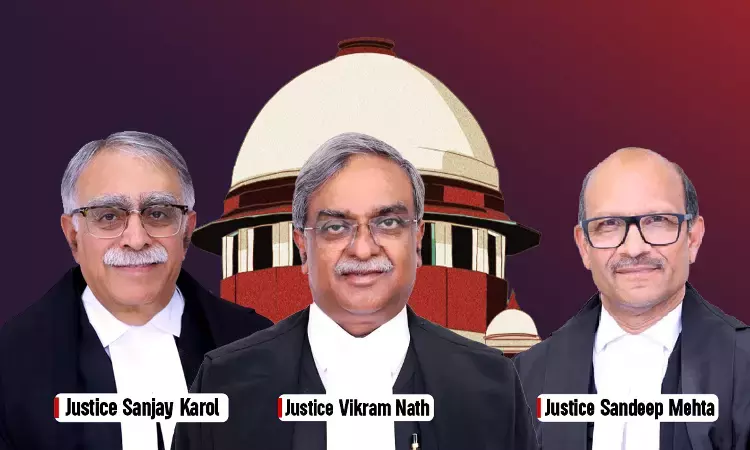
A bench of Justice Vikram Nath, Justice Sanjay Karol and Justice Sandeep Mehta made the observations while examining whether the conviction and death sentence awarded to the prime accused Dr. Abdul Hameed in the 1996 Samleti bus bomb blast case had resulted from a trial consistent with the constitutional guarantee of a fair trial and due process.
The Court observed that the legitimacy of the criminal justice system depends not on the severity of punishment but on the fairness of the process through which guilt is determined. The Court emphasised that the true measure of justice lies not in swift retribution but in restraint. It reiterated the long-settled principle that it is better for a hundred guilty persons to escape than for one innocent person to be wrongly convicted.
The Court said that the constitutional guarantee of a fair trial occupies a position of paramount importance. It observed that the right to effective legal representation, the presumption of innocence, the prosecution's burden to establish guilt beyond reasonable doubt and the requirement that evidence be scrutinised objectively are not mere procedural formalities but substantive guarantees that distinguish the rule of law from the rule of public opinion.
“The right to effective legal representation, the presumption of innocence, the burden upon the prosecution to establish guilt beyond reasonable doubt, and the requirement that evidence be scrutinized with objectivity and caution are not mere procedural formalities. They are substantive guarantees that distinguish the rule of law from the rule of public opinion. Justice must not only be done but must manifestly be seen to be done. The legitimacy of a judicial verdict rests not merely upon the outcome reached, but equally upon the fairness, transparency, and integrity of the process by which that outcome is achieved”, the Court observed.
This principle reflects the high value placed by the law on individual liberty and human dignity, requiring guilt to be established only through legally admissible, reliable and convincing evidence, the Court observed.
“This principle is neither a concession to crime nor a sign of institutional weakness, rather, it reflects the profound value that the law places upon individual liberty and human dignity. The criminal process is therefore structured around safeguards intended to minimize the possibility of wrongful conviction. Even where suspicion appears strong, public sentiment runs high, or the allegations are of the gravest character, the law insists that guilt must be established through legally admissible, reliable, and convincing evidence”, the Court said.
The Court added that justice must not only be done but must also be seen to be done, and the legitimacy of a judicial verdict depends equally on the fairness, transparency and integrity of the process through which it is reached.
The Court further held that where there is greater public outcry over an offence, courts bear an even greater responsibility to ensure that guilt is determined solely on the basis of law and evidence.
The Court observed that although the Samleti bus blast incident was undoubtedly an assault on public peace and security, the Court's task was to rigorously examine whether the convictions recorded by the trial court and the Rajasthan High Court satisfied the standards of proof mandated by criminal law. It noted that the appeals required a meticulous appraisal of the evidence rather than an assessment based on the gravity of the offence alone.
Applying these principles, the Supreme Court ultimately held that Dr. Abdul Hameed had been denied effective legal representation during his trial. It set aside his conviction and death sentence and ordered a de novo trial, while making it clear that the decision was founded on the constitutional guarantee of a fair trial rather than on the seriousness of the allegations.
Headnote
Constitution of India, 1950 - Articles 21 & 22 – Right to a Fair Trial & Effective Legal Representation - Paramount importance of substantive constitutional guarantees in criminal jurisprudence, particularly in cases involving offences that shock the collective conscience of society - The right to a fair trial encompasses a real, meaningful, and impartial opportunity to defend, which includes effective representation by a counsel of choice or competent legal aid at State expense - The constitutional obligation of the Court is to ensure real and meaningful representation rather than a mere ritualistic or illusory physical presence - Facing a complex trial carrying capital punishment without legal assistance fundamentally vitiates the criminal justice process.
Denial of Fair Trial vs. Consequence of Acquittal - Denial of legal representation does not invariably operate as an automatic passport to acquittal - Courts must balance the accused's constitutional entitlement to a fair trial against the nature and gravity of the offence, its societal impact, and the overarching demands of public justice - Where a trial stands constitutionally infirmed due to the complete lack of effective legal assistance, a de-novo trial is the only legally permissible remedy to restore procedural fairness while ensuring justice is carried to its logical conclusion - Held, that the Appellant (Accused No. 9), facing charges under Section 302 IPC and explosive offences carrying the death penalty, remained effectively unrepresented throughout the recording of prosecution evidence, cross-examining 81 witnesses on his own without any amicus curiae or legal aid - Such a hasty and stage-managed trial violates the baseline principle of "judicial calm" - In view of the grave nature of the Samleti bus bomb blast (claiming 14 lives), an outright acquittal is inappropriate; hence, the conviction is set aside and a de-novo trial is ordered before a designated Special Court. [Relied on Mohd. Hussain v. State (Govt. of NCT of Delhi), (2012) 9 SCC 408; Naveen v. State of M.P., (2023) 17 SCC 381; Suk Das v. UT of Arunachal Pradesh, (1986) 2 SCC 401; Paras 23- 36]
Code of Criminal Procedure, 1973 - Section 164 - Section 306 – Admissibility and Evidentiary Value of Retracted Confession - Mandatory Compliance with Statutory Safeguards - Resiling Approver / Co-accused Confession - A retracted confession whose voluntariness is seriously disputed and whose authenticity is compromised by repeated recording/repudiation cannot form the primary foundation of a conviction - For a retracted confession to sustain a finding of guilt, it must receive strong, independent, and substantive corroboration in material particulars connecting the accused with the crime - Compliance with statutory warnings under Section 164(2) CrPC is an indispensable prerequisite to ensure the voluntary character of a confession. Any subsequent insertion or procedural variation indicating that warnings were not administered prior to recording diminishes the degree of assurance and invalidates its reliability - Once an approver resiles from a confession made under a grant of pardon and fails to fulfill the conditions under Section 306 CrPC, their statement can at best be treated as a confession of a co accused under Section 30 of the Indian Evidence Act - Such a confession is not substantive evidence and can only be used to lend assurance to a conclusion otherwise arrived at via independent, legally admissible evidence - Held, the conviction of Accused No. 12 (Pappu @ Salim) rested solely on successive, repeated confessional statements which he subsequently disowned in open court, denouncing his approver status. In the complete absence of independent physical, forensic, or circumstantial evidence, the conviction is unsustainable - Evidentiary superstructure cannot stand once the foundation of the confession is discredited - Conviction set aside. [Relied on Kashmira Singh v. State of Madhya Pradesh, (1952) 1 SCC 275; Suresh Budharmal Kalani v. State of Maharashtra, (1998) 7 SCC 337; Paras 44, 45, 46, 47, 48, 49, 50, 69]
Indian Evidence Act, 1872 - Section 27 – Scope and Ambit of Disclosure Statements: The statutory exception carved out under Section 27 IEA is attracted only when the information furnished by an accused distinctly relates to a relevant fact discovered which was previously unknown to the investigating agency - A mere statement expressing a willingness to identify a place or location already within the knowledge of the police, or pointing out a spot without resulting in the recovery of an incriminating fact/article having a direct nexus with the crime, does not constitute a "discovery" - Panchnama / Memorandum Not Substantive Evidence - Recitals in a panchnama or site verification memorandum do not constitute substantive evidence - The substantive evidence is the live testimony of the witness in the witness box proving the precise information furnished and the corresponding discovery - Held, the prosecution's reliance on site verification proceedings and the pointing out of Masjids/premises by Accused Nos. 1 and 10 failed to meet the threshold of Section 27, as no incriminating fact, weapon, or explosive substance linked to the Samleti blast was discovered - Generic references or travel companionship in a co-accused's confession do not substitute proof of a specific conspiracy. [Relied on Pulukuri Kotayya v. King-Emperor, 1946 SCC OnLine PC 47; Murli & Anr. v. State of Rajasthan, (2009) 9 SCC 41; Paras 63, 64, 65, 66]
Criminal Jurisprudence & Appellate Powers - Circumstantial Evidence – The Panchsheel Principles - To sustain a conviction based entirely on circumstantial evidence, the prosecution must establish a complete, coherent, and unbroken chain of clinching circumstances that unequivocally points exclusively toward the hypothesis of guilt and excludes every reasonable hypothesis consistent with the innocence of the accused - Section 386(a) CrPC – Interference with Orders of Acquittal - An appellate court possesses full powers to review and reconsider the entire evidence underlying an acquittal - it must respect the double presumption of innocence operating in favour of an acquitted accused ordinary presumption under criminal law reinforced by the judicial finding of acquittal - An acquittal cannot be disturbed unless the findings of the court below are palpably wrong, manifestly erroneous, perverse, or demonstrably unsustainable - If two reasonable views are possible, the view favourable to the accused must prevail - Held, the High Court's view in acquitting Accused Nos. 1, 2, 4, 5, 6, and 10 was a highly plausible and reasonable view, as the prosecution failed to produce any direct or corroborative evidence linking them specifically to the execution or planning of the Samleti bus blast, apart from generic references in an uncognate confession - Orders of acquittal affirmed. [Relied on Sharad Birdhichand Sarda v. State of Maharashtra, (1984) 4 SCC 116; Chandrappa v. State of Karnataka, (2007) 4 SCC 415; Ramesh Babulal Doshi v. State of Gujarat, (1996) 9 SCC 225; Sheo Swarup v. King Emperor, 1934 SCC OnLine PC 42; Paras 54-60, 71-74]
Case no. – Crl.A. No. 1827-1829/2019 Diary No. 38125 / 2019
Citation : 2026 LiveLaw (SC) 700
Case Title – Abdul Hameed v. State of Rajasthan
Tags

Amisha Shrivastava
Amisha Shrivastava is a Senior Correspondent with LiveLaw, covering the Supreme Court of India. She can be reached at amisha@livelaw.in

