



- Home
- /
- Top Stories
- /
- Government Not Clearing Names Of...
Government Not Clearing Names Of Candidates Recommended For Judgeship A Major Problem : Justice Abhay Oka
Narsi Benwal
31 March 2026 8:07 AM IST
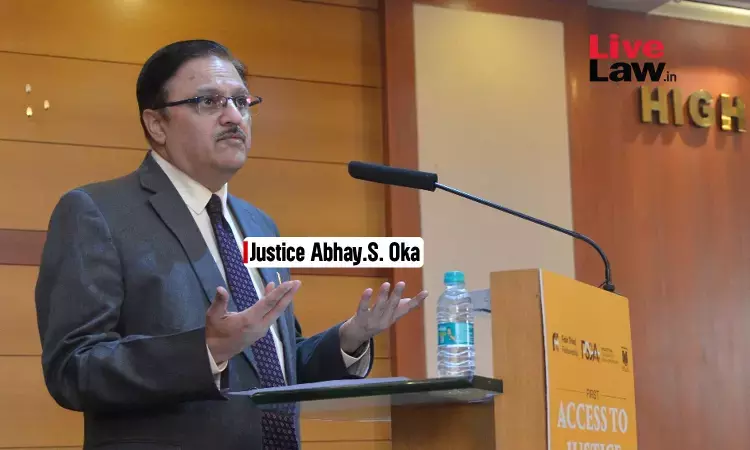
"We speak about Viksit Bharat, but we don't speak about the Judge to Population Ratio of India," Justice Oka said.
Former Supreme Court judge Justice Abhay Oka on Monday said that the failure on the part of the Union Government to quickly clear the names of advocates, who are recommended for judgeship by the Supreme Court Collegium, is one of the major problems in the system because of which the 'judiciary has failed' to fulfil the expectations of the citizens. The judge pointed out that names of...
This is a premium content
Available exclusively to
Our subscribers
Subscribe Premium 
INR 1099+GST
Your support helps us to bring you more content at
an affordable subscription scheme !!!
All payment options available
Former Supreme Court judge Justice Abhay Oka on Monday said that the failure on the part of the Union Government to quickly clear the names of advocates, who are recommended for judgeship by the Supreme Court Collegium, is one of the major problems in the system because of which the 'judiciary has failed' to fulfil the expectations of the citizens.
The judge pointed out that names of candidates are not cleared for months altogether, which adversely affects the candidate's profession and also harms their privacy.
"Another important issue is about the appointment of judges in HC... One major problem in our system is, after the Supreme Court Collegium recommends the names, good candidates have to wait for more than a year... Sometimes, this compromises with a person's privacy..." Justice Oka said.
The judge pointed out how a young lawyer in Karnataka, whose name was recommended for judgeship, had to suffer because the Government did not clear his name for around nine months.
"In Karnataka I have seen a practice, that when a person is recommended they usually don't get work (with a view that they may be appointed)... They are young they need to run their family but since there is no word from the Government that person suffers as s/he don't get work," Justice Oka explained.
Further, the judge shared an experience of another young lawyer, whom he personally 'persuaded' to become a judge.
"It was only after I personally persuaded that young lawyer, he consented for the judgeship. In fact, the entire Bar of the HC was happy with his recommendation. But his name wasn't cleared for months and then that person withdrew his consent. Of course, he has a great practice even in the Supreme Court and later on when he appeared before me, I thought he should not be appearing before the court but must be sitting in some court... But this is one of the major problems," Justice Oka said.
At an event organised by the People's Union for Civil Liberties (PUCL) to commemorate the 45th Annual JP Narayan Memorial Lecture in Mumbai, the judge, speaking on the theme "Reclaiming Justice", explained in his more than hour-long address why the judiciary has, at times, failed to meet citizens' expectations arising from the guarantees of the Constitution of India.
The judge reflected on several areas where the justice delivery system has fallen short due to systemic and institutional constraints.
People compelled to approach SC for bail
One such concern flagged by Justice Oka was the growing tendency in bail matters, where relief that could appropriately be granted at the Magistrate level is often denied, compelling accused persons to pursue remedies all the way up to the Supreme Court.
"Problem is even at Magistrate level people aren't getting bail... See what happens or what kind of attack a judge faces once s/he gives bail... People are only asking why in deserving cases, people are not getting bail? It leads to a situation where our legal system fails... For eg, an accused who was supposed to get bail at Magistrate level, they have to approach the Supreme Court for the relief..." Justice Oka said.
The judge explained how the Supreme Court has clearly laid down law in several important cases including that in KA Najeeb's case, which is very clear on the point of 'long incarceration' and that 'pre-trial incarceration cannot be converted into a punishment.'
"Now the question is, are courts following this? Of course, some courts are not, and this happened recently in a case in Delhi," Justice Oka pointed out.
In his speech, the judge highlighted that a major problem is that people only focus on the 'superficial' things and keep criticising the judiciary over 'vacations, judges not disclosing assets, not pronouncing orders in time, long holidays, etc.
"One fundamental mistake that we have committed is whenever there is a legal issue, we only discussed about Supreme Court & High Court but not about the Trial Courts... Long vacations, non-disclosure of assets etc these are all superficial things, but we all failed in revamping the trial courts... There are enormous powers conferred upon Magistrates, Trial Courts etc. but we have always labelled these trial courts as lower court," Justice Oka bemoaned.
Abysmal judge-to-population ratio
The judge explained how trial courts, which deal on a daily basis with cases that directly affect the common person's life, such as matrimonial disputes, bail matters, criminal trials, and cheque dishonour cases, continue to shoulder the bulk of the justice delivery system. It is precisely these categories of routine yet high-volume cases, the judge pointed out, that are steadily increasing, leading to what he described as a "docket explosion" or a mounting backlog in the trial courts.
"I expected new criminal laws to bring in some respite for Magistrate Courts... They have around 100 to 150 matters and much of their time is wasted in marking attendance of accused in each matter... These judges, who are young, they get only six holidays a month, of which 3 holidays they spend attending workshops, lectures etc. In all this, they develop a mechanical approach and there is no innovation (of ideas). This is happening because we do not have a proper Judge to Population Ratio," Justice Oka highlighted.
Justice Oka added, "We speak about Viksit Bharat, but we don't speak about the Judge to Population Ratio of India... Large number of cases are coming daily under the Negotiable Instruments Act, Sec 498A etc. This is only increasing the backlog... When we compare India with other developed countries and the robust system there, we never discuss the Judge to Population of those countries."
The judge also underlined another problem that affects the functioning of the judiciary - infrastructure. He said that merely appointing or creating more posts for judges would not be sufficient, as the pressing need is for a good infrastructure.
"We need good infrastructure... It's not that creating of more posts will work, we also need infrastructure... In Uttar Pradesh, it has happened, the State created additional posts but they cannot appoint judges because there are no courtrooms," Justice Oka said.
When addressing the issue of mounting backlog, Justice Oka observed that the judiciary has, in some respects, "failed" to properly fix its priorities. He pointed to this concern while expressing his disagreement with a notification issued by the Supreme Court of India that mandated priority listing of cases involving senior citizens, suggesting that such blanket prioritisation may not always align with the broader needs of justice delivery.
"According to me, that is wrong... In Bombay HC, we have a third generation of a litigant prosecuting a case because of the pendency and then you ask us to give priority to a fresh case filed by a 60-year-old person? Whom should we give priority to? There are matrimonial cases, of course there people are young in their thirties etc still we should not give them priority? There are cases of undertrials, no doubt we need to prioritise them..." Justice Oka said.
Should commercial litigation be prioritised at the cost of common man's litigation?
The judge then pointed out the nature of litigation in India, which he said is a 'common man's litigation' like that of labourers, teachers, pensioners etc.
"Was it necessary in the Indian scenario, to prioritise commercial matters? I have nothing to do with the ranking of India in world bank list or commercial list but we need to be concerned about India's ranking on litigation related to common man. Cases u/s 138 of the Negotiable Instruments (NI) Act are numerous and because of them, so many other cases are being suffered. We need a debate on whether commercial matters be given priority? Second is whether priority needs to be given to Arbitration matters? Can our system afford prioritising arbitration matters? We need to apply our minds to such issues as because of these matters, courts are unable to fulfil the expectations of common man..." Justice Oka underscored.
While concluding his speech, Justice Oka responded to a question by a law student, who suggested the use of Artificial Intelligence (AI) for dealing with the piling backlog.
"AI has a limited scope of use... You need to understand this... For eg, when you are cross-examining a witness, you cannot rely on AI but you need to apply your own mind... A human mind will understand the psychology of the witness, their background etc and accordingly put up questions... But AI won't be able to do this... Similarly, AI cannot be helpful in drafting a complaint because for that a human mind will think of who would be the witnesses, the material that can be placed on record etc but AI won't be able to do that... AI, I can say can be used to cross check any mistakes in Drafts... Like in SC thousands of judgments have been translated into Hindi and even Bengali with the help of AI... But you cannot let AI decide a case," Justice Oka explained.
Tags

Narsi Benwal
Narsi Benwal is a Special Correspondent with Live Law covering Bombay High Court and also the Trial Courts across Maharashtra

