



- Home
- /
- Top Stories
- /
- Haldwani Evictions : Supreme Court...
Haldwani Evictions : Supreme Court Directs To Examine If Occupiers Are Eligible Under PMAY Scheme
LIVELAW NEWS NETWORK
24 Feb 2026 4:53 PM IST
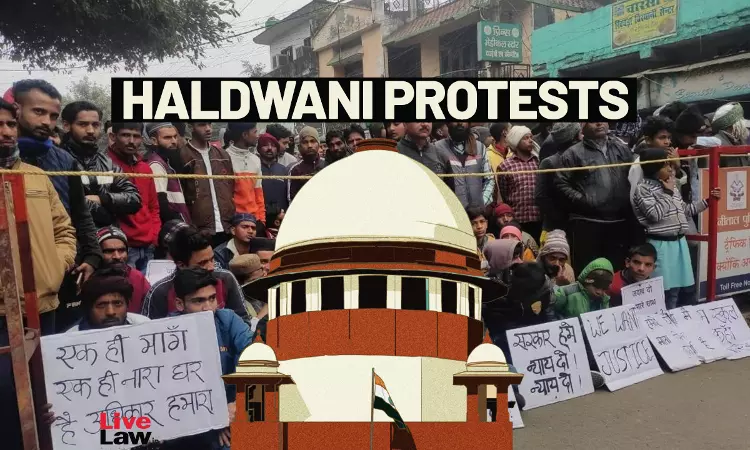
In the Haldwani eviction matter, the Supreme Court on Tuesday directed the Uttarakhand Legal Services Authorities to hold a camp to enable the families, who are facing eviction for occupying public land needed for railways, to apply for rehabilitation under the Pradhan Mantri Awaas Yojana.The Court ordered that the camp be held after March 15, on the suggestion of the petitioners that it...
This is a premium content
Available exclusively to
Our subscribers
Subscribe Premium 
INR 1099+GST
Your support helps us to bring you more content at
an affordable subscription scheme !!!
All payment options available
In the Haldwani eviction matter, the Supreme Court on Tuesday directed the Uttarakhand Legal Services Authorities to hold a camp to enable the families, who are facing eviction for occupying public land needed for railways, to apply for rehabilitation under the Pradhan Mantri Awaas Yojana.
The Court ordered that the camp be held after March 15, on the suggestion of the petitioners that it be conducted after the month of Ramzan. The Court directed the Nainital district collector and other revenue authorities to give necessary assistance. The exercise has to be completed before March 31.
The Collector should determine the family-wise eligibility of the applicants under the PMAY and submit a report to the Court.
A bench comprising Chief Justice of India Surya Kant and Justice Joymalya Bagchi was hearing the petitions challenging the December 2022 order of the Uttarakhand High Court ordering the eviction of nearly 50,000 persons who have allegedly encroached upon the public land in Haldwani in Uttarakhand. In January 2023, the Supreme Court stayed the High Court's direction and the interim order was extended from time to time.
In July and September 2024, the Court had passed directions to the State, the Union and the Railways to come up with a rehabilitation plan for the persons to be relocated from the public land.
During today's hearing, the bench observed that nobody can claim a right to occupy public land. The only thing the persons can claim is that they be rehabilitated, and even that is "more of a privilege than a right", the bench opined.
"There is no question that it is the land of the state and it is prerogative of the state to decide how to use the land. Only thing is they have been staying there and now the issue is when they are asked to leave, they be given some cushion. Our prima facie view is that it is more of a privilege and less of a right," Justice Bagchi said.
CJI Kant emphasised that the occupants cannot dictate how Railways should utilize the land. The bench also commented that it was unsafe and risky for the people to stay so close to railway lines, and it was better than they move to a better place.
Additional Solicitor General Aishwarya Bhati submitted that the occupants can be rehabilitated under the Pradhan Mantri Awaas Yojana. She asserted that the land was essential for the development projects of the railways.
Advocate Prashant Bhushan submitted that there are nearly 5000 families in the area, who have been living there for years. Even schools and other public institutions exist there, he added. He however welcomed the suggestion of rehabilitation. "This is a salutory order, but my hunch is that, very few are going to be found eligible," Bhushan said after the order was dictated.
Senior Advocate Salman Khurshid, for some petitioners, submitted that the area has been notified as a slum, and the benefit of the slum rehabilitation schemes also would apply. He also requested the Court to make some provisions for schools, hospitals and places of worship existing there.
CJI said that there has to be a balanced and flexible approach, so that the State's developmental needs as well as the rehabilitation of persons can be ensured.
"At the end of the day, it is a question of lives of thousands of families. A flexible approach can save them. They will be the worst losers of this litigation. Right now, we don't know about the schooling of the children, the condition of their homes, from where drinking water is coming...there has to be a solution, a balanced approach," CJI Kant said.
Case Title: Abdul Mateen Siddiqui v. Union of India and Ors. Diary No. 289/2023 (and connected cases)


