



- Home
- /
- Top Stories
- /
- 'How Can BCI Regulate Law...
'How Can BCI Regulate Law Colleges?What Do They Know About Legal Education?' Supreme Court Asks
Debby Jain
23 Sept 2026 11:38 AM IST
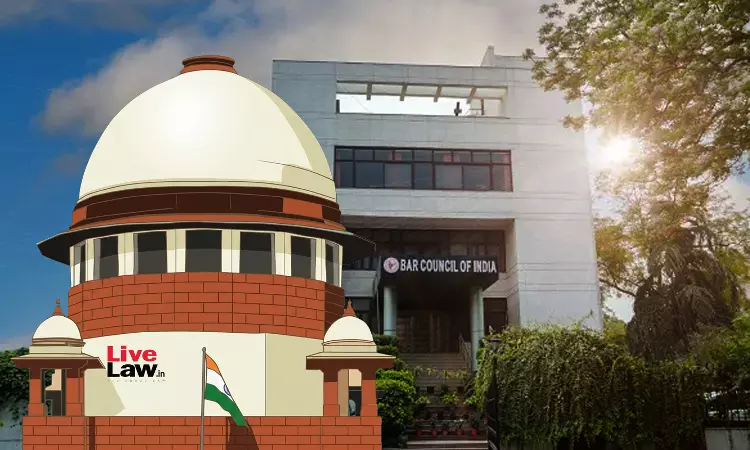
The Supreme Court observed that it will examine whether the BCI has the statutory powers to regulate legal education.
The Supreme Court on Wednesday observed that it will examine whether the Bar Council of India (BCI), as a statutory regulator of the legal profession, has the power to control and regulate law colleges or universities.The Court questioned how the BCI could be considered an expert body to regulate legal education, observing that eminent law scholars and academics were better placed to deal...
This is a premium content
Available exclusively to
Our subscribers
Subscribe Premium 
INR 1099+GST
Your support helps us to bring you more content at
an affordable subscription scheme !!!
All payment options available
The Supreme Court on Wednesday observed that it will examine whether the Bar Council of India (BCI), as a statutory regulator of the legal profession, has the power to control and regulate law colleges or universities.
The Court questioned how the BCI could be considered an expert body to regulate legal education, observing that eminent law scholars and academics were better placed to deal with academic matters. The Court orally said that while the BCI could lay down general guidelines, such as prescribing whether a law course should be of four or five years' duration, it could not exercise control over legal education.
A bench comprising Chief Justice of India Surya Kant, Justice Joymalya Bagchi and Justice V Mohana was hearing pleas challenging the functioning of the BCI-PEARL FIRST Trust and the establishment of law institutions by the Trust.
Advocate Prashant Bhushan, appearing for the petitioners, submitted that the BCI had, in 2016, passed a resolution abolishing its earlier Trust and transferring its funds to a new Trust. He also referred to a pending CBI investigation and questioned the subsequent creation of the BCI-PEARL FIRST Trust.
Bhushan alleged that BCI Chairman Manan Kumar Mishra had declared himself a lifetime trustee of the Trust and that the Trust subsequently established one law college in Goa and another in Andhra Pradesh.
He further challenged two State legislations concerning the institutions, arguing that they effectively placed the institutions under the control of the BCI.
"The Acts say BCI will nominate 27 out of 35 members of the Executive Council. It also says the Trust will run the law colleges," Bhushan submitted.
Senior Advocate Guru Krishna Kumar, appearing for the BCI, submitted that the matter had been deliberated upon following the Court's earlier observations questioning the clauses allowing BCI officebearers to be permanent trustees even after their tenure. He said that the BCI had now passed a resolution providing that there would be no lifetime trustees and that the tenure of trustees would be co-terminus with their membership of the BCI.
Bhushan, however, maintained that the statutory provisions themselves confer substantial control over the institutions on the BCI. Bhushan argued that a regulator could not itself run an institution which it was required to regulate.
"The regulator can't run this law college," he submitted, adding that it raised an issue of conflict of interest.
The CJI noted that the first law school in the country had also been established by the BCI. Bhushan responded that the institution referred to by the Court was a public university and its Executive Council was not dominated by the BCI. The petitioners also questioned the proposed fee structure, with Bhushan referring to a proposed charge of ₹25,000.
The CJI then summed up the real issue arising for consideration: "How can BCI regulate law colleges? That's the real question."
The CJI observed that the statutory role of the BCI comes into existence after a person obtains a licence to practise law, and questioned whether that statutory role extends to regulating a law school or university.
"Whether law school can be regulated? If that is answered, this is resolved. We'd like to examine whether BCI has power to control and regulate university/law college," the CJI said.
The CJI further observed that regulation of law colleges ought to involve experts in academic fields.
"How the BCI is expert body to regulate legal education? What do they know about legal education? There are eminent law scholars, academia...you can lay down general guidelines...curriculum should be 4 or 5 year...but you can't control"
Senior Advocate Shobha Gupta, appearing in a connected matter, submitted that crores of rupees are coming into the Trust, and the matter required scrutiny.
The bench issued notice on the petition, and sought for the response of the Bar Council of India.
Case: GIRISH MITTAL Vs BAR COUNCIL OF INDIA | W.P.(C) No. 1115/2026
Tags

Debby Jain
Debby Jain is a Correspondent with LiveLaw, covering the Supreme Court of India

