



- Home
- /
- Top Stories
- /
- How Can Non-Devotees Of Lord...
How Can Non-Devotees Of Lord Ayyappa Challenge Sabarimala Custom? Supreme Court Asks
Gursimran Kaur Bakshi
8 April 2026 4:48 PM IST
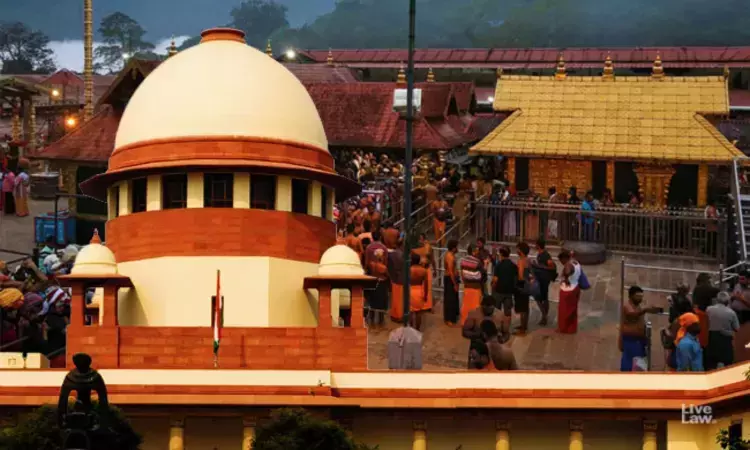
If no devotee has challenged it, why should the Court entertain a petition by a person having no concern in the temple, the bench asked.
The 9-judge bench of the Supreme Court, hearing the reference on the Constitutional questions arising from the Sabarimala temple women-entry case, asked how persons who are not devotees of Lord Ayyappa could challenge the temple custom.It was on a Public Interest Litigation filed by an organisation named "Indian Young Lawyers Association" that the Supreme Court in 2018 struck down the...
This is a premium content
Available exclusively to
Our subscribers
Subscribe Premium 
INR 1099+GST
Your support helps us to bring you more content at
an affordable subscription scheme !!!
All payment options available
The 9-judge bench of the Supreme Court, hearing the reference on the Constitutional questions arising from the Sabarimala temple women-entry case, asked how persons who are not devotees of Lord Ayyappa could challenge the temple custom.
It was on a Public Interest Litigation filed by an organisation named "Indian Young Lawyers Association" that the Supreme Court in 2018 struck down the restriction on the entry of women in the age group of 10-50 years to the Sabarimala Lord Ayyappa temple.
Justice BV Nagarathna, part of the 9-judge bench, asked if the petitioner was an organisation of devotees. Solicitor General of India Tushar Mehta replied that they were not.
Justice Nagarathna then asked how persons who are not devotees of Lord Ayyappa could challenge the custom of the temple.
Justice Nagarathna further asked if a devotee would have challenged the custom. "They are not devotees. Let us be clear, can any devotees of Lord Ayyappa file a writ petition challenging it? A non-devotee, a person who is not concerned with the temple, challenges it. Can this court entertain the writ petition?"
Justice Nagarathna added that if such an organisation had filed a civil suit challenging the custom, it would have been rejected under Order VII Rule 11 CPC on the ground of having no cause of action or causal connection.
Solicitor General Tushar Mehta pointed out that this was exactly one of the questions referred to the 9-judge bench - Whether a person not belonging to a religious denomination or religious group can question a practice of that religious denomination or religious group by filing a PIL?
Justice Nagarathna said that this question must be decided first. "No devotee has challenged it, it is the person who has no concern," she said.
Chief Justice of India Surya Kant noted that the 2018 Sabarimala judgment had held that the Court can intervene when an issue of public interest is brought before it, regardless of the locus of the petitioner. CJI added that if the locus was an issue, then the writ petition should have been dismissed in 2006 itself, when it was filed. "If it was to be dismissed at the threshold, it should have been done in 2006," the CJI said. The Solicitor said that it could have been dismissed with a two-page order that the person had no locus.
The Chief Justice also expressed that only persons who are personally aggrieved can agitate issues relating to Articles 25 and 26 of the Constitution. "Your objection is Articles 25 and 26, these are all personal issues, somebody who has grievance can only come to the court," CJI said. SG said that the minority judgment of Justice Indu Malhotra took this view, by saying that a stranger or a third party cannot question the practice.
Senior Advocate Indira Jaising, appearing for the original writ petitioners, said that if the writ petition is non-maintainable, then the reference should be discharged.
"We are 20 years down the line, if you want to dismiss, dismiss it, we will pack our bags and go and discharge the reference," she said. The CJI then commented, "That is why I said it should have been dismissed in 2006 itself."
Jaising replied : "Either we address you or we don't on the merits. If your lordships feel there is no need to address on merits, kindly discharge the reference. We will deal with the question as and when the case arises in each individual cases. There are seven cases, relating to Parsi women, Muslim women ," Jaising submitted.
The Solicitor General asked if he could file a writ petition demanding entry of Muslim women in mosques. "Would the Court not ask me how am I concerned? Let an affected lady come."
Justice Nagarathna reiterated her query, "If no devotee is challenging it, why should this court concern with a non-devotee?"
Senior Advocate Rajeev Dhavan, submitted that the concept of PIL was developed to allow carriage of proceedings on behalf of others who are underrepresented. If such a petition is filed on behalf of Hindu women, would the Court dismiss it at the threshold, Dhavan asked. "Yes, because no devoteee has come, and why should this Court concern itself about a non-devotee?" Justice Nagarathna replied.
The CJI said that the stage of considering the locus of the Sabarimala petitioners has already been crossed.
SG argued that the concept of PIL was evolved to enable legal representation for those who were incapable of approaching the Courts. However, most PILs are now being filed for the sake of vested agendas, he added. He said that PILs are no longer necessary since there are avenues for free legal aid, e-filing and virtual courts, bringing justice to the doorsteps of a citizen.
"Now, no one really needs representation through another for an unrepresented class. National Legal Services Authority is there. District Legal Services Authorities are there. If someone has no means, they can approach the District Legal Services Authority and say- my fundamental rights are violated, advise me, or file a petition on my behalf before the Supreme Court or the High Court. Then why, my Lords, should such PILs be entertained? And we know that many PILs today are motivated PILs. Somebody else is behind them," SG said,
CJI also agreed with the SG's view regarding misuse of PILs, but said that there was no requirement to lay down general principles regarding PIL in the present reference proceedings.
"On a general principle of PIL, we may not even need to hear you. We agree with you that the Court has to be very cautious in entertaining PILs today, particularly when people come with different kinds of agendas," CJI said.
A 9-judge bench of the Supreme Court is on the second day of the hearing the Constitutional issues referred to the larger bench in the Sabarimala review. Apart from CJI Surya Kant, the Bench comprises Justice BV Nagarathna, Justice MM Sundresh, Justice Ahsanuddin Amanullah, Justice Aravind Kumar, Justice Augustine George Masih, Justice Prasanna B Varale, Justice R Mahadevan and Justice Joymalya Bagchi.
Live updates can be followed here.
Gursimran Kaur Bakshi
Gursimran is the Principal Correspondent with LiveLaw for the Supreme Court. She can be reached out at: simrankaurbakshi@livelaw.in

