



- Home
- /
- Top Stories
- /
- 'How Can Right To Conscience Be...
'How Can Right To Conscience Be Taken Away By Marriage?' : Supreme Court Questions Excommunication Of Parsi Women Marrying Outside Faith
Gursimran Kaur Bakshi
5 May 2026 5:43 PM IST
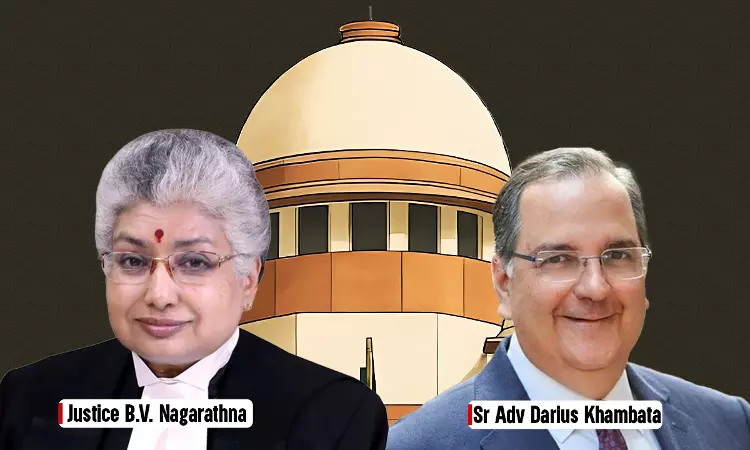
The Court commented that the practice presupposed that faith is lost by interfaith marriage.
On the 11th day of hearing in the Sabarimala reference, Supreme Court orally commented that the practice followed by Zoroastrians, barring a Parsi woman from entering the fire temple(Agiaries) if she marries outside her religion, is prima facie excommunication purely based on gender and is discriminatory.Justice BV Nagarathna made these remarks during arguments by Senior Advocate Darius...
This is a premium content
Available exclusively to
Our subscribers
Subscribe Premium 
INR 1099+GST
Your support helps us to bring you more content at
an affordable subscription scheme !!!
All payment options available
On the 11th day of hearing in the Sabarimala reference, Supreme Court orally commented that the practice followed by Zoroastrians, barring a Parsi woman from entering the fire temple(Agiaries) if she marries outside her religion, is prima facie excommunication purely based on gender and is discriminatory.
Justice BV Nagarathna made these remarks during arguments by Senior Advocate Darius J. Khambata, who represents the petitioner, Goolrokh Gupta, in the set of petitions concerning the Parsi woman's religious identity.
Gupta, born a Parsi woman, married a Hindu man under the Special Marriage Act, 1954(SMA), and continued to practice her religion. But she was barred by the Valsad Parsi Anjuman Trust, in Gujarat, from entering the temple and attending the last rites of her parents. She approached the Gujarat High Court in a writ petition, which in 2012 upheld the practice, observing that a woman's religious identity is merged with that of her husband upon marriage. That is, the common law doctrine of coverture applies, and she ceases to be a Parsi upon marrying outside her religion.
Her petition challenging the High Court order got tagged with the Sabarimala reference and came before nine-judge bench.
Khambata submitted that Zoroastrianism is a very forward-looking religion, and this practice is actually man-made, which is why it's difficult to find any religious texts that support this claim.
Justice Nagarathna asked: "So marriage is the basis for discrimination and only via the lady?"
Khambata responded that if a Parsi man marries outside his religion, he and his family will continue to have all rights, including the right to enter the fire temple. But this casting out is only for the women, and extends to her family as well. He referred to a Bombay High Court judgment in this regard.
He added that there is no uniform practice of barring Parsi women in India, as different religious trusts follow different practices.
"The petitioner trust under its previous trustees freely permitted [entry of ] intermarried Parsi women into the temples and places of worship. The Bombay Parsi Trust... has itself passed a resolution in 1991 to allow enter of women, and we have placed material records that several Anjumans across India permit entry. Valsad, suddenly under the new trustee, decided that we will impose our personal view and predilections upon this."
Khambata told the Court that a Parsi woman will have to seek a declaration from the competent Court in order for her to continue her status as belonging to the Zoroastrian religion.
While Justice Bagchi stated that the "deemed conversion" aspect is reflected in the common law doctrine of curverture, that is, the identity of the woman is merged with the man upon marriage, Justice Nagarathna said it appears to be a practice of excommunication.
"The right to conscience under Article 25(1) is a right by birth, and it can't be taken away by marriage...In this case, marriage as a basis for classification is discriminatory against women," She averred.
Seemingly agreeing to the same proposition, Justice Sundresh said: "This practice presupposes once there is inter-marriage, faith is given up." To this, Justice Nagarathna commented: "Its virtually ex-communication."
Responding to these inquiries, Khambata stated that this is being done under the SMA, which is a reformatory law coming under Article 25(2)(b), meant to prohibit such practices.
Justice Nagarathna questioned why the children of a Parsi man marrying an inter-religion have all the benefits but not a Parsi woman. "She[the woman] has got religion by birth, how can it be taken away by marriage?"
CJI Surya Kant also shared his views and stated that this case is protected under Sections 19(Effect of marriage on member of undivided family) read with 21(Succession to property of parties married under Act.) and 21A(Special provision in certain cases) of the SMA.
"The issue that you are raising may not be required to be responded to because in terms of Sections 19 and 21A, nothing more is required. Your simplest argument would be majority judgment runs contrary to the statutory scheme under Sections 19, 21 and 21A. The Statute is protected under article 25(2)(b). The statutory laws of religion only applies to Hindu and their allies expressed mentioned in the statute. So, if a marriage is solemnised by a Parsi, Muslim or Christian, they don't lose religious identity."
Gursimran Kaur Bakshi
Gursimran is the Principal Correspondent with LiveLaw for the Supreme Court. She can be reached out at: simrankaurbakshi@livelaw.in

