



- Home
- /
- Top Stories
- /
- How Supreme Court Dealt With Sonam...
How Supreme Court Dealt With Sonam Wangchuk's Detention: A Look At Questions Posed During Hearing
Gursimran Kaur Bakshi
14 March 2026 3:35 PM IST
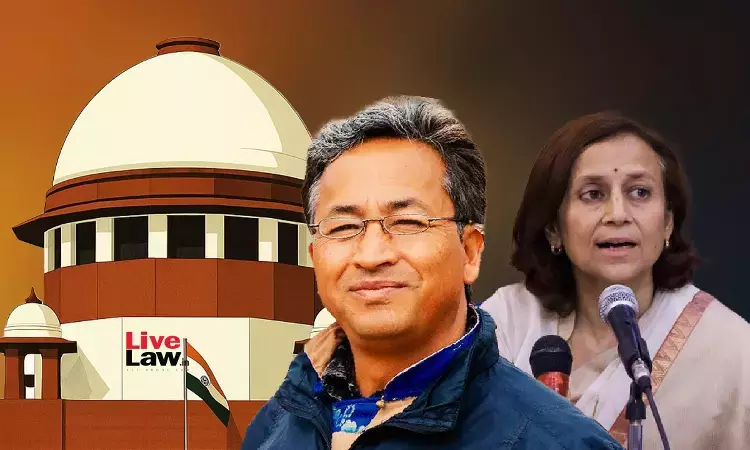
The Union Government on March 14 revoked the detention of Ladakh activist Sonam Wangchuk under the National Security Act, 1980, while his wife's habeas corpus petition challenging his detention was pending before the Supreme Court of India.During the hearing, the Court raised several questions to the Union Government regarding the circumstances surrounding Wangchuk's preventive...
This is a premium content
Available exclusively to
Our subscribers
Subscribe Premium 
INR 1099+GST
Your support helps us to bring you more content at
an affordable subscription scheme !!!
All payment options available
The Union Government on March 14 revoked the detention of Ladakh activist Sonam Wangchuk under the National Security Act, 1980, while his wife's habeas corpus petition challenging his detention was pending before the Supreme Court of India.
During the hearing, the Court raised several questions to the Union Government regarding the circumstances surrounding Wangchuk's preventive detention.
Wangchuk had been detained by the Leh District Magistrate on September 26, 2025, following protests in Ladakh demanding statehood that allegedly turned violent. The detention order alleged that he was “indulging in activities prejudicial to national security.” After his detention, he was shifted to Jodhpur Central Jail.
His wife, Dr. Gitanjali Angmo, moved the Supreme Court on October 3 seeking a writ of habeas corpus and challenging the legality of the detention. The Court issued notice to the Centre on October 6, 2025.
The matter was heard on multiple dates.
The case was scheduled to be heard on March 17 by a Bench of Justice Aravind Kumar and Justice PB Varale. However, before the hearing could take place, the Centre revoked the detention order with immediate effect, noting that Wangchuk had already undergone nearly half of the maximum detention period permitted under the NSA.
We examine some of the key questions posed by the Court during the hearing
Court urged Centre to consider release on medical grounds
An application was made to have Wangchuk examined by a specialist physician after he complained of stomachache, reportedly due to water contamination. Allowing for an examination, the Court had asked for the medical report to be submitted. After perusing the report, the Court, on February 4, urged the Centre to review Wangchuk's detention since his health was not in good condition.
The request was made by Justice Varale, who had said: "...give it a thought as the officer of the Court. The detention order was passed on 26/9/2025, nearly five months. Considering more particularly his health and condition of the detenue, which is certainly not very good. Even the report which we saw on the earlier occasion, it shows that his health is not that good, and there are certainly [other factors] age-related. Is there any possibility for the Government to rethink?"
However, the Centre refused to allow his release on medical grounds, claiming that Wangchuk's health was fine and he was getting the best of the treatment. The Additional Solicitor General went to the extent of saying that it was only because of his detention that he was getting a better treatment at AIIMS Jodhpur, as "in Ladakh, there would have been nothing."
Later, the Centre conveyed its decision that Wangchuk can't be released on medical grounds as it can't make an exception in a preventive detention matter.
Centre reading too much into speeches : Court
Throughout the hearing, the Centre alleged that Wangchuk wanted to bring an Arab Spring-like uprising to "overthrow" the government and incited the youth to self-immolate, as had happened during the uprising. It was also said that Wangchuk instigated youth to create “riot-like” situations, as happened during violent Gen-Z protests in Nepal, Bangladesh and Sri Lanka.
It was alleged that the reference to Gandhian non-violence was just a facade. Further, Wangchuk was alleged to have called for a plebiscite in Kashmir and said that Tibet under China and Balochistan under Pakistan enjoy more autonomy than what Ladakh enjoys. According to the Centre, he incited Ladakhis not to help the Indian army during wartime.
Wangchuk denied that he supported an Arab uprising or self-immolation as a form of protest. It was explained that someone had asked Wangchuk what Ladakhis could do if Sixth Schedule demands are not met. In response to this, Wangchuk had given an example of the Arab Spring and self-immolation, and the recent movements in Nepal and Bangladesh, which people around the world have followed, and suggested that we should form a Gandhian form of non-violent protest. That is how they agreed on a hunger strike.
It was also claimed that Wangchuk was told during the interview that someone had expressed that Kargil should go with Kashmir. In response, Wangchuk said that any region should go where it is happy. He asserted that he never asked the Ladakhis not to help the Indian army during war and had, in fact, said that political issues should not be mixed with nationalism.
The Court repeatedly asked how all these speeches have a nexus with what happened on September 24, and how Wangchuk instigated all this. When it was argued that Wangchuk incited youth towards violent methods of protest under the facade of Gandhian ways of protest, Justice Kumar remarked that the Centre is reading “too much into” his speeches. Justice Varale said that Wangchuk had in fact shown concern that young people are abandoning the Gandhian ways of protest.
Justice Kumar also told the SG at one point during the hearing : "If you say we don't ask any questions, we won't ask any questions."
Questions over four videos
Since the very beginning, Wangchuk maintained that he was supplied with incomplete grounds of detention on September 29. 4 videos (dated September 10, 11 and 24) referred in the detention order were supplied to him after 28 days, only on October 23, and the hearing of the Advisory Board was the next day. It was also submitted that Wangchuk had made various representations to the authorities asking for the four videos to be furnished, but he was not given any response.
The affidavit filed by the Leh District Magistrate stated that Wangchuk was supplied with grounds of detention on September 29, within the 5 days specified under Section 8 of the NSA. It was vehemently claimed that it is an “afterthought” to claim that four videos were not supplied to him, as DIG Ladakh had personally gone to meet him and showed him the contents of the detention order. The whole exercise was videographed. Later, it also pointed out that there is an acknowledgement by Wangchuk as well that he has seen those four videos.
Subsequent to this, Wangchuk had submitted that indeed it was videographed, but the video had no audio, and Wangchuk was only shown the thumbnails of the folders, which apparently contained those videos. It was mentioned that Wangchuk did not raise this issue then because he was under the impression that he would be able to see it later and challenge it. Wangchuk was given a laptop on October 5, and when he checked the pendrive, the four videos were not there. It was also mentioned that a day before, on October 4, the Advisory Board had already confirmed his detention.
The Court questioned whether there was an endorsement by Wangchuk that he had seen those four videos.
Justice Varale asked if there was any specific evidence on record to show that Wangchuk had seen those videos, considering he had written four to five letters asking for those videos, and there was no response. It ordered that the pendrive furnished to Wangchuk on September 29 be placed in a sealed cover before the Court.
Justice Varale asked: "Whether such endorsement was obtained that videos are being shown to the detenue and the detenue has seen the video? This endorsement only refers to that he has received documents in a pen drive. It is not disclosed in the endorsement that he had occasion to see the video[s]... If you have shown the video, you could have drawn a statement to that effect and obtained his signature."
Justice Kumar also questioned why no reply was given to the queries regarding this by Wangchuk. Justice Kumar said: "ASG Nataraj, he only said he received documents as per the above index...but he does not say he has seen the contents of those videos."
Justice Kumar told Nataraj, "Mr Nataraj, assuming for a moment, say, we accept your contention, then when he gave this representation, you could have just denied it...Have you done it?... More particularly, when the matter was seized by this matter...This is 13 October, by which time we were hearing the matter. Let us give that video."
Court flags inaccuracy with translations of speeches
Wangchuk had raised the issue of the translation of speeches in the arguments and during rejoinder. It was argued that the speeches were deliberately misinterpreted, and his speech appealing for peace was not placed before the detaining authority. The Court orally questioned the accuracy of the translation given by the Union and remarked that there should not be any malice in the context that if Wangchuk's original speech is of 3-4 minutes, the translation should not be of 10 minutes. The bench then asked for a true translation of all speeches along with the original records.
Justice Kumar orally stated that in the era of artificial intelligence, the accuracy is about 98% in translation.
Justice Kumar said: "Even in the tabular column you have given[chart by Additional Solicitor General KM Nataraj], this does not find a place at all...that does not find a place in the detention order. If this is the basis on which you formed your opinion order for detaining him, it should find a place. "
Justice Varale orally remarked: "There should be at least the correct transcript of what he states. You may have your reasons, assuming you are supporting the order, saying that it was for the detaining authority, in what way the speech was given and whether it had the impact or effect. At least whatever he stated in the speeches, we expect the true translation. There should not be any malice or it should not be that what he said is 2-3 minutes, and your translation goes for 7 to 8 minutes, 10 minutes. Whereas, the speech is of 3 minutes, saying that I condemn this, let us stop this, perhaps we started, but as the violence is there, let us stop this. That is only 3 minutes and your translation goes to 10 minutes, then there is certainly a big variance in that."
In response to the questions raised by the Court, the Centre said it wanted to say something "substantial" on this. But no effective hearing took place after that, and the matter got adjourned on the next few dates. Last week, the matter was adjourned till March 17 due to the ill health of the Solicitor General. Ahead of next week's hearing, Wangchuk's detention was revoked today.
Case Details GITANJALI J. ANGMO v UNION OF INDIA AND ORS|W.P.(Crl.) No. 399/2025
Appearances: Senior Advocate Kapil Sibal (for Angmo) and Solicitor General Tushar Mehta(for Union) and Additional Solicitor General KM Nataraj for Leh
The writ petition has been filed by Advocate on Record, Dr Sarvam Ritam Khare
Tags
Gursimran Kaur Bakshi
Gursimran is the Principal Correspondent with LiveLaw for the Supreme Court. She can be reached out at: simrankaurbakshi@livelaw.in

