



- Home
- /
- Top Stories
- /
- Impound Vehicles With Unpaid...
Impound Vehicles With Unpaid E-Challans, Freeze Online Services: Supreme Court Orders, Notes Over ₹23,000 Crore Traffic Fines Pending
Yash Mittal
1 Oct 2026 4:38 PM IST
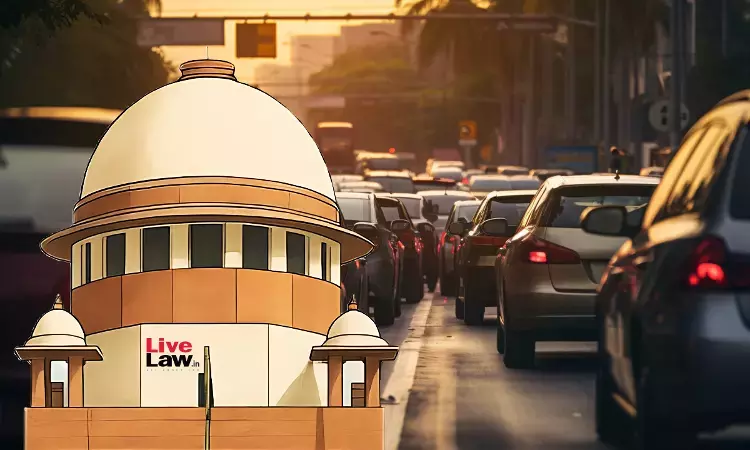
The Court also ordered the freezing of online services, blacklisting and denial of fitness/PUC certificates for unpaid e-challans.
The Supreme Court has directed States and Union Territories to take stringent measures to recover pending traffic fines, including impounding vehicles found with unpaid e-challans during random checks and freezing online services relating to vehicles until outstanding dues are cleared.The Court observed that merely issuing thousands of e-challans would serve little purpose unless the...
This is a premium content
Available exclusively to
Our subscribers
Subscribe Premium 
INR 1099+GST
Your support helps us to bring you more content at
an affordable subscription scheme !!!
All payment options available
The Supreme Court has directed States and Union Territories to take stringent measures to recover pending traffic fines, including impounding vehicles found with unpaid e-challans during random checks and freezing online services relating to vehicles until outstanding dues are cleared.
The Court observed that merely issuing thousands of e-challans would serve little purpose unless the authorities ensured recovery of the fines. The Court was informed that approximately ₹49,194.05 crore remained recoverable towards e-challans issued across the country, out of which ₹26,175.05 crore had been recovered.
The directions were passed on September 28 in the ongoing road safety case S. Rajaseekaran v. Union of India, which the Supreme Court has been monitoring since 2012.
"It is not just sufficient to keep issuing e-challans to the person who is alleged to have violated the provisions of the Act. Police may issue thousands and lakhs of such e-challans but the question is how do you recover the fine as sought to be imposed by way of those e-challans," the Court observed.
The Bench directed that vehicles be subjected to random checks and that necessary steps be taken to impound a vehicle if it is found that an e-challan issued against it has not been honoured.
“We also direct that let there be random checking of the vehicles and if it is found that the e-challan issued has not been abided or honored, necessary steps shall be taken to impound the vehicle itself.”, ordered the bench.
Apart from impounding of the vehicles, the Court has also directed all States and Union Territories to adopt stringent measures for recovery of unpaid e-challans, including freezing online vehicle-related services, blocking ownership transfers, denying fitness and PUC certificates, and blacklisting vehicles on the Parivahan Portal.
“…what is expected of the Authorities insofar as effective implementation of recovery of fine etc. is concerned is to freeze the online services for vehicles which have outstanding amounts. The Authorities shall bar from renewing registration certificate, issuing duplicate registration certificate and also shall not entertain any request for updating owner's address etc. The authorities shall also deny fitness certificate until all pending traffic fines are entirely cleared and further there should be blacklisting of the vehicle concerned on the Parivahan Portal. This will come in the way of the person concerned if he wants to sell his vehicle. The authorities should also proceed to block ownership transfer. For multiple violations, the driving license shall be suspended from renewal and measures shall also be taken to suspend the driving license which may be in force. What is most important is that no Center should be permitted to issue PUC certificate.”, the Court ordered.
The aforesaid mechanism was ordered by the Court after noting that the existing mechanism, which ordinarily requires e-challans to be sent to the jurisdictional court for recovery of the fine, would be insufficient, considering the mounting number of challans pending for recovery.
The Court also cautioned authorities that repeated directions would be of little consequence if they were not implemented on the ground.
“We may keep issuing directions for an indefinite period of time, but if all these directions are going to remain on paper and ultimately not going to be implemented by the authorities, then one fine day, we may have to take some stern action which may not be liked by the authorities.”, the Court said.
Other Directions Include:
1. AI-Based Electronic Enforcement
The Court further directed States/UTs, the National Highways Authority of India and other road-owning agencies to ensure that electronic enforcement systems installed under the statutory framework are AI-enabled and capable of detecting the 12 categories of violations specified under Rule 167A(3) of the Central Motor Vehicles Rules, 1989. The systems are to facilitate generation of e-challans in accordance with law across the country.
2. National Road Safety System And Data Integration
While implementing the Standard Operating Procedure dated October 28, 2025, prepared by the Ministry of Road Transport and Highways (MoRTH), the Court directed the Ministry to examine how recommendations contained in the NCRB Concept Paper/Plan of October 2023 could be incorporated into a supplementary action plan for strengthening nationwide electronic enforcement under Section 136A of the Motor Vehicles Act which mandates the electronic monitoring and enforcement of road safety across national highways, state highways, and specified urban areas.
The proposed framework includes establishment of a National Road Safety System, an appropriate institutional and funding mechanism, and interoperable integration of VAHAN-4, SARATHI, e-Challan, e-DAR, IRAD and State/Central Traffic Control Rooms for real-time exchange of enforcement and road-safety data.
3. Monthly Public Dashboard Ordered
To bring transparency, the Court directed MoRTH to establish a public online dashboard monitoring implementation of Section 136A of the Motor Vehicles Act read with Rule 167A of the CMVR and the October 28, 2025 SOP.
The dashboard is to provide State/UT-wise and National Highway corridor-wise information concerning, corridors identified for electronic enforcement; number and functional status of electronic enforcement devices; categories of violations being monitored; and violations detected vis-à-vis e-challans generated.
The information is to be updated at least once every month. The Court also directed that annual data may form part of MoRTH's “Road Accidents in India” report.
(Note: The Court's suggestion that the pending e-challan dues ought to be recovered from the electricity bills was an oral remark, not part of an order uploaded today.)
Tags

Yash Mittal
Yash Mittal is a Correspondent with LiveLaw, covering the Supreme Court of India

