



- Home
- /
- Top Stories
- /
- In Farewell Speech, Justice Pankaj...
In Farewell Speech, Justice Pankaj Mithal Flags Judicial Pendency, Warns Against Unchecked AI Use
Amisha Shrivastava & Gursimran Kaur Bakshi
29 May 2026 6:49 PM IST
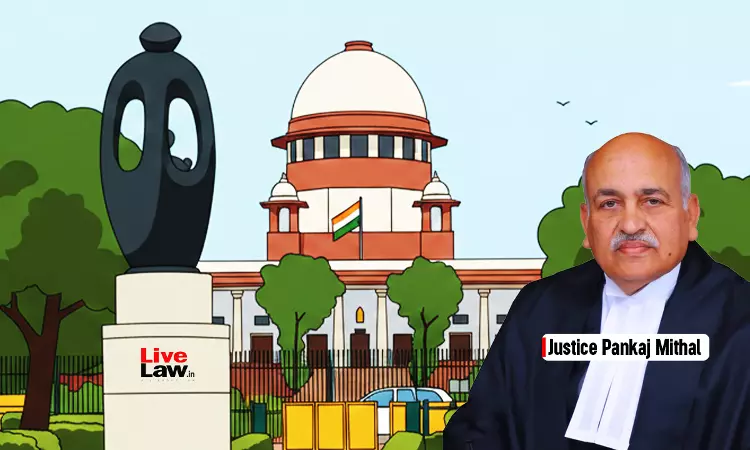
At a farewell function organised by the Supreme Court Bar Association for retiring Supreme Court judges Justice Pankaj Mithal and Justice JK Maheshwari, Justice Mithal expressed concern over mounting judicial pendency and cautioned lawyers against overreliance on artificial intelligence.Justice Mithal stressed that the mounting pendency of cases was not merely a statistical or...
This is a premium content
Available exclusively to
Our subscribers
Subscribe Premium 
INR 1099+GST
Your support helps us to bring you more content at
an affordable subscription scheme !!!
All payment options available
At a farewell function organised by the Supreme Court Bar Association for retiring Supreme Court judges Justice Pankaj Mithal and Justice JK Maheshwari, Justice Mithal expressed concern over mounting judicial pendency and cautioned lawyers against overreliance on artificial intelligence.
Justice Mithal stressed that the mounting pendency of cases was not merely a statistical or administrative issue but one that directly affected the lives and liberties of millions of citizens.
“As I near the conclusion of my journey, one concern increasingly occupies my mind, the condition and the future of the judicial delivery system. From the vantage point of Supreme Court, one gets a wider and sometimes a sobering view of the challenges confronting the judiciary. The mounting pendency of cases is not merely a statistical issue or an administrative concern, it directly affects the lives, liberties and aspirations of millions of citizens who approach courts with hope and faith. Every pending case represents a human story awaiting resolution, a family dispute prolonging distress, an undertrial awaiting liberty, a commercial matter affecting livelihoods, or a citizen seeking protection of constitutional rights. Behind every file lies a human life suspended in uncertainty. Delay in justice burdens not only the institutions but the society itself”, he said.
He acknowledged the pressures faced by constitutional courts, which are increasingly required to address questions involving governance, technology, liberty, economic regulation, social justice and constitutional morality. Despite imperfections and delays, he noted, ordinary citizens continue to approach courts because they believe justice will ultimately prevail, and preserving that trust remains the foremost duty of every stakeholder in the system.
Justice Mithal opined that the solution to these challenges lay not only in increasing infrastructure and judicial strength but also in strengthening institutional culture, discipline, efficiency and sensitivity. While technology and reforms can assist the system, he noted, the soul of justice delivery ultimately depended on human commitment.
Addressing young lawyers and junior advocates, Justice Mithal said professional success does not come through shortcuts or superficial presentations but through relentless hard work, continuous dedication and commitment to clients and the court. He advised lawyers to maintain humility and accessibility, saying these qualities earn lasting respect from both the Bar and the Bench.
He also cautioned against excessive reliance on artificial intelligence. While acknowledging that technology can assist lawyers in research and access to information, it cannot replace careful legal reasoning, ethical responsibility and judicial consciousness, he said.
“The legal profession today stands at the threshold of a technological information transformation driven by artificial intelligence. While technology can assist lawyers in research, organization and access to information, we must remain cautious that convenience does not replace careful legal reasoning. No software, however advanced, can substitute the trained human mind, ethical responsibility and judicial consciousness that the justice system requires”, he stressed.
He pointed out that courts were already witnessing inaccurate pleadings, false citations and careless drafting arising from unchecked reliance on artificial intelligence, thereby weakening professional standards and undermining the credibility of institutions.
He emphasised, “Technology must remain a tool of aid in the hands of the advocates, not a replacement for the advocates intellect, responsibility and duty to the court.”
Speaking about the role of lawyers, Justice Mithal noted that the society often views the profession through the lens of conflict and litigation, but true advocacy extends far beyond courtroom battles.
“The role of the bar becomes even more critical in preserving public faith in the justice system…Lawyers are the architects of peace and peacemakers within our social order. Your primary calling is to mend social fracture fractures, resolve long standing disputes, and restore harmony where there is discord. By promoting reconciliation, honest settlement and mutual understanding, you make justice sulabh, sasta and saral – accessible, affordable and simple”, he said.
Justice Mithal concluded by thanking his fellow judges, members of the Bar, registry officials, court staff, personal staff and law clerks for their support throughout his career.
Justice Mithal was born on June 17, 1961, in Meerut in a family of lawyers. He enrolled with the Bar Council of Uttar Pradesh in 1985 and began practice at the Allahabad High Court, primarily handling civil matters including land acquisition, rent control, education, labour, motor accident and constitutional cases.
A third-generation lawyer, he was elevated as an Additional Judge of the Allahabad High Court on July 7, 2006, and became Chief Justice of the High Court of Jammu and Kashmir and Ladakh on January 4, 2021, and was transferred as Chief Justice of the Rajasthan High Court on October 14, 2022.
He was elevated to the Supreme Court on February 6, 2023. In December 2025, he was conferred the degree of Doctor of Laws (LL.D.), Honoris Causa, by the Rajiv Gandhi National University of Law, Patiala. Justice Mithal is due to retire on June 16, 2026.
Tags


