



- Home
- /
- Top Stories
- /
- India Not Patriarchal Or Gender...
India Not Patriarchal Or Gender Stereotyped As The West Understands : Solicitor General To Supreme Court In Sabarimala Reference
Anmol Kaur Bawa
7 April 2026 3:41 PM IST
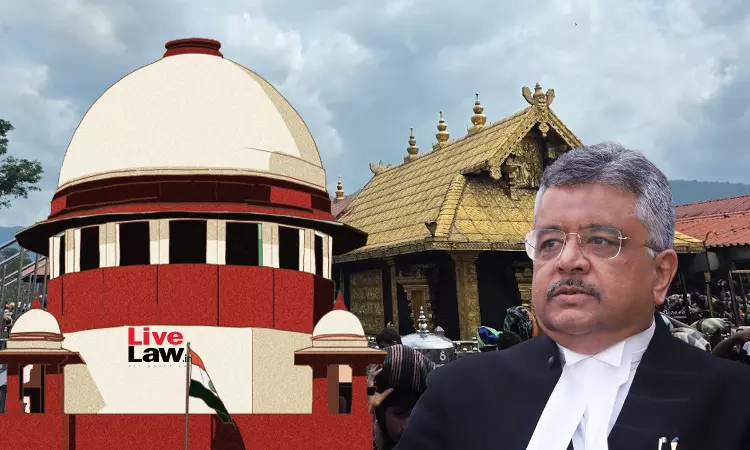
"India has always treated women equally; we have always treated them at a higher pedestal," SG submitted.
The Solicitor General of India, Tushar Mehta, on Tuesday submitted before the Supreme Court in the Sabarimala reference that India cannot be characterised as a patriarchal or gender stereotyped society in the manner understood in Western discourse, while opposing the extension of constitutional doctrines such as untouchability to gender-based temple entry restrictions.Addressing the...
This is a premium content
Available exclusively to
Our subscribers
Subscribe Premium 
INR 1099+GST
Your support helps us to bring you more content at
an affordable subscription scheme !!!
All payment options available
The Solicitor General of India, Tushar Mehta, on Tuesday submitted before the Supreme Court in the Sabarimala reference that India cannot be characterised as a patriarchal or gender stereotyped society in the manner understood in Western discourse, while opposing the extension of constitutional doctrines such as untouchability to gender-based temple entry restrictions.
Addressing the 9-judge Bench, the Solicitor General stated:
"India is not that patriarchal or gender stereotyped that the West understands."
The Solicitor General further submitted that Indian society has historically accorded women a position of reverence and respect, pointing out that the cultural ethos of the country reflects deep respect for women in both spiritual and public life.
He stated:
"India has always treated women equally; we have always treated them at a higher pedestal... there are several judgments of the recent past where there are concepts of 'patriarchial society' or there are some 'gender stereotypes'. My lords, they were never there."
Emphasising the unique cultural position of women in India, he added:
"We are the only society, we worship ladies. fFom the President of India, to the Prime Minister of India, to the Judges of the Supreme Court, we bow down for our leading ladies, so let us not introduce those concepts of patriarchy or gender stereotypes."
'Founding mothers of the Constitution'
The Solicitor General then turned to the debates of the Constituent Assembly to emphasise the role played by women members in shaping the constitutional framework governing religious freedom.
He referred specifically to Rajkumari Amrit Kaur and Dr. Hansa Mehta, submitting that these leaders played a decisive role in ensuring that regressive social practices were not revived through an expansive interpretation of religious liberty.
The Solicitor General stated that they had objected to the use of certain expressions in the draft constitutional provisions and had cautioned against language that might allow past social evils to return.
At this stage, Justice Nagarathna remarked that the women members of the Constituent Assembly should be recognised for their foundational contributions to constitutional development.
She observed:
"We call them the founding Mothers; we always say the Founding Fathers of the Constitution, so let us call these women the Founding Mothers of the Constitution."
Phrase 'All Persons Equally Entitled' In Article 25 Reflects Secularism, Not Gender Equality: SG
The Solicitor General also addressed the interpretation of the phrase "all persons are equally entitled" in Article 25, contending that its inclusion was rooted in concerns about religious harmony rather than gender equality.
He submitted that the framers introduced the phrase in the context of communal tensions surrounding Partition, with the objective of ensuring that no religious group could claim preferential rights based on numerical strength.
"All persons are equally entitled- these words are introduced for the first time. The intention was that one religion may not claim better rights merely based upon numerical strength."
He argued that gender equality was already addressed through Articles 14 and 15 of the Constitution and therefore should not be read into Article 25 as an independent basis to regulate religious practices.
Describing the phrase as a reflection of constitutional secularism, he submitted:
"It is a manifestation of secularism; it has nothing to do with gender."
Article 26 Protects Rights Of Sub-Groups Within Religious Denominations: SG
The Solicitor General also explained the scope of Article 26, particularly the phrase "any section thereof," submitting that the provision was intentionally framed to protect the rights of smaller groups within larger religious denominations.
He argued that this formulation ensures that diverse sects and sub-communities within a religion are able to manage their own religious affairs independently.
Illustrating this point, he referred to religious institutions that are visited by followers of multiple faiths and submitted that such institutions would still qualify as a denomination or a section of a denomination within the meaning of Article 26.
He stated:
"The phrase 'any section thereof' has been purposively added by the framers to include not just a whole denomination but also a section of a religious denomination."
The hearing in the Sabarimala reference is continuing before the Constitution Bench.
Live updates can be followed here.
Also from today's hearing - 'There Can't Be Untouchability For 3 Days A Month', Justice Nagarathna On Article 17 Application In Sabarimala Case
Case Title: KANTARU RAJEEVARU Versus INDIAN YOUNG LAWYERS ASSOCIATION THR.ITS GENERAL SECRETARY MS. BHAKTI PASRIJA AND ORS., R.P.(C) No. 3358/2018 in W.P.(C) No. 373/2006
Tags

Anmol Kaur Bawa
Reporter

