



- Home
- /
- Top Stories
- /
- 'Industry' Definition : No Clear...
'Industry' Definition : No Clear Majority Emerges From Supreme Court Judgment, Only 4 Out Of 9 Judges Back New Test
Gursimran Kaur Bakshi
23 Aug 2026 10:26 AM IST
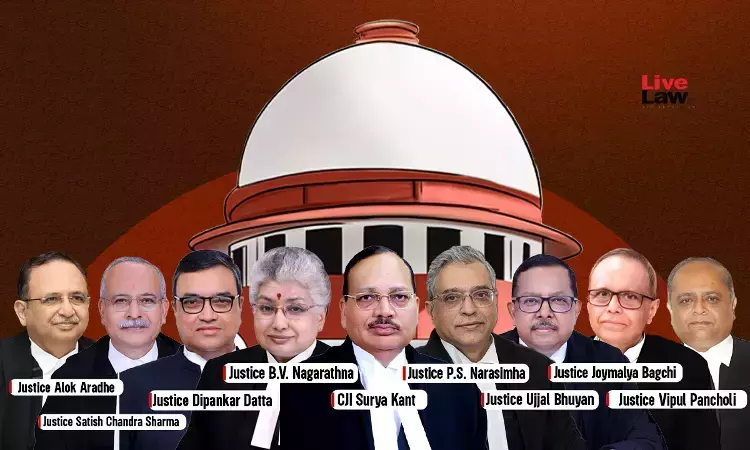
The verdict has a 4-4-1 outcome regarding the correctness of the 1978 judgment in the Bangalore Water Supply case.
The Supreme Court's much-awaited nine-Judge Bench judgment on the meaning of “industry” under the Industrial Disputes Act, 1947 does not appear to yield a clear majority in favour of the new test formulated by Chief Justice of India Surya Kant.While the Chief Justice's formulation is supported by three other judges(Justice Satish Chandra Sharma, Justice Alok Aradhe and Justice...
This is a premium content
Available exclusively to
Our subscribers
Subscribe Premium 
INR 1099+GST
Your support helps us to bring you more content at
an affordable subscription scheme !!!
All payment options available
The Supreme Court's much-awaited nine-Judge Bench judgment on the meaning of “industry” under the Industrial Disputes Act, 1947 does not appear to yield a clear majority in favour of the new test formulated by Chief Justice of India Surya Kant.
While the Chief Justice's formulation is supported by three other judges(Justice Satish Chandra Sharma, Justice Alok Aradhe and Justice Vipul Pancholi), four judges [ Justice BV Nagarathna, Justice Dipankar Datta, Justice Ujjal Bhuyan, & Joymalya Bagchi ]specifically affirm the correctness of the interpretation laid down by the seven-Judge Bench in Bangalore Water Supply & Sewerage Board v. A. Rajappa. Justice PS Narasimha reaches the conclusion of not disturbing Bangalore Water Supply, but on a different ground - that the Industrial Disputes Act has already been repealed and replaced by the Industrial Relations Code, 2020.
CJI's new formulation gets support from four
The judgment authored by CJI, for himself and three others, held that Justice VK Krishna Iyer's triple test, laid down in the Bangalore Water Supply judgment(1978) on the interpretation of the word "industry" as occurring in the now-repealed Industrial Disputes Act 1947, needs reconsideration because it goes beyond its natural statutory boundaries.
It has been stated that Justice Iyer's triple test encapsulated the widest range of activities, including social initiatives, charitable undertakings, and welfare activities, as industry, which was not the intention of Parliament. This may advance workers' rights and the protective objectives of labour welfare legislation, but it doesn't align with reality.
"In our considered view, it is difficult to attribute to the Legislature an intention that every organised venture, enterprise, institution, or activity involving some degree of employer-employee cooperation should lock, stock and barrel stand encompassed within a single statutory definition. Such an interpretation risks extending the reach of the Act beyond the purpose for which it was enacted, namely, to provide a framework for the regulation and resolution of industrial disputes and allied matters arising in the context of industrial employment."
Section 2(j) of the Industrial Disputes Act, 1947 defines 'industry ', which was interpreted in the Bangalore Water Supply judgment as:
(i)A systematic and organised activity
(ii)Cooperation between employer and employee in the conduct of such activity; and
(iii)The production or distribution of goods and services directed towards the satisfaction of human wants and wishes(excluding activities of a purely spiritual or religious character)
Under the triple test, the absence of a profit motive or any gainful objective was held to be immaterial. Justice Iyer's judgment clarified that an enterprise could fall within the ambit of industry irrespective of whether it operated in public, joint, private or any other sector. It focused on the functional character of the activity.
So, for instance, professions, clubs, educational institutions, cooperatives, research bodies, charitable undertakings, and other analogous ventures can't be excluded. However, it excluded purely sovereign functions but didn't exclude welfare activities of economic adventures undertaken by the government or statutory body.
CJI proposes to make commercial motive a dominant factor todetermine industry
The newly formulated test, proposed by CJI + 3, defines industry as an undertaking which is:
1. a systematic and organised activity
2. involving cooperation between employer and employee; and
3. the production, distribution, or provision of goods or services possessing a discernible commercial character that is analogous to trade or business and calculated to satisfy material human wants and wishes
The judgment has clarified that it is difficult for them to accept that the commercial nature of the activity is wholly irrelevant. It has retained that the absence of profit or a gainful objective is irrelevant. However, the true focus is functional, and the decisive test is the "nature of the activity" and the existence of an employer-employee relationship.
As for the governmental entities discharging sovereign or regal functions, the bench noted that the exemption marked to sovereign functions was construed in the narrow sense. The bench agreed with the formulation in the Bangalore Water Supply that governmental functions governed by a distinct constitutional or statutory framework, including those falling within Articles 310 and 311 of the Constitution, stand on a different footing and are outside the scope of the Industrial Disputes Act.
However, the bench rejected the approach that every governmental entity, enterprise or undertaking must necessarily fall within the ambit of industry.
"The mere fact that an activity is undertaken by the State and does not fall squarely within the traditional understanding of a sovereign function cannot, by itself, compel the conclusion that it constitutes an 'industry'. To adopt such a position would be to presume inclusion as the rule and exclusion as the rarest of exceptions, thereby enlarging the definition in a manner that is neither mandated by the statutory text nor required by principle."
It has said that many governmental activities are undertaken primarily to discharge constitutional obligations, advance public welfare, or fulfil social objectives, and thus they may not possess the commercial or economic character which is a requirement of the reformulated triple test.
The newly formulated triple test will apply prospectively and doesn't disturb the pending cases.
Four judges expressly uphold Bangalore Water Supply
Justices Datta (for himself and Justice Bhuyan), Nagarathna and Bagchi wrote separate judgments specifically affirming Bangalore Water Supply case dictum.
Justice Nagarathna firmly rejected the need to reconsider Bangalore Water Supply & Sewerage Board v. A. Rajappa. In her view, the reference to the Nine-Judge Bench itself was unnecessary, as there was no real conflict between the earlier decisions which prompted the reference.. She concludes that the 1978 judgment “does not call for any interference or modification” and that the Triple Test and the dominant-nature test laid down there continue to correctly interpret Section 2(j) of the Industrial Disputes Act.
Justice Nagarathna also places considerable emphasis on stare decisis and the legislative history. She notes that the 1982 amendment to the definition of “industry” was never brought into force. In her analysis, the amendment reflected a partial legislative response to Bangalore Water Supply, but the executive's failure to notify it could not be treated as legislative rejection of the Supreme Court's interpretation. For nearly four decades, therefore, Bangalore Water Supply remained the operative law.
Justice Dipankar Datta similarly rejects the need to reconsider Bangalore Water Supply, and is particularly critical of the attempt to reopen the precedent after such a long period. His reasoning emphasises that the 1978 judgment had already become settled law through decades of judicial and institutional reliance. He notes that even if Bangalore Water Supply were assumed to have become unworkable, reconsidering it only after the Industrial Disputes Act had ceased to operate would serve little practical purpose. He therefore concluded that the reference should be rejected and that the elaborate interpretation of “industry” in Bangalore Water Supply requires “no tinkering at all, much less any reconsideration.”
Justice Bagchi, in particular, expressly states that he agrees with Justices Nagarathna and Datta that the Triple Test propounded in Bangalore Water Supply correctly determines the scope and ambit of “industry” under the Industrial Disputes Act. He nevertheless agrees with the Chief Justice and Justice Narasimha on the ultimate consequence that the old law should govern disputes arising under the repealed statute, while the Industrial Relations Code should be interpreted independently.
Justice Bagchi, however in variance from the Justices Nagarathna, Datta and Bhuyan, held that the reference was validly made, but on merits, he agreed with them regarding the correctness of the 1978 judgment.
No need to disturb Bangalore Water Supply: Justice Narasimha
Justice Narasimha, though agreed that the reference was necessary at that time, said that it has become unnecessary now because the legal landscape has fundamentally changed. The Industrial Disputes Act was repealed with effect from November 21, 2025, and the Industrial Relations Code, 2020 introduced a new definition of “industry” under Section 2(p). He pointed out that Bangalore Water Supply had governed the field for nearly 48 years. In his view, there was little justification for reopening that settled interpretation when the statutory provision itself had ceased to operate.
Case Details: STATE OF U.P. Vs JAI BIR SINGH | C.A. No. 897/2002
Citation : 2026 LiveLaw (SC) 848
Tags

Gursimran Kaur Bakshi
Gursimran is the Principal Correspondent with LiveLaw for the Supreme Court. She can be reached out at: simrankaurbakshi@livelaw.in

