



- Home
- /
- Top Stories
- /
- Infrastructure Projects Need...
Infrastructure Projects Need 'Preventive Justice' So That They Don't Get Stalled In Litigation : CJI Surya Kant
Amisha Shrivastava
16 Sept 2026 9:05 AM IST
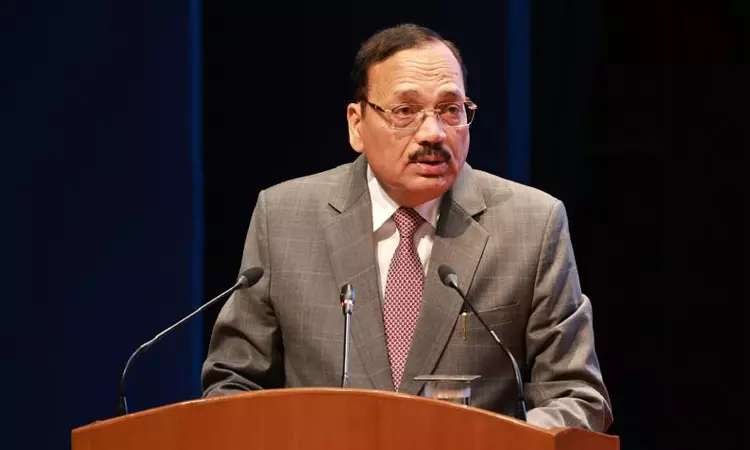
The real measure of success is not simply in quickly resolving disputes, but how well we design projects so that fewer disputes arise in the first place, the CJI added.
Chief Justice of India Surya Kant on Monday called for a shift from “retrospective justice” to “preventive justice” to address disputes before they disrupt infrastructure projects, highlighting that such projects cannot afford to wait for arbitration or appeals to run their course.“What our infrastructure ecosystem therefore needs is a shift from retrospective justice to...
This is a premium content
Available exclusively to
Our subscribers
Subscribe Premium 
INR 1099+GST
Your support helps us to bring you more content at
an affordable subscription scheme !!!
All payment options available
Chief Justice of India Surya Kant on Monday called for a shift from “retrospective justice” to “preventive justice” to address disputes before they disrupt infrastructure projects, highlighting that such projects cannot afford to wait for arbitration or appeals to run their course.
“What our infrastructure ecosystem therefore needs is a shift from retrospective justice to preventive justice: from questioning, after the project has been disrupted, to designing the contractual and institutional framework so that disagreements can be identified and addressed before they become disputes through communication and dispute avoidance mechanisms. After all, the finest compliment to a dispute resolution mechanism is not that it has resolved many disputes, but that the project it served had so little need to use it”, he said.
Addressing the FIDIC Global Infrastructure Conference 2026 in New Delhi, the CJI stressed that while courts and arbitral processes would continue to play an important role, the legal system must also focus on preventing disputes from arising in the first place.
He stressed that Courts are the “ultimate guarantors of legality and enforceability”. At the same time, he noted, infrastructure projects could not be put on hold while disputes moved through formal processes.
“But I have no hesitation in saying that a legal system should not measure its success only by how effectively it resolves disputes after they have arisen; it should also ask how effectively the institutions around a project prevent those disputes from arising in the first place. I say this because a bridge cannot pause construction while an arbitration proceeds; a highway cannot wait for an appeal to run its course; and a power project cannot suspend its economic purpose while the parties debate the meaning of a force majeure clause,” he said.
The CJI emphasised that Rule of Law was not limited to a court correcting an error after it had occurred but was also about designing contracts and institutions in a way that made expectations clear, properly defined powers, fairly allocated risks and provided a credible and timely route for resolving disagreements.
“The Rule of Law, in this sense, is part of the architecture of infrastructure delivery itself, present in every contract, every allocation of risk, and every mechanism a project builds to resolve its own disagreements,” he said.
He called for a shift “from questioning, after the project has been disrupted, to designing the contractual and institutional framework so that disagreements can be identified and addressed before they become disputes through communication and dispute avoidance mechanisms.”
The CJI also stressed the importance of allocating risks to the party best placed to manage them. Infrastructure projects, he noted, can face unforeseen ground conditions, regulatory changes and circumstances beyond the control of the parties.
He said that a well-drafted contract should create a shared understanding of how parties would respond when a project encountered circumstances that neither had expected.
“When that allocation is wrong, the consequences are familiar. Contractors price defensively to protect themselves; governments end up carrying risks they were never best placed to bear. And the parties eventually find themselves in an Arbitration or a Courtroom. A well drafted contract, therefore, should do more than record the commercial bargain; it should create a shared understanding of how the parties will respond when the project encounters circumstances that neither party expected,” he said.
The CJI referred to the early years of one of India's major urban infrastructure projects, where engineers and contractors were encouraged to resolve disagreements at the site level within days, before they became formal claims. The project was completed ahead of schedule and with little litigation compared to comparable infrastructure projects elsewhere, he said.
He said that such an approach showed that dispute resolution could become part of the ordinary governance of a successful project rather than an “emergency exit for a failed project”.
The CJI also made a case for greater standardisation in infrastructure contracts. Infrastructure projects increasingly involve capital, engineering expertise, construction capacity and assets spread across different countries, he noted. He said that if provisions dealing with payments, variations, extensions of time, unforeseen conditions and dispute resolution are reinvented for every project, unnecessary uncertainty is created.
However, the CJI clarified that he was not advocating a single contractual form for every project and jurisdiction, as local law, local capacity and local circumstances would continue to matter.
“Standardisation in that sense means that the basic structure of an infrastructure contract is familiar, while still leaving room for the realities of a particular project. It gives an Indian contractor, a European lender, an African government and an Asian consultant a shared vocabulary in which risk, responsibility and remedy mean roughly the same thing regardless of where the project happens to be located”, he said.
The CJI stressed that the legal profession had a role in learning from recurring disputes. He emphasised that if disputes over variations, payments, extensions of time or changed site conditions repeatedly arise, lawyers should consider whether the contract itself can be drafted differently for future projects.
Turning to India's infrastructure expansion, the CJI emphasised, “Our ambition cannot simply be to build more. It must be to build faster, more resiliently, more sustainably and more productively. For that ambition to be realised, world-class engineering and innovative financing are necessary, but they are not sufficient. We also need contracts that create confidence rather than confrontation, procurement systems that reward genuine value rather than merely the lowest number on a page, and dispute frameworks that resolve disagreements at the pace the project itself requires.”
The CJI urged government, industry and the legal profession to focus on clarity of obligations, balanced allocation of risk, sensible standardisation, early dispute avoidance and, where disputes could not be avoided, swift and independent resolution.
“These are not narrow legal technicalities confined to the small print of a contract. They are, in the fullest sense, instruments of good governance,” he said.
Concluding his address, the CJI stressed that Rule of Law was not only about correcting what had gone wrong but also about creating conditions for things to go right.
“The real measure of success, therefore, is not simply how quickly we resolve disputes, but how well we design projects so that fewer disputes arise in the first place,” he added.
Tags

Amisha Shrivastava
Amisha Shrivastava is a Senior Correspondent with LiveLaw, covering the Supreme Court of India. She can be reached at amisha@livelaw.in

