



Inquiry Vitiated If Complainant's Close Relative Sits In Committee, Proof Of Actual Bias Not Required: Supreme Court
Saima Anjum
18 Nov 2026 4:41 PM IST
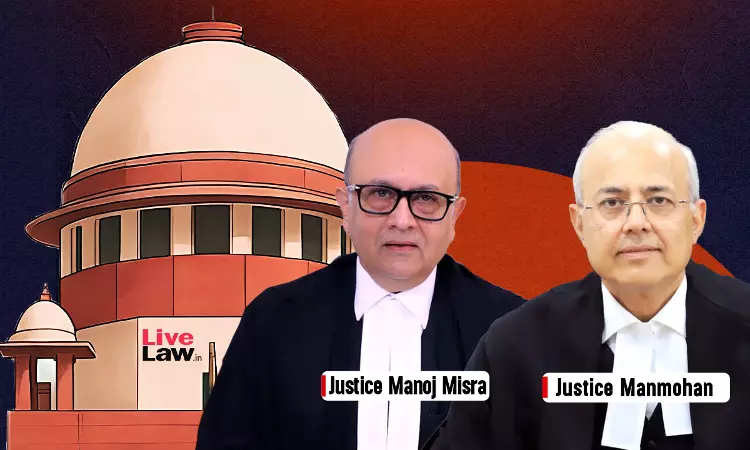
The test is not whether actual bias is proved, but whether there exists a 'reasonable likelihood of bias' or 'real possibility of bias', the Courtheld.
A bench of Justice Manoj Misra and Justice Manmohan observed so while restoring the School Tribunal's order of 2024, which had quashed her termination. The bench also directed the Education Officer to consider absorbing the appellant in any other 100% grant-in-aid school within its jurisdiction, in accordance with Rule 26(2)(iii) of the Maharashtra Employees of Private Schools (Conditions of Service) Rules, 1981 (MEPS Rules).
The appellant was appointed as an Assistant Teacher at the school, run by Respondent 1 (R1, Sudhir Shikshan Sanstha), in 2009. A Government Resolution of 2016 granted 20% grant-in-aid status to the school. The appellant alleged that from then onwards the School's Secretary excluded her name from the salary grant bills sent to the Education Department. A complaint was filed before the Education Minister and other authorities in 2021, and a three-member Inquiry Committee was constituted by the Education Officer, which led to the Management threatening and intimidating the complainant, as alleged, subsequent to which a show cause notice alleging misconduct including tampering with documents was issued.


The Committee found that the Headmaster/Secretary had failed to include her name in the list of teachers eligible for the 20% grant and directed that it be included. Meanwhile, the Sanstha's Executive Committee resolved to authorise the Secretary to conduct an inquiry against her subsequent to which its own Inquiry Committee under Rule 36 of the MEPS Rules, with Prakash Masurkar, a member of its Executive Committee, as Convenor, and Bhau Wasnik, a retired Principal, as a member was constituted. The appellant nominated the third member and also expressed apprehension of bias.
After a charge-sheet was filed in August 2021, the Inquiry Committee submitted findings in 2022 by a majority of two out of three members, and she was terminated in 2022. The School Tribunal first set aside the termination in 2023, but the High Court remanded the matter because the Tribunal had not considered material evidence. After remand, the Tribunal again quashed the termination and directed reinstatement with continuity of service and full back wages, holding that the Secretary, who issued the charge-sheet and was the key witness, could not be accepted as a witness since the person cannot be judge in his own cause, and called the proceedings “a farce of enquiry”.
A writ petition before the Bombay High Court was filed by the Sanstha which confirmed the termination, holding that the Chief Executive Officer (CEO) was not a member of the Inquiry Committee, so there was no question of acting as a judge, and that the inquiry followed the law and gave full opportunity to the appellant.
Aggrieved by the High Court's order, the appellant approached the Supreme Court.
The Supreme Court framed the issue as follows:
“Whether the circumstances of the present case give rise to reasonable likelihood of bias from the perspective of a fair-minded person and whether the same renders the inquiry proceedings against the Appellant unsustainable in law?”
No one can be a judge in one's own cause
On the rule against bias, the Court observed that natural justice requires that no one be a judge in his own cause, that the affected party be heard, and that the decision-maker be “independent, impartial and not biased or prejudiced in a manner that precludes fair and genuine consideration of the arguments advanced by the parties.” It was also observed that the rule exists to protect the integrity of decision-making and public confidence, and it “looks to the appearance or risk of bias rather than to bias in fact.”
With regards to the forms of bias, the bench reviewed pecuniary, personal and official bias. On personal bias, it noted that the adjudicator may be a close relative of a party. It referred to State of UP v Mohd Nooh, wherein a person conducting an inquiry gave evidence against the employee and then resumed the inquiry. The bench also noted a Canadian case in which a tribunal's decision was set aside because its Chairman was the husband of an officer of a party, calling that situation “directly analogous to a close blood relationship on an inquiry panel.”
Proof of actual bias not needed
The bench then referred to a series of judgments including AK Kraipak v Union of India & Ors, Ashok Kumar Yadav & Ors. v. State of Haryana & Ors, Ranjit Thakur v. Union of India & Ors.; and English case R v. Bow Street Magisterate, ex parte Pinochet (No.2) to hold that Indian courts have consistently adopted the 'reasonable likelihood' test.
“Consequently, it is today universally accepted that the test is not whether actual bias is proved, but whether there exists a 'reasonable likelihood of bias' or 'real possibility of bias', in the mind of a reasonable person as distinguished from a merely fanciful apprehension. The submission of learned senior counsel for the Respondents that it was mandatory for the Appellant to prove a specific instance of bias is, therefore, not legally tenable.”
With regard to kinship, the bench referred to an anecdote about Justice Badruddin Tyabji, whose sons appeared before him, and observed that kinship was once not treated as a disqualification, but “it is now well established that kinship does disqualify wherever it is close enough to give rise to a 'reasonable likelihood of bias'.” The bench observed that there is no reason to differentiate between courts and administrative tribunals in this approach.
No fair inquiry if family members are acting as prosecutor, witness and judge
Further, the Court recorded that “the inquiry apparatus was subjected to a total familial capture,” as the Convenor is the brother-in-law of the Sanstha's President, the uncle of its Vice-President and the husband of a Committee Member. He is also the real brother of Rajesh Masurkar, who was the complainant, a principal witness and the prosecutor, and who “tendered evidence before his own brother acting as convenor, who accepted the said evidence and held the Appellant guilty.” The argument that the Secretary was a formal witness was rejected by the bench, observing that he was the sole witness on eleven of the twenty charges, and since he secured the Headmaster's post by superseding the appellant's seniority, “his personal interest in the outcome of the proceedings is palpably evident.”
“Where the roles of complainant, prosecutor, witness and adjudicator overlap or intersect, as in the present case, the inquiry suffers from a fundamental vice, as the separation of functions essential to a fair disciplinary proceeding collapses entirely. It is a settled position of law that an inquiry must be fair, transparent and impartial. Concentrating the roles of prosecutor, witness and adjudicator within a single close-knit family deprives the employee of an effective and meaningful hearing. The requirement of impartiality is not restricted to the absence of direct pecuniary interest, but encompasses every circumstance that creates a reasonable apprehension that the proceedings were pre-determined or biased.”
The bench held that holding multiple hearings, examining several witnesses or permitting extensive cross-examination cannot cure a foundational illegality arising from bias or unfairness in the decision-making process, and that judicial review in disciplinary matters extends to whether the inquiry was fair and impartial, in accordance with Articles 14 and 21.
On Doctrine of necessity
On the doctrine of necessity, the bench held that the doctrine, an exception to the rule against bias, applies where no other person or authority is eligible or available. Although Rule 36(2)(a)(i) allowed any Executive Committee member to be nominated, procedural fairness required that immediate family members of the controlling family be avoided, “especially when two unrelated members of the Executive Committee were available.” The Sanstha did not say that those two members were disqualified.
On bias, the bench said that “in a group deliberation, each member of an Inquiry Committee is bound to influence the others,” especially where the member is closely connected with the school. The bench was unable to accept that the Convenor and Bhau Wasnik had no mutual discussion.
Further, the bench held that a waiver must be voluntary, informed and unequivocal, and that these requirements were not met, as the Inquiry Committee's own majority report recorded the objection to the Convenor and rejected it on the ground that “actual bias or prejudice must be established, not mere relationship.” The objection was also taken in the appeal before the School Tribunal which showed that the appellant never accepted the appointment of Prakash Masurkar at any stage. The bench, thus, did not treat her letter as a waiver.
Furthermore, the bench held that the High Court had mistaken the Convenor to be Rajesh Masurkar rather than Prakash Masurkar observing as under:
“Further, the contention that the Inquiry Committee had acted in violation of principles of natural justice, as one of its office bearers had acted as a Judge in his own cause was squarely raised before and decided by the High Court. However, it appears that the High Court fell into confusion over the names and mistook the Convenor of the Inquiry Committee to be Rajesh Masurkar instead of Prakash Masurkar. In fairness to the High Court, given the number of Masurkars on the Executive Committee of Respondent No.1-Sanstha, some confusion was perhaps inevitable!”
In the light of aforesaid, the Supreme Court held that the circumstances gave rise to a reasonable likelihood of bias from the perspective of a fair-minded person and that the inquiry was unsustainable in law. Allowing the appeal, it set aside the High Court's judgment and restored the School Tribunal's judgment.
“Consequently, this Court is of the view that on an objective appreciation of the case, circumstances give rise to a reasonable likelihood of bias from the perspective of a fair-minded person and thus, the inquiry proceedings initiated against the Appellant are unsustainable in law.”
It also directed the Education Officer (R3), to consider the feasibility of absorbing the appellant in any other 100% grant-in-aid school within its jurisdiction in accordance with Rule 26(2)(iii) of the MEPS Rules.
“The present Appeal is allowed and the impugned judgment of the High Court in Writ Petition No. 4965 of 2024 dated 29th April 2025 is set aside. Further, the judgment of the School Tribunal, Nagpur dated 21st March 2024 is restored. This Court also directs Respondent No.3- Education Officer to consider the feasibility of absorbing the Appellant in any other hundred per cent (100%) grant-in-aid School within its jurisdiction in accordance with Rule 26(2)(iii) of MEPS Rules.”
Appearances:
For Petitioner: Mr. Satyajit A. Desai, Adv.; Mr. Sachin Patil, Adv.; Mr. Prateek Kumar Singh, Adv.; Mr. Sachin Singh, Adv.; Mr. Shashank Upadhyay, Adv.; Ms. Anagha S. Desai, AOR
For Respondents: Mr. Sudhanshu Choudhuri, Sr. Adv.; Ms. Rucha Pande, Adv.; Mr. Yash Singhania, Adv.; Mr. A. Selvin Raja, AOR; Mr. Nitin Lonkar, Adv.; Mr. Siddharth Dharmadhikari, Adv.; Mr. Aaditya Aniruddha Pande, AOR; Mr. Shrirang B. Varma, Adv.


