



- Home
- /
- Top Stories
- /
- Journalist Seema Chishti Seeks To...
Journalist Seema Chishti Seeks To Intervene In Supreme Court Reference On Legislative Privileges
Amisha Shrivastava
30 Sept 2026 6:33 PM IST
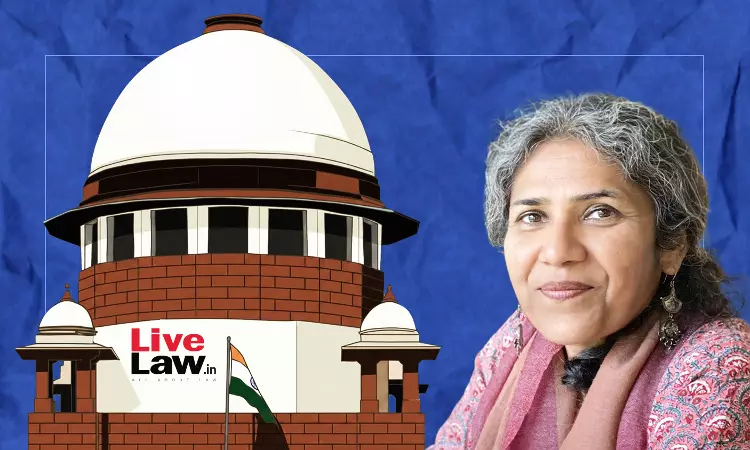
Journalist Seema Chishti, Editor at The Wire, has moved the Supreme Court seeking permission to intervene in the long-pending case concerning the scope of legislative privileges under Article 194(3) of the Constitution and their interplay with the fundamental right to freedom of speech and expression under Article 19(1)(a).In her intervention application filed though Advocate-on-Record...
This is a premium content
Available exclusively to
Our subscribers
Subscribe Premium 
INR 1099+GST
Your support helps us to bring you more content at
an affordable subscription scheme !!!
All payment options available
Journalist Seema Chishti, Editor at The Wire, has moved the Supreme Court seeking permission to intervene in the long-pending case concerning the scope of legislative privileges under Article 194(3) of the Constitution and their interplay with the fundamental right to freedom of speech and expression under Article 19(1)(a).
In her intervention application filed though Advocate-on-Record Neha Rathi, Chishti has contended that legislative privileges are not absolute and must be interpreted in harmony with fundamental rights, including the right to life and personal liberty under Article 21.
She has sought to assist the Court in laying down constitutional standards governing the exercise of legislative privileges against journalists, editors, publishers and citizens engaging in public discourse.
The plea states –
“The present proceedings also provide an opportunity to reconcile the earlier judicial pronouncements and lay down clear constitutional standards concerning (i) (ii) (iii) the scope and limits of Article 194(3); when criticism of legislative proceedings may or may not amount to breach of privilege; and the constitutional protection available to journalists, editors, publishers and citizens engaging in fair and bona fide public discourse concerning true and correct reportage…The Applicant respectfully submits that legislative privileges and fundamental rights do not operate in separate, watertight compartments, but must be read together, harmoniously, so as to give full effect to the constitutional scheme of democratic governance.”
The application has been filed in N. Ravi & Ors. v. Speaker, Legislative Assembly, Chennai & Ors., which is scheduled to be heard by a seven-judge Constitution Bench of the Supreme Court from October 6.
The case raises significant questions on the extent to which privileges under Article 194 of the Constitution can operate against fundamental rights guaranteed under Article 19.
The central issue before the court is whether the privileges available to members of state legislatures under Article 194 can override the fundamental right to freedom of speech and expression under Article 19(1)(a). The court will also examine whether legislative privileges can be invoked against citizens, including journalists, in circumstances where their speech or publication is alleged to constitute a breach of legislative privilege.
Chishti's application relies on the Supreme Court's 2024 judgment in Sita Soren v. Union of India, in which a seven-judge Bench held that legislative privileges are functional in nature and are intended to protect the collective functioning of the House, rather than operate as personal immunities for legislators.
Chishti has submitted that legislative privileges must be assessed in the context of their constitutional purpose and cannot be treated as absolute. She has argued that the Indian constitutional framework, founded on constitutional supremacy, differs from the traditional English model of parliamentary sovereignty, and the powers conferred on State Legislatures under Article 194 must remain within constitutional limits.
Chishti has urged the Supreme Court to clarify the scope and limits of Article 194(3), the circumstances in which criticism of legislative proceedings may constitute a breach of privilege, and the constitutional protections available to journalists, editors, publishers and citizens engaged in fair and bona fide public discourse and accurate reportage.
Background
The case originates from a 2003 dispute between the Tamil Nadu Legislative Assembly and The Hindu newspaper over articles criticising then Chief Minister J. Jayalalithaa and her government.
In April 2003, The Hindu published a series of articles criticising the government. On April 25, the newspaper also published an editorial titled Rising Intolerance, which criticised Jayalalithaa's alleged intolerance. K. Kalimuthu, then Assembly Speaker, referred the publications to the Assembly's Privileges Committee, alleging that they lowered the reputation of the House and infringed its sovereignty.
On November 7, 2003, the Tamil Nadu Legislative Assembly passed a resolution holding The Hindu's editorial staff guilty of breach of privilege and sentencing them to 15 days' simple imprisonment. The journalists approached the Supreme Court challenging the Assembly's action, and the Court stayed the warrants issued against them on November 10, 2003.
The case raises questions concerning the extent to which State Legislatures can invoke their privileges against publications or statements made outside the House, and whether such privileges can restrict fundamental rights guaranteed under the Constitution.
The Supreme Court, on December 8, 2003, referred the matter to a Constitution Bench of at least five judges, observing that substantial questions of law arose concerning the interpretation of Articles 194(3), 19(1)(a) and 21.
In December 2004, the Court referred the matter for consideration by a seven-judge Bench after identifying apparent conflicting observations in two earlier Constitution Bench decisions – Pandit M.S.M. Sharma v. Shri Krishna Sinha and In Re: Powers, Privileges and Immunities of State Legislatures (Special Reference No. 1 of 1964).
In M.S.M. Sharma, the Supreme Court held that the freedom of speech guaranteed under Article 19(1)(a) was subject to the special provisions concerning legislative privileges under Article 194(3).
In the 1965 Special Reference No. 1 of 1964, a seven-judge bench examined the extent of legislative privileges and the jurisdiction of constitutional courts in matters involving alleged breaches of privilege. The Court held that legislative privileges were subject to constitutional limitations and could not simply prevail over legislative privileges.
Tags

Amisha Shrivastava
Amisha Shrivastava is a Senior Correspondent with LiveLaw, covering the Supreme Court of India. She can be reached at amisha@livelaw.in

