



- Home
- /
- Top Stories
- /
- Judges Decide As Per Law But Are...
Judges Decide As Per Law But Are Called Independent Based On Outcomes In High-Stakes Cases: Justice Rajesh Bindal
Amisha Shrivastava
15 April 2026 8:26 PM IST
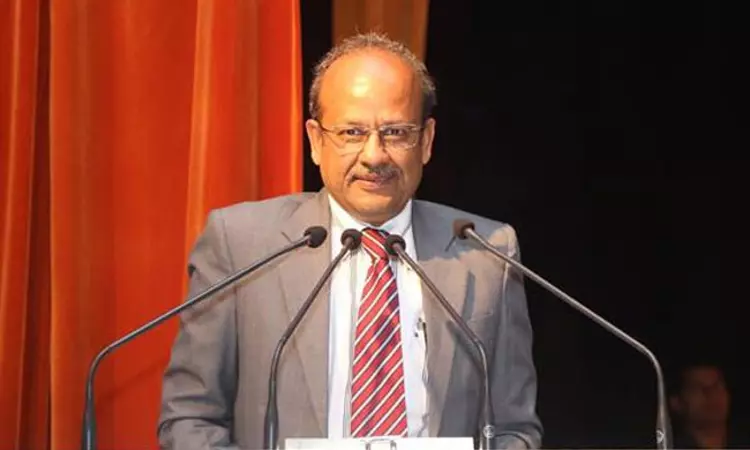
Retiring Supreme Court judge Justice Rajesh Bindal today said that judges decide cases according to law, but the judiciary is criticised based on whether the outcome is favourable or not, especially in high stakes cases.Echoing former judge Ajay Rastogi's words on how judges are perceived as independent only if they decide against the government, he said, “In his farewell function,...
This is a premium content
Available exclusively to
Our subscribers
Subscribe Premium 
INR 1099+GST
Your support helps us to bring you more content at
an affordable subscription scheme !!!
All payment options available
Retiring Supreme Court judge Justice Rajesh Bindal today said that judges decide cases according to law, but the judiciary is criticised based on whether the outcome is favourable or not, especially in high stakes cases.
Echoing former judge Ajay Rastogi's words on how judges are perceived as independent only if they decide against the government, he said, “In his farewell function, Justice Rastogi said the independent judges are only understood as one who decides against the government. I think we all decide as per law only. The only problem is if somebody wins he says 'I have full faith (in judiciary)' but if somebody loses he says 'the courts are wrong'. We are regularly seeing this only because the litigation is high stakes.”
Justice Rastogi had emphasised that decisions must be based on the material on record and said it is a “wrong tendency” to describe a judge as independent only when the judge rules against the government.
Justice Bindal, who demitted office as a judge of the Supreme Court today, was speaking at a farewell function organised by the Supreme Court Bar Association.
In his address, Justice Bindal said judges must approach every case with a “clean slate” and decide matters without being influenced by earlier rulings. He said he had tried to do his best in every role he undertook.
Justice Bindal recalled practical reforms led by him during his tenure, including digitisation of postmortem reports, integration of forensic laboratories with courts, and steps to reduce delays caused by non-availability of records. He said these measures were aimed at solving recurring procedural issues in trial and investigation processes.
He also noted that digitised records enabled courts to continue hearing matters even when physical access was restricted during the COVID-19 pandemic and abrogation of Article 370 in Jammu and Kashmir.
On judicial functioning, Justice Bindal said that lawyers should focus on assisting in reaching the correct legal conclusion rather than winning a case, stressing the importance of public confidence in the judiciary.
“This is the last court, and the courts are the last remedy. The effort should be to assist the court and not to win the case, only because laying down a wrong law may have huge consequences. You should only assist the court to come to a right conclusion, so that the confidence of the people remains in this system”, he said.
He also emphasised that issues within the system should be addressed internally, instead of discussing it publicly.
“I would say, rather as an advocate or as a judge, no institution is perfect. Nobody is perfect. There are some errors somewhere, some problems somewhere, that we should sort out in house only. We should not discuss anything outside that. This is what I feel. We can solve everything, but there is some habit of saying in the public and if we say something, or you say in public, something that has more weight as compared to a common person, because we are part of the system. Whatever problem is there, I think our system is open. Our Chief never says no, any High Court, also, the Chief would never say, no. They are all accessible, whatever is there you share your issues. You can all get all your problems solved instead of discussing in the public”, he said.
He cautioned that artificial intelligence, while useful, can be misused and must be handled carefully in legal practice.
Justice Bindal concluded by thanking the Bar, his colleagues, and court staff, stating that he leaves the institution with satisfaction and with good memories from his career as an advocate and judge.
During his address, Chief Justice of India Surya Kant said Justice Bindal's career across the Punjab and Haryana High Court, Jammu and Kashmir and Ladakh High Court, Calcutta High Court, Allahabad High Court, and the Supreme Court gave him exposure to “India's justice system in its variety” and different litigating cultures. He said this shaped both Justice Bindal's judicial approach and administrative work.
On institutional contributions, the Chief Justice highlighted Justice Bindal's role in the Punjab and Haryana in developing software system for medico-legal and postmortem reports, which was later adopted nationally. He also noted his work in improving record maintenance and court infrastructure.
Referring to Justice Bindal's judgments, Justice Surya Kant highlighted a custody case where Justice Bindal held that a child cannot be treated as property and given to a parent with whom the child had no contact for ten years. He also cited a decision directing that compensation in motor accident claims be transferred directly into victims' bank accounts to prevent malpractice. In another case, he noted, Justice Bindal reiterated that no public figure stands above the constitutional principle of equality before law.
The Chief Justice said Justice Bindal's contribution lay both in the judgments he delivered and in strengthening institutional systems.
“He is in one of the rare classes of judges whose contribution is measured not only by what the decided but what they enabled the institution to do better. There are judges who leave behind memorable citations, there are judges who leave behind improve systems. My brother leaves behind both”, he said.
He also highlighted Justice Bindal's caution against the use of AI-generated fake citations, stating that while technology can aid court functioning, it cannot replace preparation and professional integrity.
“Recently, he warned against the growing use of AI generated citations in courts and cautioned the members of the bar that by virtue of these products please do not indulge in frivolous litigation. He has welcomed technology where it strengthens access and administration but he has been equally clear that no technological tool can substitute preparation and professional integrity”, the CJI highlighted.
Tags

Amisha Shrivastava
Amisha Shrivastava is a Senior Correspondent with LiveLaw, covering the Supreme Court of India. She can be reached at amisha@livelaw.in

