



- Home
- /
- Top Stories
- /
- Judges Should Not Hesitate To...
Judges Should Not Hesitate To Decide Rightly Even If It Costs Them Elevation Or Displeases Those In Power: Justice Nagarathna
LIVELAW NEWS NETWORK
4 March 2026 8:45 AM IST
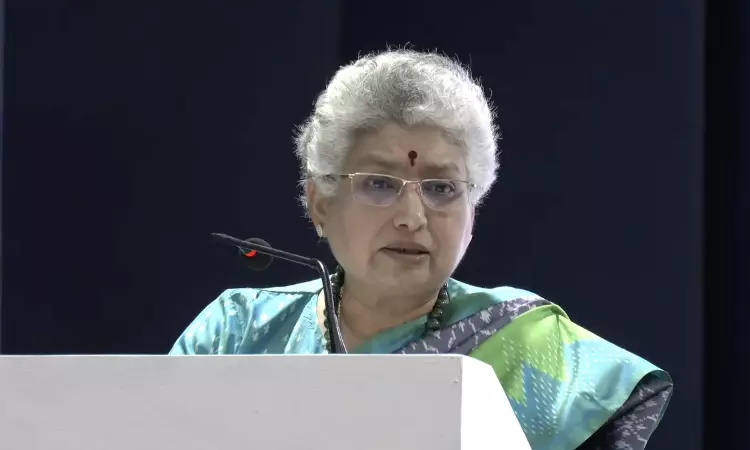
"A judge must be free from political pressure, institutional intimidation, or popular demand," she said.
Judges should not hesitate to take the right decision even if it can cost their elevation or displease those in power, Justice BV Nagarathna, Supreme Court Judge, said, asserting that courage and conviction are indispensable to the meaningful exercise of judicial review.Delivering the 2nd T.S. Krishnamoorthy Iyer Memorial Lecture at the Kerala High Court yesterday, Justice Nagarathna...
This is a premium content
Available exclusively to
Our subscribers
Subscribe Premium 
INR 1099+GST
Your support helps us to bring you more content at
an affordable subscription scheme !!!
All payment options available
Judges should not hesitate to take the right decision even if it can cost their elevation or displease those in power, Justice BV Nagarathna, Supreme Court Judge, said, asserting that courage and conviction are indispensable to the meaningful exercise of judicial review.
Delivering the 2nd T.S. Krishnamoorthy Iyer Memorial Lecture at the Kerala High Court yesterday, Justice Nagarathna observed that judicial review frequently requires courts to invalidate legislation, restrain executive action, and at times even set aside constitutional amendments enacted by political majorities.
“These are not easy tasks. They often carry political consequences,” she said. Judges may well be conscious that an unpopular ruling could affect their prospects of elevation, extension, or place them in the “bad books of the powers that be.” However, she firmly added, that awareness must never come in the way of doing what the Constitution demands.
The oath of office, she described, is a judge's “judicial dharma” and must be honoured irrespective of personal or professional consequences. If decisions are shaped by apprehension about career outcomes, judicial review risks becoming symbolic rather than substantive.
Even if judges know that unpopular decisions may cost them elevation, extension, or bring them in the bad books of the powers that be. That should not come in the way of their decisions. Ultimately, it is the conviction, courage and independence of each judge which really matters. We, as Judges, should always follow our oath of office which is our judicial Dharma and live up to it irrespective of its consequences on our career. Otherwise judicial review becomes symbolic
Justice Nagarathna invoked H. R. Khanna as the finest example of constitutional courage. During the Emergency, in ADM Jabalpur v. Shivkant Shukla, the Supreme Court by majority held that during the suspension of fundamental rights, even the right to approach courts for enforcement of personal liberty stood curtailed. Justice Khanna dissented, holding that the Constitution did not permit the State to extinguish the right to life and liberty even in an Emergency.
His dissent, she noted, came at significant personal cost. He was superseded for the office of Chief Justice of India. Yet history, and later constitutional jurisprudence, vindicated his position. The Supreme Court in Justice K.S. Puttaswamy v. Union of India expressly overruled ADM Jabalpur and reaffirmed that fundamental rights are not at the mercy of executive will. That corrective moment, she suggested, demonstrated that constitutional fidelity ultimately outlasts transient political expediency.
On Judicial independence also includes judge's right to dissent
Judicial independence, Justice Nagarathna said, ultimately derives its meaning not merely from constitutional safeguards or institutional design, but from the manner in which judges discharge their office. It has two distinct yet interrelated dimensions.
"First is independence from external influence. A judge must be free from political pressure, institutional intimidation, or popular demand," she said.
Justice Nagarathna further said that it also includes the right of a judge to express dissent.
"Second, and more subtly, independence also operates within the judicial institution. Judicial independence is not exhausted by insulation from the political branches. It also requires that each judge be free to form and express his or her own considered view of the law, even when that view diverges from colleagues. Separate and dissenting opinions are manifestations of intellectual autonomy. This is independence of the judiciary in its most enlightened form," she said.
"A judicial opinion is not a negotiation document; it is an articulation of constitutional conviction. If the law, as we understood it, requires clarity – even bluntness – then dilution for the sake of consensus is a form of compromise we should be unwilling to make," she added.
Transformative Constitutionalism and the Basic Structure Doctrine
Justice Nagarathna's lecture was on the topic “Transformative Constitutionalism and the Basic Structure Doctrine.” She argued that both these constitutional ideas ultimately depend upon a judiciary willing to act independently and without fear.
Tracing the evolution of the Basic Structure Doctrine, she referred to early cases such as Shankari Prasad Singh Deo v. Union of India and I.C. Golak Nath v. State of Punjab, culminating in the landmark decision in Kesavananda Bharati v. State of Kerala. In Kesavananda Bharati, the Supreme Court rejected the argument that Parliament's amending power was unlimited. While Parliament could amend any part of the Constitution, it could not alter its basic structure.
Subsequent decisions such as Minerva Mills Ltd. v. Union of India and S.R. Bommai v. Union of India entrenched this doctrine, reinforcing that constitutional supremacy, secularism, federalism, separation of powers and judicial review form part of the Constitution's foundational identity.
Justice Nagarathna explained that the basic structure doctrine addresses a structural anxiety inherent in any written Constitution. A Constitution that is entirely unamendable risks stagnation. A Constitution that is wholly amendable risks self-erasure. The doctrine negotiates this tension by permitting change while prohibiting destruction of essential features.
Alongside this, she elaborated on transformative constitutionalism, which seeks to realise the Constitution's promises of liberty, equality and fraternity across time. It recognises that the Constitution was not merely a legal document but a normative commitment to dismantle historical injustices and reconstruct social relationships.
However, she emphasised that transformative constitutionalism cannot operate in isolation from constitutional limits. The basic structure doctrine disciplines transformation by ensuring that change does not hollow out foundational guarantees. Conversely, transformative constitutionalism animates the basic structure by ensuring that constitutional commitments remain responsive to contemporary conditions.
At the institutional level, both doctrines converge in the judiciary through the power of judicial review. Courts are the constitutional actors entrusted with policing the limits of power and translating abstract constitutional values into enforceable rights. Without judicial review, the basic structure would remain a theoretical proposition. Without independence, judicial review would be exercised timidly or selectively.
Justice Nagarathna also underlined that judicial independence has both external and internal dimensions. Externally, it requires insulation from political pressure, executive influence and popular sentiment. Internally, it demands that each judge retain the intellectual autonomy to form and express a considered view of the law, even if that view differs from colleagues.
Separate and dissenting opinions, she said, are not signs of institutional weakness but manifestations of independence in its most enlightened form. A judicial opinion is not a negotiation document but an articulation of constitutional conviction. Dilution of reasoning for the sake of consensus, where clarity demands firmness, would itself be a compromise inconsistent with constitutional duty.
In a democracy committed to liberty and equality, majoritarian institutions may not always protect individual rights or minority interests. While majorities have the mandate to govern, that mandate is not untrammelled. It is the judiciary that determines the constitutional limits of majoritarian power. Courts derive legitimacy not from popularity but from fidelity to the Constitution.
Justice Nagarathna concluded by reiterating that the endurance of constitutional governance depends not only on doctrines and institutional design but on the moral fibre of those who interpret and enforce the Constitution. Judges must be prepared to invalidate unconstitutional laws, restrain unlawful executive action, and preserve the Constitution's identity, even when doing so carries personal cost.
The lecture can be watched here :


