



- Home
- /
- Top Stories
- /
- Judgment Allowing Women Entry In...
Judgment Allowing Women Entry In Sabarimala Temple Wrong: Centre Tells Supreme Court In 9-Judge Bench Reference
Anmol Kaur Bawa
7 April 2026 4:39 PM IST
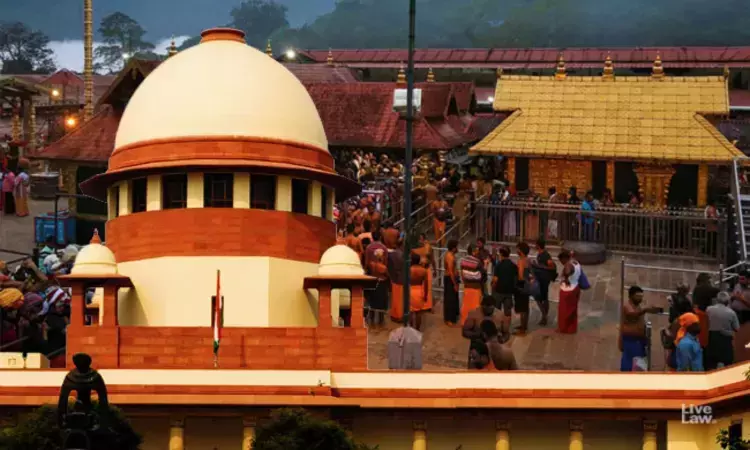
During the hearing of the Sabarimala reference, the Union Government on Tuesday told the Supreme Court that the 2018 judgment permitting entry of women of all age groups into the Sabarimala temple was wrongly decided and deserves to be declared a wrong law.Appearing for the Union, Solicitor General Tushar Mehta submitted before a 9-judge bench that the 2018 ruling requires reconsideration...
This is a premium content
Available exclusively to
Our subscribers
Subscribe Premium 
INR 1099+GST
Your support helps us to bring you more content at
an affordable subscription scheme !!!
All payment options available
During the hearing of the Sabarimala reference, the Union Government on Tuesday told the Supreme Court that the 2018 judgment permitting entry of women of all age groups into the Sabarimala temple was wrongly decided and deserves to be declared a wrong law.
Appearing for the Union, Solicitor General Tushar Mehta submitted before a 9-judge bench that the 2018 ruling requires reconsideration and reversal on legal grounds.
"It is my case that it is wrongly decided and deserves to be declared a wrong law," the Solicitor General stated during the hearing of the Sabarimala reference.
The SG also submitted that he has strong objections to the view expressed in the Sabarimala judgment that the bar on women's entry amounted to untouchability, violating Article 17 of the Constitution. The SG argued that the restriction on women's entry was only based on age. He added that there was no universal exclusion of women in Ayyappa Temples, and Sabarimala's restriction was due to the unique nature of the deity present there.
The SG also submitted that Western notions of patriarchy and gender stereotypes should not be blindly applied to India, without understanding India's civilisational values.
As regards the equal right guaranteed under Article 25, the SG said it should be understood in the sense of equality between religions, and the issue of gender did not arise under Article 25.
The 2018 judgment, delivered by a five-judge Bench by a 4:1 majority, had permitted entry of women of all age groups into the Sabarimala temple, holding that devotion cannot be subjected to gender discrimination.
During the course of submissions, the Solicitor General clarified that the present reference before the Constitution Bench involves a broader set of constitutional questions relating to the interpretation of Articles 25 and 26 of the Constitution and the scope of judicial intervention in matters of religious practice.
He emphasised that the Union's submissions should not be viewed solely through the lens of the Sabarimala case, which he described as a sui generis matter. According to him, the Court is presently examining foundational questions of law and judicial policy that may have implications beyond a single dispute.
"I am not touching the Sabarimala part, I will deal with it in a different manner. It is a sui generis case. Right now, my lords are examining the questions of law and the judicial policy which my lords will apply. Henceforth, it may be advisable for me not to be coloured by one particular sui generis case, though it is in my case that it is wrongly decided and deserves to be declared a wrong law, for more than one reason," he submitted.
The bench expressed during the hearing that it will not go into the merits of the Sabarimala judgment, and will confine itself to the 7 Constitutional questions before it.
In November 2019, a 5-judge bench, which was hearing the review petitions filed against the Sabarimala verdict, referred certain issues to a 9-judge bench, holding that there were certain inconsistencies between the 7-judge bench decision in Shirur Mutt and the 5-judge bench decision in Dargah Committee.
The 9-judge bench later framed 7 questions, which are :
(i) What is the scope and ambit of right to freedom of religion under Article 25 of the Constitution of India?
(ii) What is the inter-play between the rights of persons under Article 25 of the Constitution of India and rights of religious denomination under Article 26 of the Constitution of India?
(iii) Whether the rights of a religious denomination under Article 26 of the Constitution of India are subject to other provisions of Part III of the Constitution of India apart from public order, morality and health?
(iv) What is the scope and extent of the word 'morality' under Articles 25 and 26 of the Constitution of India and whether it is meant to include Constitutional morality?
(v) What is the scope and extent of judicial review with regard to a religious practice as referred to in Article 25 of the Constitution of India?
(vi) What is the meaning of expression “Sections of Hindus” occurring in Article 25 (2) (b) of the Constitution of India?
(vii) Whether a person not belonging to a religious denomination or religious group can question a practice of that religious denomination or religious group by filing a PIL?
Opening the arguments today, SG Tushar Mehta took the bench through the Constituent Assembly Debates pertaining to Articles 25 and 26. He argued that the judicially evolved 'essential religious practices' test was flawed, and that it was not for the Courts to determine the essentiality of any religious practice.
As per the Constitution, it was for the legislature to make law for reform in any religion, in terms of Article 25(2)(b), the law officer of the Centre added.
A bench comprising CJI Surya Kant, Justice BV Nagarathna, Justice MM Sundresh, Justice Ahsanuddin Amanullah, Justice Aravind Kumar, Justice Augustine George Masih, Justice Prasanna B Varale, Justice R Mahadevan and Justice Joymalya Bagchi is hearing the reference.
Also from today's hearing:
Case Details: KANTARU RAJEEVARU Versus INDIAN YOUNG LAWYERS ASSOCIATION THR.ITS GENERAL SECRETARY MS. BHAKTI PASRIJA AND ORS., R.P.(C) No. 3358/2018 in W.P.(C) No. 373/2006

Anmol Kaur Bawa
Reporter

