



- Home
- /
- Top Stories
- /
- Judiciary Alone Can't Be Blamed For...
Judiciary Alone Can't Be Blamed For Case Pendency, Executive Also Responsible : Justice Dipankar Datta
Gursimran Kaur Bakshi
22 March 2026 10:20 AM IST
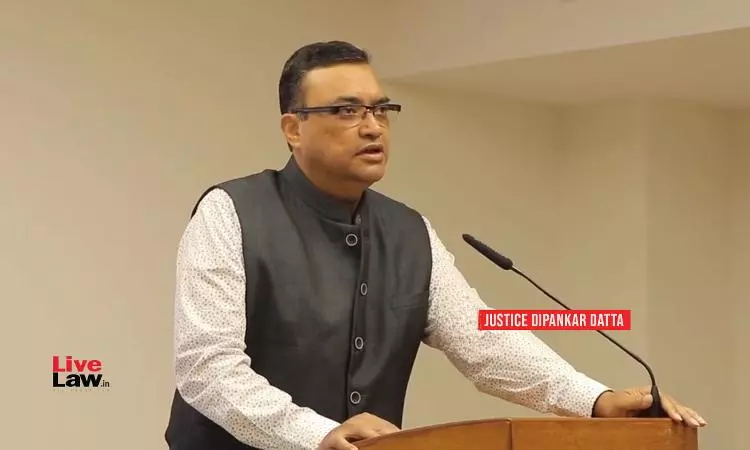
Justice Datta flagged the Govts' delays in clearing appointments, failure to increase the judge-population ratio, and neglect of judicial infrastructure.
Justice Dipankar Datta of the Supreme Court on Saturday remarked that the judiciary is often singled out and blamed for mounting case pendency because it is perceived as a "soft target", while the executive and the legislature are equally responsible for systemic delays arising from vacancies and budgetary neglect"Are we responsible for delayed justice? We are singled out. The judiciary is...
This is a premium content
Available exclusively to
Our subscribers
Subscribe Premium 
INR 1099+GST
Your support helps us to bring you more content at
an affordable subscription scheme !!!
All payment options available
Justice Dipankar Datta of the Supreme Court on Saturday remarked that the judiciary is often singled out and blamed for mounting case pendency because it is perceived as a "soft target", while the executive and the legislature are equally responsible for systemic delays arising from vacancies and budgetary neglect
"Are we responsible for delayed justice? We are singled out. The judiciary is the soft target...When it comes to Courts, you will have to understand under what circumstances judges and judicial officers work," Justice Datta said, speaking at the 1st Supreme Court Bar Association National Conference' 2026 on 'Reimaging Judicial Governance'.
Increasing posts without infrastructure defeats purpose
Justice Datta said that numbers reveal that, as of August 2025, against 1112 sanctioned High Court judgeships, only 788 judges are working. 344 posts remain vacant as per the Minister of State. He also showed the pendency in District Courts as of December 31, 2024.
Justice Datta told the audience that he was a member and also the chairman of the National Court Management System Committee of the Supreme Court. The committee had devised a formula to reduce pendencies, and the formula was forwarded to all the High Courts to find out what is the number of judges that is required.
He took an example of the State of Maharashtra, which has now 56% vacanies, and said: "So far as Maharashtra is concerned, Justice Abhay Oka was the chairman of the committee. According to him, 13,000 judges' posts were required to bring down the vacancies. But his Lordship felt that 13,000 is absolutely absurd. So he kept it at a conservative 8,000. When I became the Chief Justice of the Bombay High Court, I impressed upon the executive about increasing the number of judicial posts."
He added that, fortunately, Maharashtra was one such state that accepted the suggestions of the Chief Justice. The number of posts was increased by 2,500 in one go; yet, the pendency issue remained the same, since there was no corresponding increase in infrastructure.
"It was 3,000 earlier; it has become 5,469. What is the working strength? Working strength is the same. Vacancies have increased. Percentage increase is 56%. Now, why is it that this extra additional post cannot be filled up? First, there is no infrastructure, no court, no support staff. Secondly, where is the pool of law graduates from whom we will be filling up these posts? As it is, when it is 3,000, there is a vacancy of 5 to 10%. At one go, we have increased the posts,but without any infrastructure and without a pool of law graduates who can fill up these posts."
He quoted Justice RV Raveendran, former judge of the Supreme Court, who had said: "When a judge has 300 to 500 cases, he feels let me deal with each case and do justice. But if a judge has 2000 cases, it becomes oppressive, and the judge starts thinking of disposing of cases rather than doing justice."
Government delays in clearing recommendations
Justice Datta also criticised delays on the part of the government in processing judicial appointment recommendations forwarded by the collegium, saying such delays contribute directly to unfilled vacancies.
Referring to a chart of vacancies in the High Court, Justice Datta said: "Now a question arises, why are posts not filled up? Now, most of the time, the blame is placed on the High Court Collegium and the Chief Justice. Chief Justice, you know when your judges are retiring, why don't you send names? Well, if names are sent, the names are kept pending at the governmental level at least for five to six months. Thereafter, the files move. "
Sharing personal experiences, he said some advocates have declined consideration for judgeship due to uncertainty in the appointment process or concerns about financial viability. According to him, talented lawyers are increasingly reluctant to join the Bench because judicial salaries and service conditions may not meet their financial commitments
Justice Datta shared four instances : "The first one, an advocate, was recommended when he was below 45. By the time the recommendation reached the Supreme Court, he was plus 45. Central government returned the recommendation of the Supreme Court on the ground that he was below 45. Next time, when the case came up for reconsideration before the High Court Collegium, he appeared with folded hands and said, Sir, two years is a big enough time. I've lost sufficiently well in practice. Please don't embarrass me. He goes out.
Second incident, most of the High Court judges of a particular High Court feel that one particular advocate is suitable for being recommended as a judge. He comes up and seeks my advice. Please tell me, Sir, I'll take it that the High Court Collegium will clear my name. The Supreme Court Collegium will clear my name. Can you guarantee that the government will clear my name? I said no. Then he said, I don't want to put my head under the guillotine.
I went to Bombay. I found three, four very promising, very talented lawyers between the age group of 44 to 47. I asked them, are you interested? They were solid performance in the Bombay High Court. They said, Sir, nowadays times have changed. Our children go to abroad for educational purposes. With rupees 2.25 plus allowances, it will not be possible for me to make both ends meet. So good lawyers refuse judgeship because what we pay is not sufficient for their needs.
And the last one is the icing on the cake. This I heard from my predecessor, Chief Justice. He invited a senior advocate. He came. Yes, Sir, what do you want? I want to offer you judgeship. Very well. Sir, what is the salary? Rupees 2.25 plus allowances. What was his answer? Sir, I have four pets at home, and I spend rupees 4 lakhs for my four pets. If I have to become a judge, I have to steal."
He suggested: "So let the government think of it. You don't have the core meritorious persons coming over to the judiciary. You need to incentivize them so that they come over. Not everyone is a hermit. Not everyone is a hermit that they would be not thinking about their lives and taking judgeship. Unless you have meritorious people on the bench, don't think of expeditious disposal of cases."
States spending less than 1% of budget on judiciary
Justice Datta further stated that State governments have neglected judicial funding despite public claims of investment in the justice system. Citing data from the Indian Justice Report, he said that except for a very few States, judicial expenditure remains below one percent of total State budgets
"So far as budgetary neglect, state governments are supposed to contribute the lion's share to judiciary budgets. Yet, except for a very few, no state spends more than 1% percent of its budget on the judiciary. This is from the Indian Justice Report."
Justice Dipankar Datta also responded to a statement made by Sanjeev Sanyal, economist and member of the PM's Economic Advisory Council, about the investments States have made in the judiciary at the High Court and subordinate level.
Sanyal had asked for a budgetary estimate of how much investment was needed in judicial infrastructure. Responding to this, Justice Datta pointed out that except for Meghalaya and Uttar Pradesh, the budgetary allocation for the District judiciary in all other States is less than one percentage
"And let me tell you, apart from two states here, one is Meghalaya, and the other is Uttar Pradesh. The budgetary allocation for the judiciary in all the other states is less than rupees one. If the budget is rupees 100, for the judiciary, it is less than rupee one. And we talk of investment in the judiciary?"
Call to increase Supreme Court strength
Justice Datta also recommended increasing the sanctioned strength of the Supreme Court, observing that filings and pendency have risen sharply while the number of judges has remained unchanged at 34 since 2019.
He noted that filings increased from around 40,000 cases in 2018 to more than 75,000 in 2025, with pendency crossing 90,000 cases. In this context, he questioned whether judges alone could be held responsible for delays.
"If 100 cases have been filed, we have been successful in disposing of 93.61%. It is on the deficient side. But what happens to the whole lot of arrears? What happens to the whole lot of arrears? Why doesn't the executive consider increasing the strength of judges from 34 to 40 at least? It was 34 when the pendency was 40,000. Now it's gone up to near about 80,000 and we have the same number of judges. At least six judges would mean we have three more division benches of two. And going by this calculation of what is the filing on 15th of March, we would be touching 77,000 this year with the same number of judges. Are the judges responsible for this?"
Flags abysmal judge to population ratio
Justice Datta also cited the recommendation of the 85th Parliamentary Standing Committee led by former President Pranab Mukherjee. Reading the report, he said that it was recommended to increase the strength of judges to 50 judges per 10 lakh. This was followed by the Supreme Court's mandate in the All India Judges' case, wherein it was said in March 2002 that in five years' time, we must reach the figure of 50 judges per 10 lakh people.
"This particular directive was aimed to serve the judge population, severe the judge population imbalance and ensure prompt justice. Now, what do we find? This is the statement in 2024 February by the Minister of State, not to speak of 50 judges within five years. In 2024, the figure is 21, and presently it has gone up to 23. Why? I will also tell you that. With 21 judges per million population, with a population of 140 crores, ever-increasing litigation, the people of the nation expect that the judges who are there are solely responsible for the delay. Nothing can be more unfortunate than this."
Justice Datta recommended that defective matters should not be shown as pending because, unless defects are cured, the matters do not reach the judges.
Also from the event - There Are Instances Of Collegium Failing To Protect Righteous Judges : Justice Dipankar Datta
Gursimran Kaur Bakshi
Gursimran is the Principal Correspondent with LiveLaw for the Supreme Court. She can be reached out at: simrankaurbakshi@livelaw.in

