



- Home
- /
- Top Stories
- /
- Justice Nagarathna Flags Paradox Of...
Justice Nagarathna Flags Paradox Of Govt Raising Concerns About Case Pendency While Contributing Most To Arrears
Amisha Shrivastava
21 March 2026 3:03 PM IST
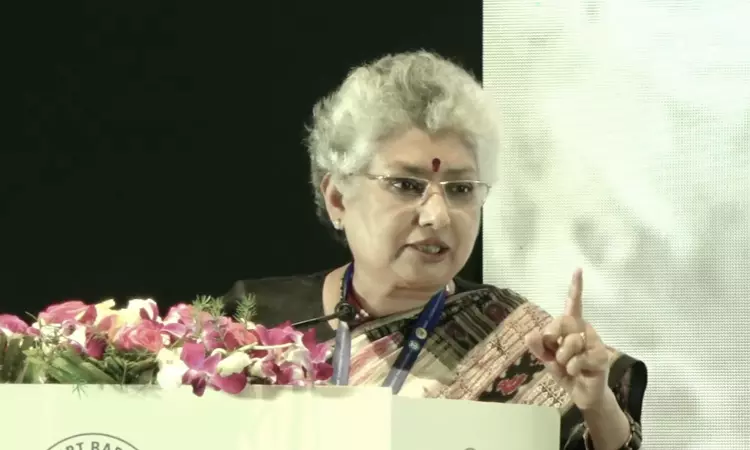
The State, instead of acting as a model litigant, was the largest generator of litigation by filing routine appeals, she said.
Supreme Court judge Justice BV Nagarathna on Saturday flagged the volume of litigation generated by the government and its tendency to pursue routine appeals as a key contributor to judicial pendency. Justice Nagarathna said that paradoxically, the government publicly expresses concern about pendency while simultaneously feeding the backlog through relentless litigation.“The pattern produces...
This is a premium content
Available exclusively to
Our subscribers
Subscribe Premium 
INR 1099+GST
Your support helps us to bring you more content at
an affordable subscription scheme !!!
All payment options available
Supreme Court judge Justice BV Nagarathna on Saturday flagged the volume of litigation generated by the government and its tendency to pursue routine appeals as a key contributor to judicial pendency. Justice Nagarathna said that paradoxically, the government publicly expresses concern about pendency while simultaneously feeding the backlog through relentless litigation.
“The pattern produces a paradox. The government publicly expresses concern about judicial backlog while simultaneously feeding that backlog through relentless litigation, the state becomes both the complainant and the cause”, she said.
Justice Nagarathna was speaking at the Supreme Court Bar Association's first National Conference 2026 on “Reimagining Judicial Governance”.
She said the State is expected to litigate with restraint but instead goes on litigating until the end. “The state is expected actually to litigate with restraint and be a model litigator. But that does not happen. It goes on litigating until the end. The government is not only a mere participant in litigation, it is also the largest single generator of litigation”, she said.
Govt officers file routine appeals to be on the safer side
She pointed out lack of incentive to reduce litigation, highlighting that government officers often prefer filing appeals as a matter of caution since settling disputes may attract audit objections, vigilance inquiries or political scrutiny.
“The result is predictable. Appeals become routine, rather than rare. Cases that should end in lower courts continue through successive layers up to Supreme Court,” she highlighted, adding that this transfers the cost of bureaucratic caution into the judicial system. She said this trend is especially visible in service and taxation matters.
She said proper administrative training and adherence to principles of administrative law could reduce the number of disputes that reach courts.
Lack of investment in judicial infrastructure
She also linked judicial congestion to lack of sustained public investment in infrastructure such as courtrooms, staff and technology, highlighting that judicial infrastructure does not receive the same political visibility as highways or welfare schemes.
“The political incentive is weak when it comes to judicial infrastructure investment, therefore the percentage allotted is also very less. The consequence is stagnation. The volume of dispute grows with population, economic activity and regulatory expansion, but the institutional capacity of courts grows slowly, therefore judicial pendency cannot be understood solely as a problem internal to courts. It is also the product of governmental choices. The government therefore stands not only as a litigant within the system, but as the principal architect of system's congestion”, she said.
At a broader level, she noted that systemic delay arises because different stakeholders act in ways that are individually rational but collectively contributes to delay - lawyers seek adjournments since they benefit from per appearance fees and extended timelines, government departments prefer appeals over accepting defeat, trial judges act with caution due to the possibility of appellate reversal and therefore focus on procedural compliance rather than aggressive docket control.
She said exhorting judges to work longer hours, asking advocates to avoid adjournments, urging governments to reduce litigation, or expecting courts to function 24*7 would not solve structural issues. She called for institutional interventions, including the creation of a judicial reforms commission and greater inter-institutional dialogue.
Questions method of measuring pendency
She also questioned how pendency is calculated. She pointed out that defective filings are often assigned numbers and included in statistics even before they reach the judge's dais. She suggested that cases should be counted towards pendency only after notice is issued, dismissal occurs or the matter is otherwise taken up.
“A case file today is pending tomorrow. A case file today adds to the statistics. But what is the form of the case file today? Many a times, the cases are filed with defects for years, for weeks, for months, the case does not come on to the dais of the judge, and they are taken note of for the purpose of statistics. Why should a defective case be given a number at all? Why should it be taken into statistics? Therefore, my submission is that cases which are defective should not be added to the statistics of Pendency”, she said.
Highlighting procedural causes of delay, she said litigants often evade service of notice, leading to years being spent at that stage. She suggested that courts should move beyond traditional postal modes and paper publication under Order V Rule 20 of the CPC and adopt electronic methods such as WhatsApp.
She also referred to delays in filing written statements and counter affidavits. While trial courts may strictly apply timelines under Order VIII Rule 1 CPC, higher courts sometimes permit delayed filings on grounds of natural justice, she said.
She further noted that defendants often prolong deliberately eviction suits and other matters through frequent adjournments, non-production of documents and failure to produce witnesses.
Justice Nagarathna acknowledged that judges also take time to write judgments but noted that they perform a dual role. Judges spend the day hearing cases in open court and often use evenings, weekends and court vacations to dictate judgments, she highlighted.
Justice Nagarathna highlighted another layer of delay when matters move in revision or appeal. She noted that despite conditional stay envisaged under Order XLI Rule 5 CPC, blanket stays are often granted, followed by prolonged litigation over vacation of stay or hearing of the main matter.
On how judges can reduce pendency
She suggested several reforms from the perspectives of judges, advocates, litigants and the government. These included judicial case management, limiting adjournments even if the judge loses popularity, efficient use of court time, clear and concise judgments, adoption of technology, prioritisation of cases, encouragement of alternative dispute resolution, ethical litigation practices, responsible use of appeals and formulation of a practical litigation policy by the government. She also stressed timely appointments of judges and adequate funding for court infrastructure.
Concluding her address, Justice Nagarathna urged delegates to give concrete suggestions to SCBA President Vikas Singh so that he could initiate dialogue with the Chief Justice of India, senior Supreme Court judges and the Attorney General to ensure that the conference leads to meaningful outcomes.

Amisha Shrivastava
Amisha Shrivastava is a Senior Correspondent with LiveLaw, covering the Supreme Court of India. She can be reached at amisha@livelaw.in

