



- Home
- /
- Top Stories
- /
- Collegium System Turned Out Total...
Collegium System Turned Out Total Disaster : Dushyant Dave; Sibal Says He Regrets Appearing In 'Second Judges Case'
Debby Jain
6 July 2026 6:43 PM IST
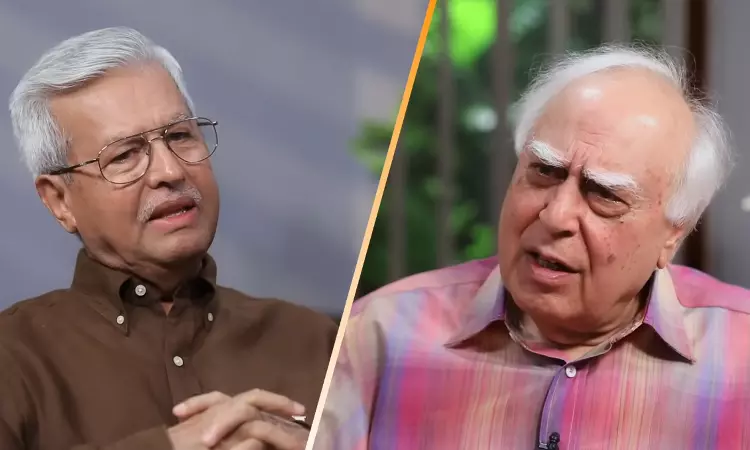
Dave commented that the Collegium is also now party to the Executive's targeting of independent judges.
In an interview on the show 'Dil Se with Kapil Sibal', Dushyant Dave, former senior counsel of the Supreme Court who quit the legal profession, recently remarked that the Collegium system of appointment of judges has turned out to be a disaster.Dave opined that over the past few years, judges have become "anti-citizen" and lost touch with the Constitution as it was enacted. According to...
This is a premium content
Available exclusively to
Our subscribers
Subscribe Premium 
INR 1099+GST
Your support helps us to bring you more content at
an affordable subscription scheme !!!
All payment options available
In an interview on the show 'Dil Se with Kapil Sibal', Dushyant Dave, former senior counsel of the Supreme Court who quit the legal profession, recently remarked that the Collegium system of appointment of judges has turned out to be a disaster.
Dave opined that over the past few years, judges have become "anti-citizen" and lost touch with the Constitution as it was enacted. According to him, recent judges have not exhibited a proper understanding of the Constituent Assembly debates in their decisions and one of the reasons behind the same is the appointment process.
"Undoubtedly, it is to do with the method of appointment of judges. My own take is that the second judges case - that really has changed the very complexion of the judiciary. The Executive did make some wrong appointments prior to 1990 but they were far and few. At the same time, I would say by and large, the Chief Justices' recommendations were fair in those days and were well-elaborated, well debated amongst the judges and good appointments were being made", Dave stated.
He added, "Undoubtedly the Collegium system, which Supreme Court found out for itself, has turned out to be a disaster. Since 1995, how many Chief Justices of India have we had who have performed questionably? Some 20-25 of them. As Chief Justices of India, very very questionable behavior."
Sibal, in this regard, remarked that he regretted appearing in the Second Judges case(which formalised the collegium system). He explained, the rationale behind the same was to tackle Executive interference in the appointment of judges at the time. Even so, he said he regretted his appearance in the matter which led to the collegium system since the result has been a "worse situation".
Notably, Dave also recalled during the interview his submission in the NJAC case before ex-CJI Khehar-led 5 judge bench, where he suggested that the judges wear burqas and pass through any Court's corridors to understand what the bar actually thought about them. He said, "I was not questioning their (judges') character...I was saying there is a challenge, you are not willing to address the challenge. And the biggest challenge is this Collegium system where the appointments are really very very poor".
Dave further opined that due to the Collegium system, the higher courts have suffered not only in terms of character of judges, but also their competence. He commented that there are very few good judges in today's time, while by and large, others are lacking in jurisprudential experience.
Dave also reflected on how many good lawyers, who ought to have made to the higher judiciary, got neglected due to the failures of the Collegium system, while less competent ones made it to the top. "Bar today consists of some outstanding lawyers who deserve to be recognized. Since last 30-40 years, we have been seeing that they have been neglected - who deserve to be appointed as High Court judges- and some people who really didn't deserve to be appointed have been appointed. Equally, from subordinate judiciary, I have no doubt that there are some outstanding judges and those judges have been ignored in elevation to High Courts."
Sibal and he later discussed how the Collegium system, which was intended to be objective, has been "extraordinarily subjective". "I remember one sentence in second judges case, which really should have been the guiding principle - that you must elect the best from amongst available. You [Collegium] don't do that", Dave commented.
Sibal, in this regard, remarked that when judges are elevated from the High Courts to the Supreme Court, they bring their own experiences of the respective High Court judges. So when they become part of the Collegium, they perhaps vouch for their particular "candidates" and the consequent negotiation amongst the Collegium judges to accommodate requests of each other results in lowering of merit.
"It's a give and take...that's the kind of bargaining that I believe does take place. In the process, the government also says we need our nominees...this kind of bargaining takes place, which is far away from merit. That may be one of the reasons for the dilution of competence and quality", Sibal said.
Dave fully agreed that there's a "give-and-take" in the Collegium system at the Supreme Court and High Courts level, as a result of which meritorious candidates are not chosen. He further added that since the BJP came to power, there has been increasing dominance of the Executive over the Collegium because each CJI since then has been "weak".
"Barring maybe...last judge who stood firm was Chief Justice [TS] Thakur...after that, judges after judges have, I would say, capitulated and they have really become subservient to the Executive on administrative side. I know of instances where Chief Justices have been hobnobbing with the Executive behind closed doors."
Dave subsequently lamented that as opposed to the earlier norm, where judges would not associate with members of the Executive, now there are "horrendous stories" of judges hobnobbing with Law Ministers and Home Ministers. "Chief Justices have sat late in the court because of interaction going on with the Home Minister", he claimed.
Both Dave and Sibal also reflected on rumours that Chief Justices concur with the Executive before recommending names for elevation. Speaking of Gujarat, Dave said that Justice Jayant Patel and Justice Akil Qureshi were targeted and discriminated against when elevation was being considered as they had given judicial decisions against the ruling party. "Collegium was party to the targeting, that is the sad story...even good judges in the Collegium whom we respect failed to protect", Dave said.
He also referred to Justice S Muralidhar (now Senior Advocate) of Delhi High Court, who was transferred after he pulled up the Delhi police for not registering an FIR against 3 BJP leaders for hate speech ahead of the Delhi Riots.
"There have been many people who have been ignored by the Collegium, wielding under pressure from the Executive", Dave said. "The reason is that if a judge gives an independent judgement, he is either transferred or his chances of coming to the Supreme Court are blocked. So the other judges, who know that this is happening, would not like to suffer the same fate", Sibal responded.
Interestingly, Dave also reminisced about his nascent years as a counsel at the Gujarat High Court, lauding the competency and integrity of the High Court's judges at the time. He remarked that it was a "treat" to appear before the Gujarat High Court judges of that time. On Sibal's question about his take on the Gujarat High Court today, Dave said that from his conversations with practising lawyers at the High Court, it is discernible that it no longer enjoys a good image.
The interview can be watched here.
Tags
Debby Jain
Debby Jain is a Correspondent with LiveLaw, covering the Supreme Court of India

