



- Home
- /
- Top Stories
- /
- Kapil Sibal Questions Supreme...
Kapil Sibal Questions Supreme Court's Delay In Deciding 'Merger' Issue Under 10th Schedule, Says It Impacts Future Of Democracy
Debby Jain & Gursimran Kaur Bakshi
13 Sept 2026 5:29 PM IST
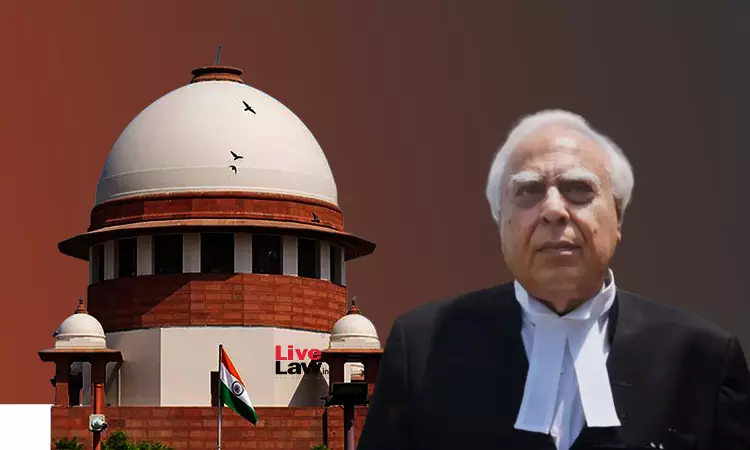
Sibal said that recognizing merger of legislative parties, without any merger of the political parties, will defeat the purpose of the anti-defection law.
Senior Advocate Kapil Sibal has questioned the Supreme Court's delay in deciding the validity of the Bombay High Court's Goa Bench judgment of 2022 concerning the merger exception under the Tenth Schedule of the Constitution, warning that recognising the merger of a legislature party without the merger of the original political party would lead to “mischief”.Speaking at a talk on 'Horse...
This is a premium content
Available exclusively to
Our subscribers
Subscribe Premium 
INR 1099+GST
Your support helps us to bring you more content at
an affordable subscription scheme !!!
All payment options available
Senior Advocate Kapil Sibal has questioned the Supreme Court's delay in deciding the validity of the Bombay High Court's Goa Bench judgment of 2022 concerning the merger exception under the Tenth Schedule of the Constitution, warning that recognising the merger of a legislature party without the merger of the original political party would lead to “mischief”.
Speaking at a talk on 'Horse Trade and Democracy', organised by the All India Lawyers Union in Kochi, Sibal said the constitutional question had remained undecided since 2022 despite its significant implications for parliamentary democracy and the anti-defection law.
The Bombay High Court's Goa Bench had held that the merger exception under Paragraph 4 of the Tenth Schedule would apply when two-thirds of the members of a legislature party merge with another political party, even if the original political party itself does not merge. This verdict came while holding that the Goa Congress MLAs who joined the BJP had not incurred disqualification, since 2/3rds of the MLAs [10 out of 15 Congress MLAs] had joined the BJP, making their act a 'merger'.
He mentioned that this precedent was invoked when 7 AAP Rajya Sabha MPs joined the BJP in April 2026 and claimed the 'merger exception', even though AAP and BJP continue to be political rivals. Likewise, in June 2026, 6 Shiv Sena UBT MPs joined the Eknath Shinde-led ShivSena, and the Speaker recognised it as a 'merger'.
Questioning the Supreme Court's delay in examining the correctness of this interpretation, Sibal said:
"I wonder why, since 2022, the Supreme Court has not taken up this matter? If you don't decide a vital constitutional issue that impacts the future of our democracy, then we will have to ask the question: why did you not decide? What's the reason?"
The Special Leave Petition (SLP(c) No.5305/2022) filed in 2022 challenging the Goa Bench's interpretation was closed as infructuous in 2026, as the term of the relevant Goa Assembly ended in 2022. A similar episode was repeated after the 2022 Goa Assembly elections, when 8/11 Congress MLAs joined the BJP. It was also upheld by the High Court in 2025 as a merger, and the petition challenging it is currently pending in the Supreme Court.
'Recognising Merger Of Legislative Parties Will Cause Mischief'
Sibal criticised the interpretation of Paragraph 4(ii) of the Tenth Schedule, under which the merger exception is applied when two-thirds of the members of a legislature party agree to merge with another political party.
According to Sibal, treating the merger of a legislature party as sufficient, without requiring the merger of the original political party, would allow the exception to swallow the rule.
"The Tenth Schedule then becomes a statute that punishes the lonely defector and rewards the organised one," he said.
He argued that the provision was intended to protect genuine political realignment but had instead become an instrument for wholesale defections.
"The Tenth Schedule does not need to be discarded. It must mean what it was enacted to mean. Para 4 should be read and, if necessary, amended so that merger is a merger of political parties, not a collective walkout by legislators," Sibal said.
He added that the merger provision must be corrected through judicial interpretation or legislative amendment, and urged the legal profession not to “launder the practice in legal language”.
"Democracy can survive disagreement; it cannot survive sale of the mandate," he said, concluding that the Tenth Schedule would remain a monument to a purpose it no longer serves unless the provision was corrected.
Sibal also referred to his writ petition before the Supreme Court challenging the interpretation of the Tenth Schedule that allows defections to be treated as mergers. The petition is being heard by a bench comprising Justices PS Narasimha and Alok Aradhe.
"First time I have filed a petition myself. A bench of Justices Narasimha and Aradhe issued notice and observed that there are enormous issues with the Tenth Schedule. That observation is an understatement," he said.
Sibal said the stakes extended beyond the fate of State governments, warning that defections could also be used to change the numbers in the Lok Sabha.
Sibal referred to the possibility of a parliamentary majority sufficient to pass constitutional amendments, describing it as the “special majority zone” and referring to “Mission 362”.
"If they reach the figure of 362, they can alter the Constitution; they can alter the concept of basic structure; they can change the secular nature of the Constitution that we embraced in 1950," he said.
He added that the implications were serious and affected every citizen, even though ordinary people might not understand what could happen if such a parliamentary majority were achieved.
'Horse-Trading Is A Constitutional Crisis'
Sibal described horse-trading as “the organised purchase of elected representatives so that majority manufactured after election replaces the majority chosen by the people”.
He said inducements could include cash, ministerial office, protection from investigation and other benefits, with the resulting defections sometimes being presented as legitimate political mergers.
"Citizen votes for one mandate, power delivered to another," he said, arguing that such practices reduce public trust to a saleable commodity.
He said horse-trading was a constitutional crisis that struck at representative government, the integrity of the popular mandate and the basic structure of parliamentary democracy.
Referring to the history of defections in India, Sibal cited the report of the Committee on Defections, constituted after a 1967 Lok Sabha resolution. The committee reported in February 1969 that there had been 542 recorded defections, around 80% of which occurred in the 12 months following March 1967. He said 116 defectors were subsequently rewarded with ministerial office.
Calls For Independent Tribunal To Decide Disqualification Matters
Sibal also questioned the impartiality of Speakers in deciding disqualification petitions under the Tenth Schedule.
"In India, the Speaker continues to be aligned to the political party which has elected him. His objectivity would always be suspect," he said.
He called for the setting up of an independent tribunal to decide disqualification matters and timelines to be prescribed for such decisions.
Investigative agencies, Governors, Speakers and, at times, the timing of court proceedings, could become involved in the making of a majority, Sibal said.
"Democracy can survive noisy politics, it can't survive the belief that every institution is a piece on the same chessboard," he remarked.
Sibal further argued that inducements such as cash, office, contracts or the quashing of an inquiry must be treated as corruption of the electorate's mandate, rather than ordinary political negotiation.
"An inducement - cash, office, contracts, quashing of enquiry - must be treated as corruption of the electorate mandate, not as ordinary give and take of politics. Parliament can do this, but it won't. Court can at least refuse an interpretation that makes the exception devour the rule," he said.
The video of the event can be watched here.
Senior Advocate Kapil Sibal to shortly deliver a talk on 'Horse-Trade and Democracy'The senior counsel will be speaking at Renewal Centre, Kaloor, ErnakulumThe address can be watched here: https://t.co/8xBVvFK5z2 pic.twitter.com/BCumNFaQKI
— Live Law (@LiveLawIndia) September 13, 2026


