Knanaya Christians Move Supreme Court Against Kerala HC Verdict Invalidating Excommunication For Marrying Outside Community
Amisha Shrivastava
25 Nov 2026 6:53 PM IST
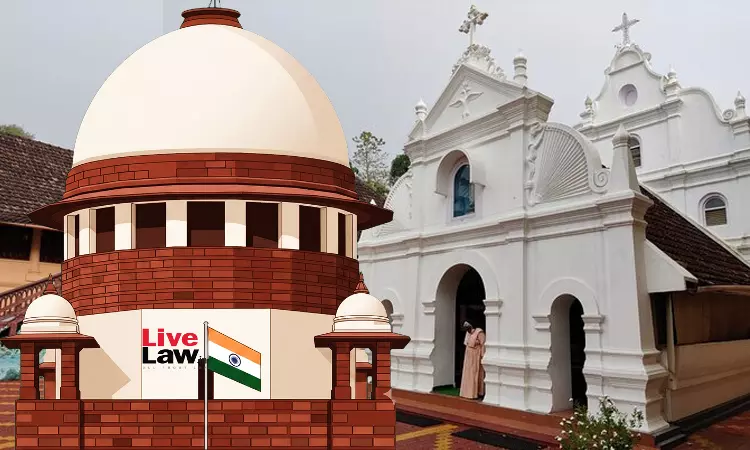
The Court hinted it will consider the matter after the verdict in the Sabarimala reference.
A plea has been filed by two members of the Knanaya Christian community before the Supreme Court challenging a Kerala High Court judgment which held that the community's practice of endogamy was neither an established custom nor an essential religious practice, and excluding members from church membership for marrying outside the community violates their fundamental rights.
A bench of Justice BV Nagarathna, Justice R Mahadevan and Justice Sanjeev Sachdeva listed the SLP on January 5th, 2027 along with other SLPs against the HC judgment.
The Court indicated that the challenge would be considered after the nine-judge Constitution Bench decides the questions referred to it in the Sabarimala reference proceedings. Apart from the issue of women's entry into the Sabarimala temple, the reference includes broader questions concerning the interplay between Articles 25 and 26 of the Constitution, the scope of denominational autonomy and judicial scrutiny of religious practices.


The reference also involves the issue of excommunication, as the Supreme Court, in February 2023, referred the case concerning the Dawoodi Bohra community's power to excommunicate members to the nine-judge Bench, observing that the balancing of denominational rights under Article 26(b) with other fundamental rights, particularly Article 21, and the question of whether excommunication is protected by Article 26(b), required consideration.
The 9-judge bench reserved its verdict in the Sabarimala reference on 14th May 2026.
The present Special Leave Petition challenges the judgment dated March 23, 2026, passed by Justice Easwaran S. of the Kerala High Court. The petitioners contend that the judgment undermines the Knanaya community's denominational and cultural rights under Articles 26 and 29 of the Constitution.
The petitioners argue that the High Court wrongly treated Christianity as a homogeneous religion while denying the Knanaya community the status of a distinct religious denomination. They contend that the community has maintained a distinct ethnic, cultural and religious identity, including the practice of endogamy, for centuries. It also argues that the High Court erred in subjecting the community's customary practices and personal law to scrutiny under Part III of the Constitution.
"The High Court finding in Paragraph 97 that custom must conform to the rights under Part III of the Constitution, has the effect of rendering Article 29 substantially otiose. Article 29 does not have the qualifications akin to Article 26 which has not been appreciated by the Hon'ble High Court. Even otherwise, endogamy qualifies as a part of uncodified personal law for Knanaya Christians. Indian Christian Marriage Act, 1872 does not apply to Christians of Travancore and Cochin. While Christians of Cochin are governed by Cochin Christian Civil Marriage Act, 1920, the Christians of Travancore do not have any codified law and are governed by uncodified personal laws of their respective denominations. The Hon'ble High Court gravely erred in subjecting personal laws to Part III scrutiny", the plea states.
The dispute originated from a suit filed in 2015 by Knanaya Catholic Naveekarana Samithy before the Additional Sub-Court, Kottayam. The plaintiffs sought a declaration that a Knanaya member would not lose membership in the Archeparchy of Kottayam by marrying a Catholic belonging to another Diocese, along with injunctions restraining the Church authorities from terminating membership on that ground and directing them to readmit members who had allegedly been excluded.
The trial court decreed the suit in 2021. The appeals filed against the decree were dismissed by the Additional District Court, Kottayam, in September 2022. The first appellate court, while holding that endogamy was a long-standing custom of the community and that the Knanaya community constituted a distinct section within Christianity, nevertheless upheld the relief granted to the plaintiffs.
In the impugned judgment, the Kerala High Court rejected the challenge to the maintainability of the suit and held that the practice of endogamy had not been established as a valid custom or essential religious practice. It held that the Church could not impose conditions on membership acquired by birth in a manner that infringed an individual's fundamental rights. The High Court also held that fundamental rights could be enforced against non-State actors in the circumstances of the case and upheld the mandatory injunction directing the Church to provide religious services and readmit members excluded for marrying outside the community.
The petitioners before the Supreme Court contend that the High Court erred in applying the essential religious practice test to determine the community's entitlement to protection under Articles 26(b) and 29(1). They argue that the Knanaya community is a distinct denomination within the Syro-Malabar Church, possessing a separate ethnic identity, customs, traditions, rituals and ecclesiastical structure, and is entitled to manage its own religious affairs and conserve its distinct culture.
The petition further contends that the High Court wrongly reversed the first appellate court's finding recognising endogamy as a custom without a cross-appeal or cross-objection challenging that finding.
"These undisputed facts unequivocally establish the Knanaya Community as a religious denomination entitled to protection under Article 26(b) of the Constitution of India to manage its own religious affairs and, as an ethnic minority, under Article 29(1) to conserve its distinct culture. Further, the Hon'ble High Court erred in reversing the finding of the First Appellate Court regarding the existence of the "custom" of endogamy in the absence of any cross appeals. It failed to appreciate that the custom has been continuously, uniformly and reasonably observed by the Knanaya Community from time immemorial and therefore is recognized under Canons 6(2) and 1509 of the Code of Canons of the Eastern Churches. The custom has at no point of time restricted the freedom or autonomy of any individual to marry a person of their choice."
The petitioners rely on the community's historical origins, its distinct ecclesiastical organisation and the establishment of a separate Vicariate of Kottayam in 1911, subsequently elevated to an Eparchy and then an Archeparchy. They contend that the practice of endogamy has been followed continuously for centuries and is recognised under Canons 6(2) and 1509 of the Code of Canons of the Eastern Churches.
The SLP also challenges the High Court's conclusions concerning horizontal enforcement of fundamental rights against religious bodies, the enforceability of mandatory injunctions requiring clergy to perform religious sacraments, and the applicability of the Specific Relief Act to the relief granted in the suit.
The petition has been filed through Advocate on Record Sriram P.