



- Home
- /
- Top Stories
- /
- 'Legislative Privilege Shouldn't Be...
'Legislative Privilege Shouldn't Be Invoked Against Non-Member For Mere Criticism' : Subhashini Ali To Supreme Court
Gursimran Kaur Bakshi
1 Oct 2026 12:46 PM IST
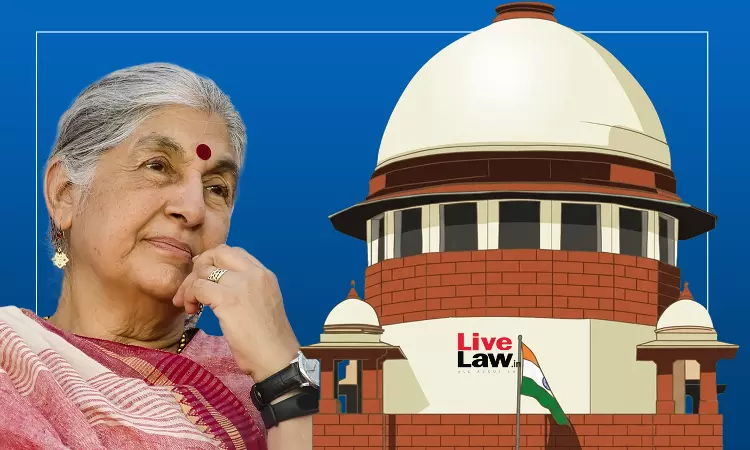
Former Lok Sabha MP and former CPI(M) Polit Bureau member Subhashini Ali has moved the Supreme Court seeking permission to intervene in the constitutional reference concerning the scope and limits of parliamentary privileges under Articles 105 and 194 of the Constitution.Ali, who served as a Lok Sabha member from Kanpur in 1989 and was a member of the CPI(M) Polit Bureau from 2014 to 2024,...
This is a premium content
Available exclusively to
Our subscribers
Subscribe Premium 
INR 1099+GST
Your support helps us to bring you more content at
an affordable subscription scheme !!!
All payment options available
Former Lok Sabha MP and former CPI(M) Polit Bureau member Subhashini Ali has moved the Supreme Court seeking permission to intervene in the constitutional reference concerning the scope and limits of parliamentary privileges under Articles 105 and 194 of the Constitution.
Ali, who served as a Lok Sabha member from Kanpur in 1989 and was a member of the CPI(M) Polit Bureau from 2014 to 2024, has said that her intervention is based on her experience as a legislator who exercised the freedoms protected by Articles 105(1) and 194(1).
The application raises questions concerning the constitutional limits of parliamentary privilege when it is exercised against citizens or members of the press for speech, reportage or criticism outside the House. Ali contends that parliamentary privilege is intended to ensure the independent and effective functioning of legislatures and to enable legislators to deliberate freely, and cannot be treated as a general power to insulate Parliament or its members from public scrutiny
She has submitted that criticism of a legislature, even if "stringent, severe, disputed or inconvenient", does not by itself amount to obstruction of the functioning of the House. According to the application, where privilege is invoked against a non-member for speech or reportage outside the House, there should be a direct and proximate connection with obstruction of legislative business or the essential functioning of the House.
The application further argues that the exercise of privilege powers such as summoning, arresting, detaining or punishing a non-member for external speech directly engages the freedom of speech and expression under Article 19(1)(a), including the freedom of the press to report and comment on legislative affairs. It also contends that Articles 105 and 194 cannot create areas of public power immune from fundamental rights or judicial review where the exercise of privilege affects the speech or liberty of citizens.
Seeks Reconsideration Of Earlier Privilege Rulings
Ali has urged the Court to consider the continuing relevance of the principles laid down in M.S.M. Sharma v. Sri Krishna Sinha (Searchlight case) and Special Reference No. 1 of 1964 (Keshav Singh case), particularly in light of the 44th Constitutional Amendment and subsequent Supreme Court jurisprudence concerning parliamentary privilege, fundamental rights and judicial review.
The application relies on Raja Ram Pal v. Speaker, Lok Sabha, where the Supreme Court recognised that the exercise of parliamentary privilege is amenable to judicial review on grounds including illegality and unconstitutionality, and Amarinder Singh v. Special Committee, Punjab Vidhan Sabha, where the Court considered constitutional limits on the exercise of privilege.
It also refers to the seven-Judge Bench judgment in Sita Soren v. Union of India (2024), stating that the Court had observed that parliamentary privilege is confined to conduct bearing the requisite relationship with the collective functioning of the House. The application notes that the issue of the Speaker's power to direct the arrest of journalists on allegations of breach of privilege is presently part of the reference.
Her limited submission is that the privilege being a constitutional power must operate within the structure and limitations of the Constitution. Further, the principles evolved by the Court must apply with greater force where privilege is asserted against citizens outside the House.
Prior to Ali, stand-up comedian Kunal Kamra, Journalists Anjum, Seema Chishti etc., also sought to intervene in the reference.
The 7-judge bench will commence the hearing on October 6.
Ali's application has been filed through Advocate Aarthi Rajan.
Case : N. Ravi v. Speaker, Legislative Assembly Chennai | W.P. (Cri.) No. 000206 - 000210 / 2003
Gursimran Kaur Bakshi
Gursimran is the Principal Correspondent with LiveLaw for the Supreme Court. She can be reached out at: simrankaurbakshi@livelaw.in

