



- Home
- /
- Top Stories
- /
- Low Judge-To-Population Ratio Must...
Low Judge-To-Population Ratio Must Be Fixed To Tackle Judicial Delays: : Justice AS Oka
Amisha Shrivastava
17 April 2026 8:35 AM IST
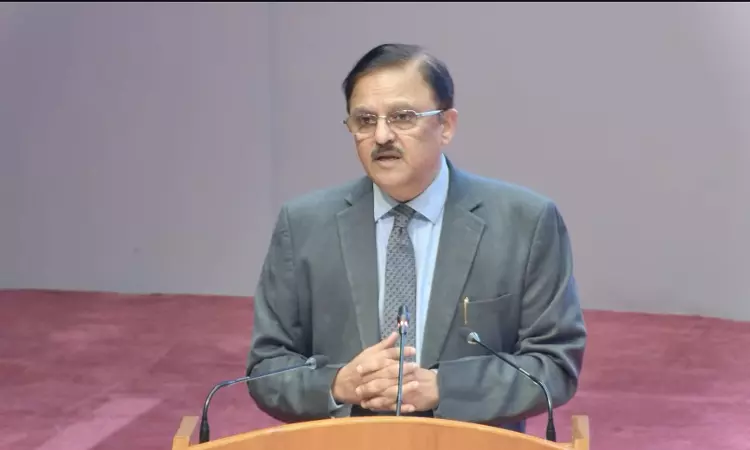
Former Supreme Court judge Justice Abhay Oka on Wednesday said that the persistent delay in trials across India is directly linked to the failure to achieve the prescribed judge-to-population ratio.Justice Oka said that improving judge strength is a basic requirement for addressing pendency and ensuring timely trials and called upon bar bodies and organisations such as the Adhivakta Parishad...
This is a premium content
Available exclusively to
Our subscribers
Subscribe Premium 
INR 1099+GST
Your support helps us to bring you more content at
an affordable subscription scheme !!!
All payment options available
Former Supreme Court judge Justice Abhay Oka on Wednesday said that the persistent delay in trials across India is directly linked to the failure to achieve the prescribed judge-to-population ratio.
Justice Oka said that improving judge strength is a basic requirement for addressing pendency and ensuring timely trials and called upon bar bodies and organisations such as the Adhivakta Parishad to take this issue up with governments. He urged them to ask why the target fixed by the Supreme Court has not been achieved despite the passage of time.
“If in 2002 required judge to population ratio was 50 and today in 2026 we have 22, there are bound to be delays, inordinate delays. Now, this is an area where the Bar Council, the bar associations, organizations like this organization, Adhivakta Parishad, should be taking very seriously and asking questions to the governments why this is not happening. Unless we have proper just to population ratio, our legal system will continue to face criticism. Now we have to seriously think about it”, he said.
Speaking at an event hosted by the Adhivakta Parishad Supreme Court Unit, Justice Oka highlighted a 2002 direction of the Supreme Court which required that within five years, the judge-to-population ratio should reach 50 judges per 10 lakh population. He pointed out that even after more than two decades, the ratio remains at around 22 to 23.
He noted that during this period, the population has increased, new categories of cases have emerged, and overall filings have gone up. In this situation, he said, delays in trials are inevitable if the judge strength remains inadequate.
“Today we are struggling at 22 or 23 after 24 years of the Supreme Court order. In the meanwhile, population has increased, new category of cases have come up, filing has increased. Now this very elementary issue we are not able to address. I am sorry to say this. I have been raising this not only in my judgments but also on public platforms. As a judge, nobody has taken this very seriously”, he said.
Justice Oka opined that criticism of delays in the Indian judicial system often ignores this basic issue. Unless the judge-to-population ratio is improved, he said, the system will continue to face criticism for inordinate delays.
He added that data on delays is now publicly available, and foreign courts can access information from sources such as the National Judicial Data Grid. He cautioned that continued delays may affect how the Indian legal system is perceived globally.
At the same time, he said that while delays are criticised, one aspect that is not sufficiently highlighted is the fairness of criminal trials in India. Despite procedural safeguards, he said, serious concerns remain such as long incarceration of undertrial prisoners, poor prison conditions, and denial of bail in cases where bail should be granted.
Justice Oka also raised concerns about delays in judicial appointments. He pointed out that after the Supreme Court collegium recommends names, the government in several cases takes 9 months, 11 months, 12 months or more to act. He said that once a recommendation is made public, the concerned lawyer's practice is affected, as litigants hesitate to brief someone likely to be elevated.
He cited an instance from Karnataka where a lawyer waited for more than a year and eventually withdrew consent. He contrasted this with a recent case where the period from recommendation to issuance of warrant was less than four months. He said that such delays make it difficult for Chief Justices of High Courts to persuade successful lawyers to accept judgeship, though some still agree despite the uncertainty.
He further pointed to inadequate judicial infrastructure, stating that while some states and districts have good facilities, infrastructure is generally poor and requires attention.
Justice Oka said that criticism of the Indian legal system arises from such visible shortcomings. He said that if a retired judge is called upon by a foreign court, the judge would have to present a truthful account of the system.
Tags

Amisha Shrivastava
Amisha Shrivastava is a Senior Correspondent with LiveLaw, covering the Supreme Court of India. She can be reached at amisha@livelaw.in

