'Make This Diwali Enjoyable': Supreme Court Suggests Virat Kohli, Other Public Figures Promote Firecracker-Free Celebrations
Amisha Shrivastava
29 Oct 2026 7:24 PM IST
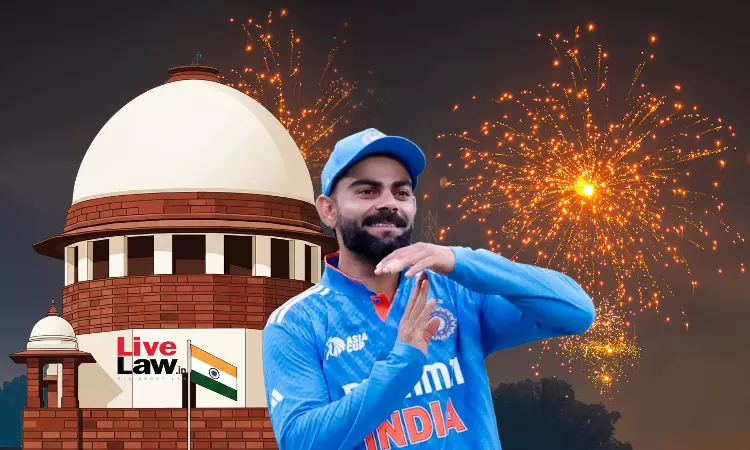
The Supreme Court on Thursday suggested to the Centre and Delhi authorities that celebrated cricketers such as Virat Kohli and other respected public figures could be involved in a public-awareness campaign encouraging people to celebrate Diwali without firecrackers.
A bench of Justice M.M. Sundresh and Justice PB Varale was hearing the ongoing proceedings concerning air pollution in Delhi-NCR.
The Court asked the authorities to widely publicise restrictions on firecrackers through television, newspapers and other platforms, and suggested that prominent personalities could record awareness segments urging people to celebrate the festival of lights without adding to pollution.
“Why can't you use the services of prominent personalities to make the public awareness like the good sportsmen or the public figures which are highly respected from any walk of life”, Justice Varale said.
Justice Sundresh added, “For Delhi, if you can say, they will come and do. They will help you. Somebody like, you know, the celebrated cricketers like Virat Kohli or somebody, you can request him to make a segment that let us make this Diwali as one that is enjoyable. Let us enjoy the spirit of the festival of light. It's a festival of light. As rightly said, it was not there originally. The problem came when the fireworks started coming. When the gunpowder came, right from the 14th century, 15th century, this would have totally gotten in.”


He observed that the authorities should communicate a message that celebrating the festival did not require activities that adversely affected others. He observed that children should also be educated about the harmful effects of firecracker pollution.
The Court also suggested involving education authorities in sensitising children about air pollution, observing that children could influence their parents' behaviour.
“Probably it is time for us to issue some direction to the education authorities to educate the children. From there, it should come. Now, how do we actually celebrate the occasion, the festival, without even causing any inconvenience to anybody”, Justice Sundresh said.
He observed that younger generation is more receptive to changing practices and thus educating children could help them encourage their families to celebrate without firecrackers.
“We have to send a message here. Now, see, my little experience is that children, the present generation are very skeptical about it. It is only the problem with the others. But if you really educate the children, they will tell their parents not to do this. Young generation, they don't want to, they will celebrate Diwali, no problem at all, but they don't believe in firecrackers. Now, see, the amount of impact that will make”, he said.
The Court referred to the impact of pollution and observed that it has to take care of everyone – children, elderly people, persons with disabilities, the sick, birds and animals.
It acknowledged the sentiments associated with the festival but said that these had to be considered alongside public health and constitutional rights. Justice Sundresh observed that Article 25 of the Constitution, which guarantees freedom of religion, was subject to public health and the other rights under Part III.
The Court said it is not inclined to impose a complete ban at that stage, because prohibition could lead to a “spiralling effect”. However, it warned the authorities against forcing it to adopt a “very hard stand” by failing to enforce its directions.
Amicus cites 2.01 million air-pollution deaths in India
Amicus Curiae Uttara Babbar made extensive submissions on the health consequences of air pollution, the dangers posed by fine particulate matter and the particular risks of firecracker use in Delhi-NCR during winter.
Citing the State of Global Air 2025 report, she submitted that air pollution is the leading risk factor for death in India, accounting for more than 2.01 million deaths. Of these deaths, 21 per cent were among children below five years of age.
She also cited estimates that residents of Delhi-NCR lose 8.2 years of life expectancy due to PM2.5 pollution when compared with the World Health Organization's guideline level of 5 micrograms per cubic metre. She referred to another estimate of 4.74 years of life expectancy lost due to persistently high particulate pollution.
She highlighted the difference between India's annual PM2.5 standard of 40 micrograms per cubic metre and the WHO guideline of 5 micrograms per cubic metre.
Explaining the risks posed by fine particulate matter, she told the Court that PM2.5 particles are sufficiently small to penetrate deep into the lungs and enter the bloodstream. The amicus also referred to evidence linking air pollution to cardiovascular disease, cancer, strokes, congenital defects, low birth weight and fetal deaths.
She cited observations by chest surgeons in Delhi that black deposits were increasingly being found in patients' lungs, including children aged 14 and 16 who had no history of smoking. She further said that, whereas approximately 90 per cent of lung cancer patients in the 1980s were smokers, nearly 50 per cent of lung cancer patients in North India are now non-smokers.
She argued that firecracker pollution has to be assessed in the context of Delhi-NCR's winter conditions. Temperature inversion during winter causes pollutants to accumulate close to the ground, while low wind speeds and the absence of rain can prevent pollution from dispersing.
PM2.5 levels rose sharply after green crackers were allowed on Diwali 2025: Amicus
Senior Advocate Gopal Sankarnarayanan, appearing for the petitioner, told the Court that a single firecracker released approximately 63,000 PM2.5 particles under controlled testing conditions.
Amicus Curiae Uttara Babbar explained that PM2.5 particles are particularly dangerous because of their small size. Unlike larger dust particles, which can be filtered by the body's natural defences, these fine particles can penetrate deep into the respiratory system and enter the bloodstream.
She also highlighted the pollution data from Diwali 2025, when the Supreme Court had temporarily relaxed the ban to permit the sale of green crackers for a limited period.
She submitted that PM2.5 levels rose sharply after Diwali. She argued that the available monitoring data might not reflect the full extent of the deterioration because only nine out of 39 continuous ambient air quality monitoring stations provided continuous readings during the intervening night of October 20 and 21, 2025 when Diwali was celebrated.
She showed the Court monitoring-station data indicating substantial gaps in readings during pollution spikes. She submitted that the available AQI averages may not accurately represent the pollution levels experienced during the festival.
She also referred to reports of a rise in respiratory and pregnancy-related complications in the days following Diwali 2025. Pulmonologists and gynaecologists reported sharp increases in outpatient and emergency cases between October 20 and 23, she said.
Green crackers are not pollution-free: Amicus
The amicus submitted that green crackers are not pollution-free and cause significant emissions, despite being designed to reduce particulate matter compared with conventional firecrackers.
She referred to concerns recorded by the Commission for Air Quality Management (CAQM) in its report dated September 25, 2025, including the lack of evidence establishing that all firecracker variants using approved formulations consistently achieved the claimed emission reductions.
The CAQM has also flagged the absence of adequate field-level testing of products actually sold in the market, as opposed to laboratory prototypes, and gaps in monitoring and enforcement.
The amicus said that QR codes, which were intended to help identify approved green crackers, were frequently missing or non-functional. It also alleged that conventional firecrackers were sold under green labels and that some QR codes were fraudulent.
She argued that these shortcomings made it difficult to ensure that only approved green crackers were sold or that their actual emissions remained within permissible limits.
Referring to the Supreme Court's order dated April 3, 2025, she submitted that the Court had previously held that there could be no reconsideration of the earlier complete ban unless it was satisfied that pollution from green crackers had been reduced to the bare minimum.
She also stressed that the Court's October 15, 2025 order had permitted green crackers only as a temporary test case and had required monitoring and assessment of the environmental impact. She submitted that a comprehensive assessment of the relaxation, including the impact on public health and the enforcement action taken, is still not available, a year after the order.
The Court observed that authorities must take action against violations, regulate sellers and traders, and widely publicise the restrictions.
It suggested that a sustained effort to reduce pollution should begin immediately and continue over successive years. Even a reduction of 25 per cent in the first year, followed by further reductions in subsequent years, would represent progress, Justice Sundresh said.
“Let us assume we pass a balanced order. Only the question is, how far it is implemented. We all know that what is going to happen. But then, let us start the process. So if you are able to reduce at least 25% this year, you can go 30%. You can go 40% thereafter. So something, you know, I think at a very higher level, you need to take it up”, he said.
He urged Additional Solicitor General Aishwarya Bhati, who regularly appears in the Delhi air pollution matter to personally look into enforcement, “We only request you personally. You can also like, you can be an Amicus. You can call them and then satisfy yourself with the steps taken. Measures, you know, that you're supposed to take. And then review. Unless you review it, there's no way of moving forward thereafter.”
The Court indicated that it would pass an order within a couple of days and require the authorities to file an affidavit explaining the measures taken and the difficulties encountered in implementing its earlier directions.