



- Home
- /
- Top Stories
- /
- 'Mandating Menstrual Leave May Harm...
'Mandating Menstrual Leave May Harm Women's Careers', Says Supreme Court; Asks Union To Consider Framing Policy
Anmol Kaur Bawa
13 March 2026 12:12 PM IST
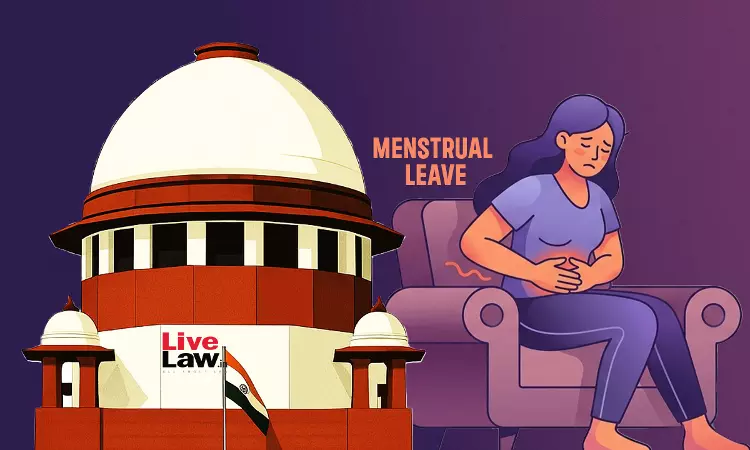
"Nobody will give them responsibilities, even in judicial services, a normal trial will not be assigned to them," CJI Kant said.
The Supreme Court on Friday disposed of a writ petition seeking paid menstrual leave for women in all establishments, asking the Central Government to consider the petitioner's representation for modelling a menstrual leave policy in consultatin with all stakeholders.During the hearing, the Court however expressed concerns that mandating menstrual leave through legislation may have...
This is a premium content
Available exclusively to
Our subscribers
Subscribe Premium 
INR 1099+GST
Your support helps us to bring you more content at
an affordable subscription scheme !!!
All payment options available
The Supreme Court on Friday disposed of a writ petition seeking paid menstrual leave for women in all establishments, asking the Central Government to consider the petitioner's representation for modelling a menstrual leave policy in consultatin with all stakeholders.
During the hearing, the Court however expressed concerns that mandating menstrual leave through legislation may have unintended consequences for women's employment. The Court remarked it could discourage employers from hiring women, thereby adversely affecting their participation in the workforce.
The bench comprising Chief Justice of India Surya Kant and Justice Joymalya Bagchi also questioned the locus of petitioner Shailendra Mani Tripathi, and pointed out that no woman herself has approached the Court.
This is the third writ petition filed by the petitioner on the same cause. The first petition was disposed of in February 2023, allowing the petitioner to give a representation before the Union Ministry of Women and Children. The petitioner approached the Court again in 2024, saying that the Ministry did not respond to his representation. That petition was disposed of in July 2024, asking the Union to take a policy decision.
In the present petition, the petitioner sought the following reliefs :
- directing the Union of India, States and UTs to come out with such law / policies / government orders which recognizes the problems faced by women during menstrual pain (Dysmenorrhea, Endometriosis, Uterine Fibroids, Adenomyosis, Pelvic Inflammatory Disease) and for grant of such relief which are necessary including the grant of leave in consonance with Articles 14 and 21 of the Constitution.
- Issue directions to fill in the lacunae that exists regarding grant of relief in the nature of leave etc. to the working women and female students under exercise of power under article 32 r/w article 14, 21 and article 141 and 142 of the Constitution.
Period leave may be counter-productive to women, the bench expresses reservations during the hearing
Senior Advocate MR Shamsad for the petitioner submitted that only the Karnataka Government has formulated a policy to allow menstrual leave.
The bench however expressed disinclination to entertain the matter. Chief Justice of India Surya Kant observed that period leave can be counter-productive.
"These petitions are deeply rooted, designed PILs. You are not a bona fide petitioner. This is basically only to create a type of impression in young women that you still have some natural issues and you are not at par with male persons and you cannot work like them during a particular time," CJI Kant said.
CJI pointed out that no woman has approached the Court, and the petitioner himself was not personally aggrieved.
The Chief Justice also asked the petitioner to consider the "long-term impact" on employment of women. Justice Bagchi said, "Affirmative action in respect of females is constitutionally recognised. But look at the practical reality in the job market. The more unattractive the human resource, the less is the possibility of assumption in the market. Look at from the business model. Will any employer be happy with the competing claims of other genders?"
"You are creating a right of taking a leave in month, the entire private sector...." CJI Kant said. "This can be harmful to their growth...You do not know the kind of mindset created at the workplace," CJI added.
Shamshad replied that while Odisha has a policy since 1992, Karnataka recently allowed such a leave policy, and Kerala allowed relaxation in schools. He added that many private organisations are voluntarily allowing period leave.
"Voluntarily they are giving, then it is excellent. That is a very good thing. But the moment you introduce it as a compulsory condition in law, you do not know the damage it will do to the career of women. Nobody will give them responsibilities, even in judicial services, a normal trial will not be assigned to them," CJI Kant said.
The bench then disposed of the writ petition with the following order :
"The petitioner has made a representation to the authority. It seems to us that whatever was required to be done at the end of the petitioner, he has done for the welfare of young women. It is not necessary for the petitioner to approach the Court time and again and seek a positive mandamus. We have no doubt that the competent authority shall consider the representation directed to be considered by this Court by order dated February 24, 2023, and July 8, 2024, for modelling a policy in consultation with all stakeholders."
Case : SHAILENDRA MANI TRIPATHI v. SECRETARY MINISTRY OF WOMEN AND CHILD DEVELOPMENT,UNION OF INDIA AND ORS. | Diary No. 73736-2025
Click Here To Read/Download Order

Anmol Kaur Bawa
Reporter

